
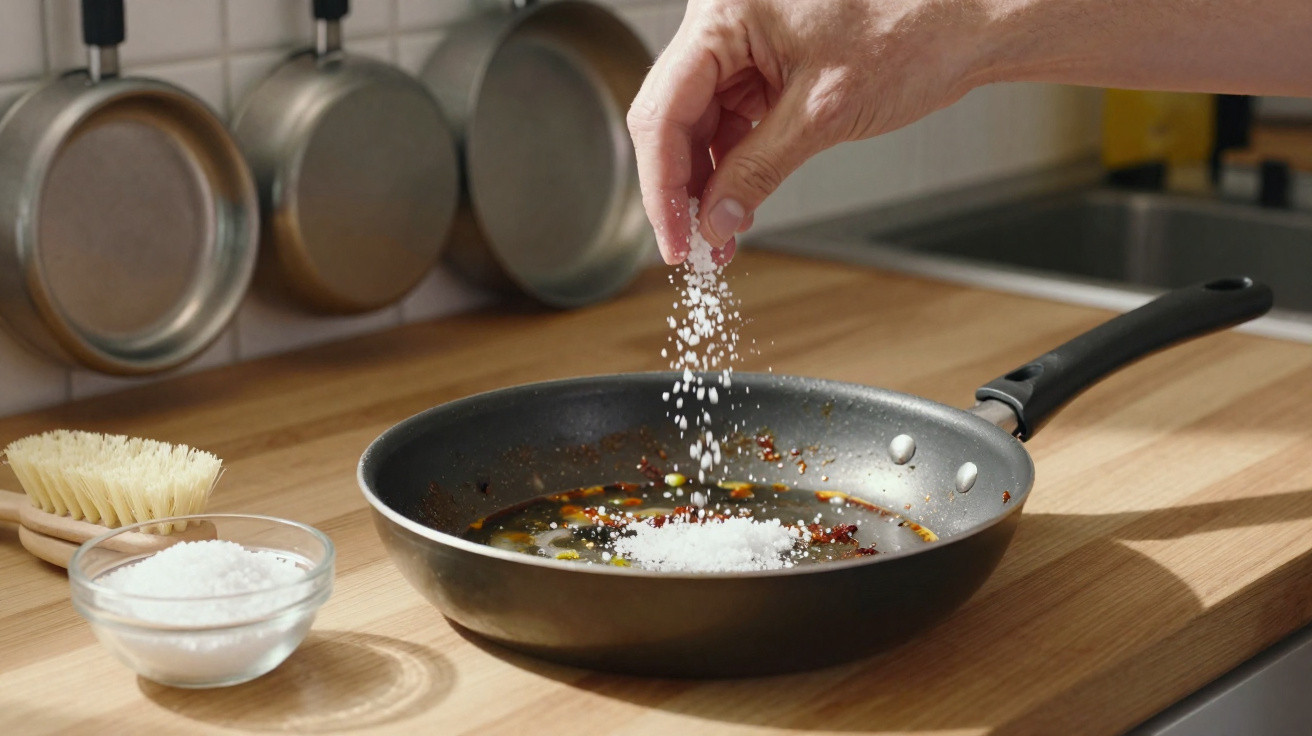
Coarse salt in a frying pan can help lift dried-on grease because it acts as both an absorbent and a mild abrasive, particularly when left in contact with the residue for several hours. This method is most effective for cast-iron, stainless-steel and uncoated aluminium frying pans. Greater caution is needed with non-stick cookware, as manufacturers and care guides advise against abrasive materials that could scratch the protective coating.
How does coarse salt work on dried-on grease?
Coarse salt draws out some of the moisture and oil remaining on the frying pan's surface. Left overnight, the crystals stay against the hardened grease and can loosen its crust, especially where burnt oil or dried sauce has built up.
The following morning, the salt also provides a controlled scrubbing action. Rather than using steel wool, the crystals create enough friction to release stuck-on residue. This approach is often recommended for cast-iron cookware because it is less likely to damage the seasoning than harsh washing methods.
How much coarse salt should be left overnight?
The amount required depends on the size of the frying pan and the extent of the greasy area. The aim is to create a visible covering across the base, rather than a large pile of salt that wastes ingredients and makes the next morning's clean-up more difficult.
- Use 2 tablespoons for small frying pans.
- Use 3 to 4 tablespoons for medium frying pans.
- Apply extra salt to areas with dark grease deposits.
- Spread it over a dry or only slightly damp frying pan.
- Do not add washing-up liquid before leaving it overnight.
If the grease is particularly hard, add a few drops of warm water to the salt to improve contact with the crust. Do not soak it, as too much water dissolves the crystals and reduces their abrasive effect the next day.
What should you do in the morning to finish cleaning?
In the morning, put the dirty salt in the bin rather than washing it down the sink. Then use kitchen roll or a damp cloth to wipe away the loosened grease. For cast-iron frying pans, dry the surface thoroughly and apply a thin film of oil to protect it from oxidation.
With stainless steel or aluminium, finish by washing with warm water, mild washing-up liquid and a soft sponge. If burnt marks remain, use products intended for stainless steel or aluminium as appropriate for the material; however, strong cleaners should not be used on porous cookware or cast iron.
Which frying pans does the coarse salt method work best on?
Coarse salt generally performs best on durable materials that can withstand light friction. It is better suited to dried grease, surface-level burnt oil and stuck-on residue that has not yet become deeply carbonised.
- Well-seasoned cast-iron frying pans.
- Stainless-steel frying pans.
- Aluminium frying pans without delicate paintwork.
- Cast-iron griddles and grill racks.
- Older pans without a non-stick coating.
For cast iron, the key precaution is complete drying afterwards. Allowing standing water or damp salt to remain for too long can encourage staining and oxidation, particularly on items without well-established seasoning.
Which frying pans should avoid this method?
Non-stick frying pans, delicate ceramic pans and cookware with scratched coatings should not be cleaned using this approach. Coarse salt may seem harmless, but its crystals can act as an abrasive and speed up surface wear when rubbed directly against it. Non-stick care guidance recommends soft sponges, mild washing-up liquid, and avoiding steel wool, abrasive powders and utensils that can scratch the coating.
The coarse salt trick is suitable for occasional cleaning of robust frying pans, not for every pan in the kitchen. Used on the appropriate material, it can remove dried-on grease with little effort; used on sensitive non-stick cookware, it may turn an easy cleaning task into permanently marked coating.


Comments
No comments yet. Be the first to comment!
Leave a Comment