
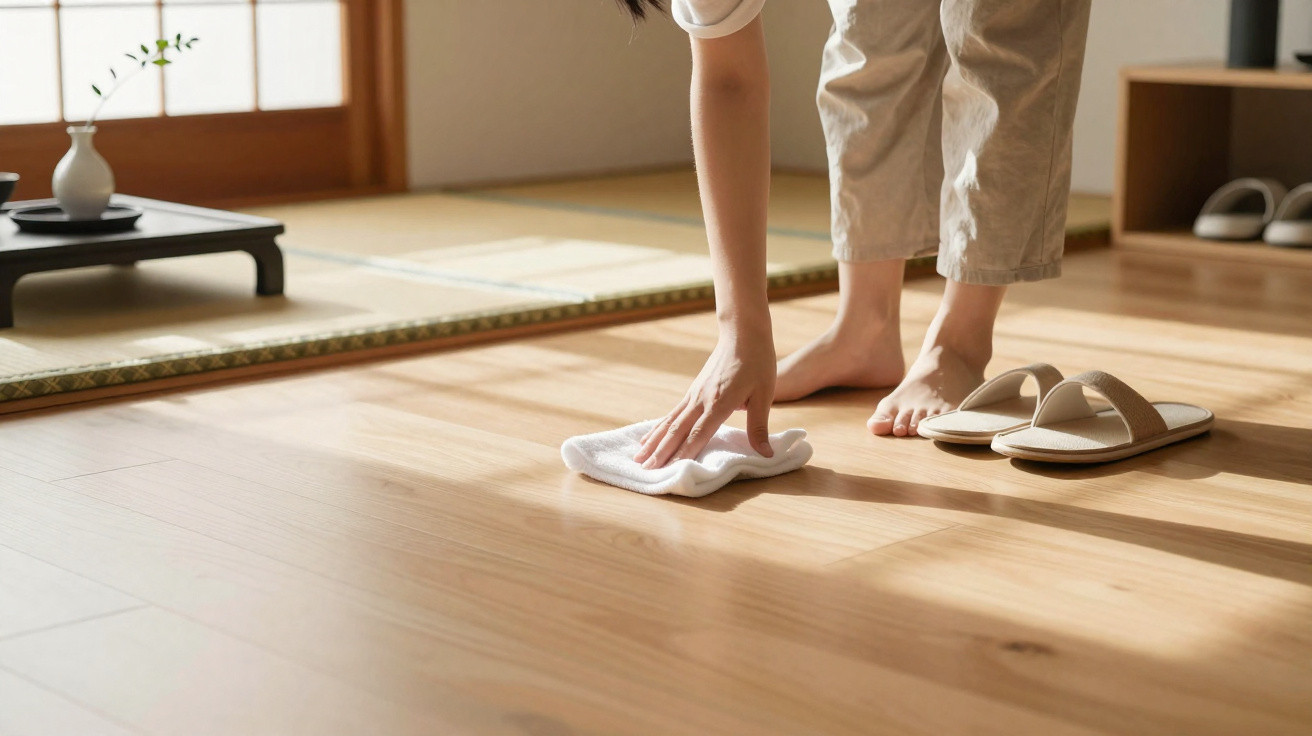
Traditional Japanese homes nearly always create an immediate sense of lightness. This comes not only from their appearance, but from the combination of ventilation, visible flooring, few displayed possessions and daily cleaning carried out in short stages rather than waiting for dirt to build up. The outcome is less dust in corners, on surfaces and along walkways.
Why does dust seem less noticeable in these spaces?
Dust builds up less readily when a home has straightforward circulation and fewer visual obstacles. In many Japanese households, the entrance acts as a filter, as shoes are removed as soon as people arrive. This custom limits street debris, fine soil and particles that would otherwise be carried across floors, tatami mats and skirting boards.
The way the space is organised also matters. Low furniture, fitted cupboards, stored futons and surfaces without an excess of ornaments make wiping, light sweeping and daily checks easier. When the entire floor can be seen clearly, dust is less likely to stay concealed for days.
Which household rituals help keep the air and floors cleaner?
These household rituals do not require a lengthy deep clean. They work because they fit into the morning routine or the end of the day, before dirt turns into a crust, loose fibres or a visible layer on wood, tatami and fabrics.
- Remove shoes at the entrance and keep separate slippers for indoor use.
- Open windows briefly to refresh the air without allowing particles to circulate for hours.
- Wipe or mop the areas with the heaviest foot traffic.
- Fold up and store futons, leaving the floor clear for quick cleaning.
- Clean worktops and window sills before dust sticks to them through moisture.
What does the layout of Japanese homes teach about household upkeep?
Everyday architecture supports maintenance. Rooms with less decorative bulk, sliding doors, unobtrusive alcoves and clear routes require fewer detours while cleaning. This reduces the time needed for the routine and lessens the common habit of pushing dust beneath furniture or into corners.
There is another important point: when every item has an assigned place, the household ritual becomes more predictable. There is no need to reorganise the entire living room before sweeping, vacuuming or wiping. Maintenance stops being a weekly event and becomes a domestic task lasting just a few minutes.
Which habits can be adapted without copying everything exactly?
Not every Brazilian home has tatami, a genkan or compact cupboards, yet several adjustments work particularly well in flats and terraced homes. The key is to limit dirt entering the property, simplify surfaces and establish regularity.
- Set aside an entrance area for shoes and bags.
- Avoid very deep-pile rugs in passageways.
- Choose furniture with a clear base so the floor can be reached easily.
- Allocate ten minutes a day to dust, floors and bed linen.
- Reduce the number of small items left on open shelves.
What accounts for this constant feeling of order?
The impression of order comes from repetition. When dust is removed before it becomes excessive, the home stays consistently tidy for longer. Japanese homes show that effective cleaning does not rely solely on powerful products or one major cleaning day, but on consistency, unobstructed movement and attention to the areas where debris gathers most.
This domestic model works by bringing together a short routine, visible floors, a controlled entrance and well-stored possessions. Dust has less room to settle when there is no build-up, visual obstruction or a full week of delay between one clean and the next.


Comments
No comments yet. Be the first to comment!
Leave a Comment