
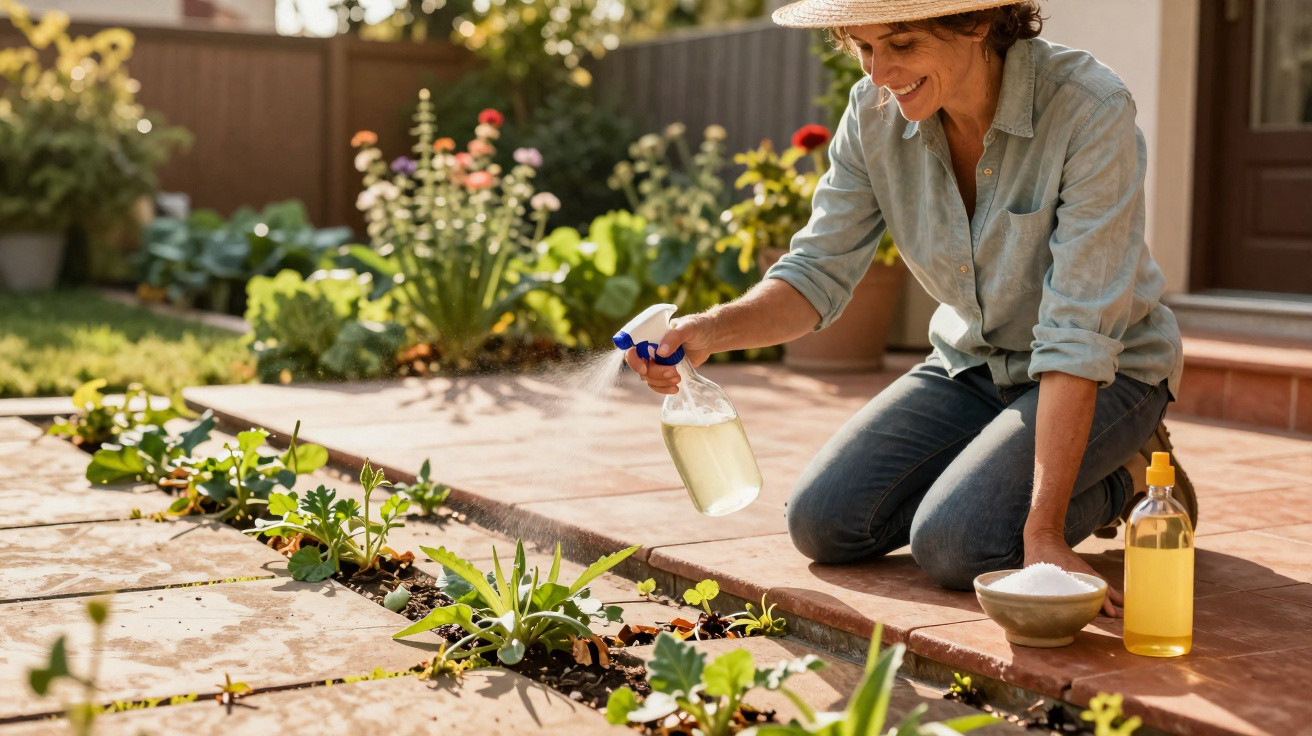
Green clumps suddenly push up between paving stones, gravel and patio slabs – and the battle starts all over again every time.
Many people instinctively reach for vinegar, only to be surprised when the weeds quickly return.
Anyone wanting to keep paths, driveways and patios tidy without harsh chemicals or hours spent kneeling needs more than vinegar from a bottle. One simple kitchen helper can make a real difference – and an increasing number of amateur gardeners use this household remedy because it makes the task noticeably easier.
Why vinegar alone does not solve the weed problem
Vinegar mainly works at the surface. Its acid attacks leaves and stems, causing them to discolour and dry out. The area can look clean again very quickly. Beneath the soil, however, a different process is taking place: in many cases, the roots remain intact.
Fresh shoots can emerge from these surviving root remnants after a few days or weeks. It can feel as though the area was only just sprayed, yet everything looks the same again. This is particularly evident in patio-slab joints, driveways and gravel paths.
A small amount of vinegar may be enough for very fine, isolated blades of grass. In more heavily overgrown areas, though, it reaches its limits. Anyone seeking a lasting result would need to repeat the treatment continually. That costs time, tests patience and often takes the enjoyment out of gardening.
Vinegar mainly scorches the parts of a plant above ground – in many cases, the root system survives and leads to rapid regrowth.
The overlooked star: washing-up liquid as an ally in the battle against weeds in joints
This is where a product found in almost every home comes in: washing-up liquid. As well as removing greasy films from dishes, it can do something else in the garden: it breaks down the protective waxy coating on leaves.
This fine wax layer normally makes plant surfaces water-repellent. Droplets bead up instead of soaking in. The surfactants in washing-up liquid reduce this protective effect. Water and other added ingredients adhere more effectively and penetrate more easily.
When washing-up liquid is sprayed directly onto leaves and young shoots, the plant gradually loses its ability to retain moisture. Its above-ground parts dry out. It has an effect on its own, but the result becomes stronger when combined with vinegar.
Washing-up liquid and vinegar: turning kitchen supplies into a cleaner for paving joints
Many gardeners now use a straightforward mixture that takes only moments to prepare. It is primarily intended for weeds in paving joints, gravel paths and along edges where no plants are wanted anyway.
- 1 tablespoon washing-up liquid
- 1 litre water
- optional: 1 cup household vinegar
Stir everything thoroughly and pour it into a spray bottle. Then spray it precisely onto the unwanted plant parts. A dry, warm day, ideally with sunshine, is the best time to do this. That allows the mixture to remain on the leaves long enough to take effect.
Washing-up liquid ensures that vinegar and water do not simply bead off, but penetrate deep into the leaves and remain there for longer.
Different mixtures for different problem areas
The strength of the mixture can be adjusted to suit the situation in the garden. Anyone dealing only with light green growth in joints does not need a “maximum-strength version”.
Gentle version for young shoots
For narrow joints or the first small plants, a mild mixture is sufficient:
- 1 litre water
- 1 tablespoon mild, preferably eco-friendly washing-up liquid
This option is suitable when the aim is to remove only thin blades of grass or delicate seedlings. The impact on the soil remains manageable, while the effect on tender plants is still clearly visible.
Stronger mixture with vinegar
For denser growth, some people use a more concentrated combination:
- 1 litre household vinegar
- 2 teaspoons washing-up liquid
This solution is intended for stubborn clumps in joints or at path edges. Here, the acidity of the vinegar works alongside the wetting action of the washing-up liquid. Plants wilt more quickly, and fresh shoots are less likely to break through.
Radical mixture with salt – for exceptional cases only
Salt can intensify the effect further. One frequently mentioned mixture is:
- 1 litre vinegar
- 40 grams salt
- 10 millilitres washing-up liquid
This combination is intended solely for surfaces where absolutely nothing should grow permanently: beneath wheelie bins, on purely gravelled areas or along garage driveways that are meant to remain strictly functional.
Salt disrupts the water balance of plants and can alter soil structure over the long term. Anyone using it should understand that such spots may remain almost free of plants for a considerable time – not only unwanted self-seeded flowers, but also anything planted there later.
Important precautions in the garden
Even though the ingredients come from the kitchen, they are not harmless in the garden. Washing-up liquid can affect soil structure and reduce the soil’s capacity to absorb water. Microorganisms are sensitive to changes in surface tension within soil pores.
Salt has an even more critical effect. It can severely harm earthworms and other soil organisms and can effectively exhaust an area. Anyone who values healthy, living soil should use salt only with great precision and extreme restraint.
Spray only where nothing else is growing or intended to grow – paths, patio joints and gravel strips.
Careful, targeted application avoids collateral damage. Spray mist must not reach lawns, beds or vegetable-growing areas. It is best to use a spray head with a coarse stream, hold it close to the plant and apply it only to the leaves.
How to incorporate this household remedy sensibly into garden care
There is no need to keep every joint “sterile” with chemicals or kitchen ingredients. A combination of mechanical work and occasional, targeted use of the mixture is often enough. Larger clumps can first be loosened with a joint scraper or weeding knife, then the remaining plant can be treated. This brings the mixture closer to the root area.
Regular sweeping and removing loose seeds significantly reduces new growth. Dense planting in joints with suitable mat-forming plants can also be an alternative: creeping thyme, low-growing sedum varieties or other plants that tolerate foot traffic leave less room for weeds.
Risks and sensible limits on use
One common mistake is to spray extensively out of frustration when growth is heavy. This can send washing-up liquid and vinegar into cracks where flowers or herbs may be wanted later. A clear plan is better: which area is to remain permanently “bare”, and which might be planted up in future?
Timing is another consideration. Spraying immediately before rain achieves little. Rain quickly washes off the mixture, carries it into the soil and reduces its surface effect. Dry, warm weather is more suitable – plants take up more of the active mixture and dry out visibly faster.
What the terms mean – briefly explained
Surfactants, the key ingredients in washing-up liquid, are substances that bind water and fat together. In the garden, they help water-based solutions stick more effectively to smooth leaves. Without them, much simply beads off.
Acetic acid, the active component in household vinegar, attacks cell walls. Plant tissue loses stability and dries out. Too much vinegar in the soil can shift its pH value. For this reason, its use is best limited to small areas.
Salt, finally, works through osmosis: plant cells lose water and shrink. The same effect makes salty soils problematic for many plants in the long term. Agriculture encounters this issue in regions with excessive irrigation and evaporation.
Alternative and supplementary methods for growth in paving joints
Those wishing to avoid vinegar and salt have other options. Hot water from a kettle also damages cells, especially in young plants. Thermal tools using hot air or infrared are free from pollutants, although they cost more to buy.
Good design offers long-term help: wider joints can be deliberately planted with ground-covering plants that withstand foot traffic. Very narrow joints stay cleaner for longer with high-quality jointing sand or special joint fillers. Where something still pushes through, a quick pass with a joint scraper is usually enough – leaving the washing-up-liquid spray mixture as an exception for particularly irritating spots.



Comments
No comments yet. Be the first to comment!
Leave a Comment