
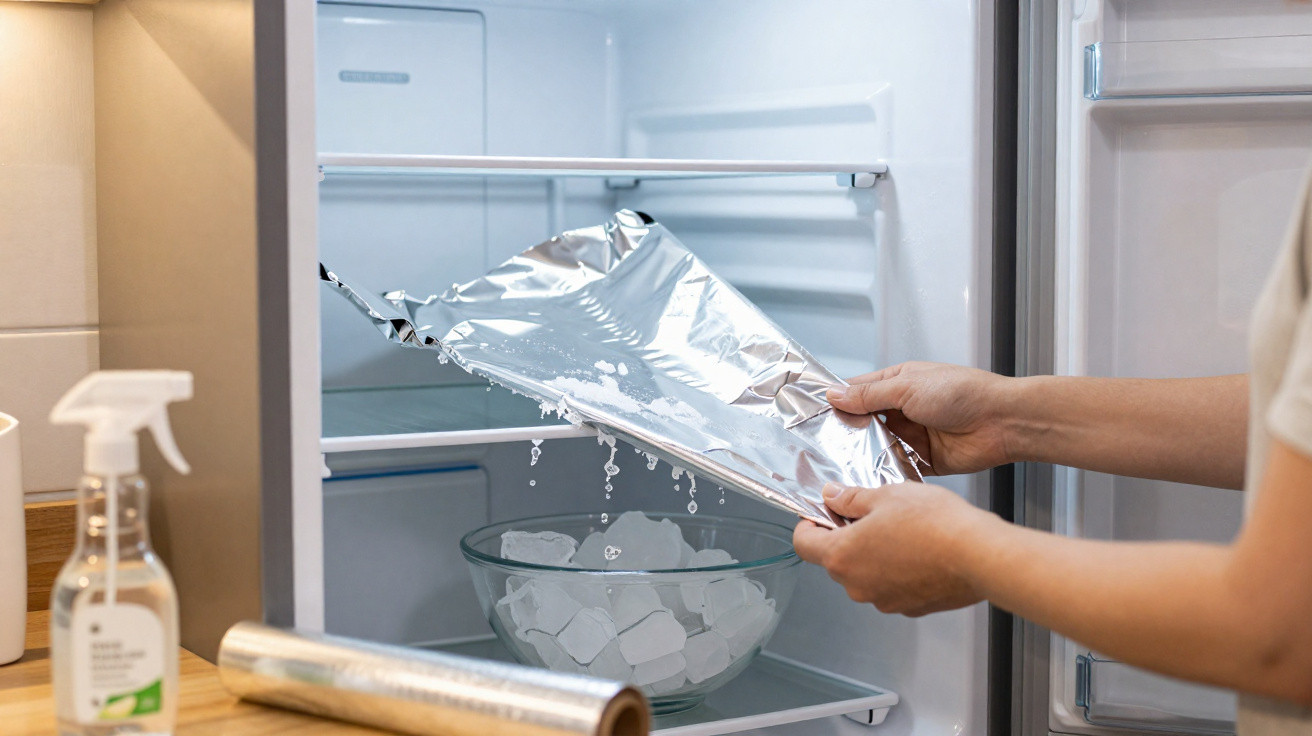
Anyone who has stood frustrated at the freezer with a spoon, spatula or knife knows how troublesome a heavily iced-up freezer compartment can be. Ice blocks drawers, takes up valuable space and quietly increases electricity bills. A simple aluminium foil trick can make the ice layer far easier to remove, making appliance maintenance much less of a chore.
Why ice in the freezer is more than a cosmetic issue
Frost forms in the freezer every time the door is opened. Warm, humid air enters, meets freezing-cold surfaces and turns to ice layer by layer. It may barely be noticeable at first, but after a few weeks thick sheets can be stuck to the walls.
This is not merely unsightly; it also has direct consequences:
- The ice acts as insulation, slowing down the transfer of cold.
- The compressor runs for longer to maintain the required temperature.
- Electricity consumption rises, often noticeably when calculated over a year.
- The door does not seal as well, allowing even more warm air to enter.
- Packaging tears more easily when it freezes to the ice and is pulled away.
Many people put off defrosting for months. The traditional method means emptying everything out, switching off the appliance, laying out towels and waiting for hours until the ice layers finally melt. Trying to speed things up with a knife or screwdriver also risks damaging the interior lining or refrigeration pipes – an expensive mistake if it causes the freezer to leak.
“The real issue is not the ice itself, but how firmly it bonds to the inner surface.”
How aluminium foil tackles stubborn freezer frost
This is where aluminium foil comes in. The principle is surprisingly straightforward: ice clings particularly well to rough, slightly porous surfaces. Many freezer interiors fit this description – even when they look smooth, they have tiny irregularities that ice crystals can grip.
Aluminium foil creates a smooth, non-porous layer between the surface and the ice. This changes how the ice attaches:
- The ice adheres mainly to the foil rather than directly to the plastic.
- The bond is weaker, so the ice interlocks less firmly.
- During cleaning, the foil can be pulled away along with the layer of ice.
“The foil works like a peel-away protective skin: the ice sticks to it, not to the appliance.”
How to fit aluminium foil correctly in the freezer
Preparation matters if this trick is to work properly. Foil fitted carelessly can quickly come loose or fail to hold the ice effectively.
Step-by-step guide
Empty the freezer completely
Store perishable food briefly in a cool bag or on the balcony if outdoor temperatures are suitable.Remove all existing ice
Switch off the appliance, unplug it and wait until most of the ice has melted. Carefully loosen larger pieces with a plastic spatula.Dry the interior thoroughly
Wipe every surface with an absorbent cloth until no moisture is visible. Remaining dampness will otherwise prevent the foil from sitting properly against the surface.Cut the foil to size
Cut strips to cover the back wall, the upper section and areas that are especially prone to icing. Several smaller pieces are better than one large sheet that continually creases.Press the foil on smoothly
The matt side may face inwards or outwards; what matters is that the sheets sit as smoothly as possible. Smooth out air bubbles with your hand or a soft cloth.Secure the edges
Fold the edges neatly around the corners. If needed, use a narrow strip of tape on dry plastic surfaces – but never cover ventilation openings or sensors.
Those who do this neatly will notice a clear difference at the next “mini defrost”. Many users report that, instead of facing one major battle with ice, they only need to peel off and replace a few foil strips every few months.
Where aluminium foil is most useful in a freezer
Not every area freezes up at the same rate. If foil is limited, it is worth applying it strategically.
| Area in the freezer | Typical issue | How to use the foil |
|---|---|---|
| Back wall | thick layer of ice, limited space | large sheets pressed on smoothly, especially worthwhile |
| Upper interior area | an “ice roof” above frozen food | attach one or two longer strips across the width |
| Corners and edges | small ice formations that are difficult to reach | small pieces that can be replaced easily |
| Near ventilation openings | rapid icing caused by circulating cold air | fit with a gap and keep openings clear |
Over time, you will learn which areas of your own freezer are particularly troublesome. Those are precisely the places where foil protection is most worthwhile.
How often should aluminium foil be replaced in the freezer?
This method will not turn an older freezer compartment into a “maintenance-free” appliance. However, it can significantly reduce the effort involved. In practice, replacing the foil every few months has proved effective.
Replacement is advisable at the latest when:
- the foil is torn;
- thick, uneven slabs of ice are forming;
- surfaces no longer feel smooth.
“It is better to replace a strip once too often than spend hours scraping again later.”
Keeping the roll of aluminium foil close to the freezer often means the replacement can be done almost incidentally, for example while sorting through stored food anyway.
Protection against scratches and costly damage
There is another benefit that many people only recognise too late: every hard object used in the freezer can leave marks. Metal spoons, knives and improvised ice scrapers can quickly create micro-scratches in the plastic lining. Ice then adheres even more readily there next time.
Aluminium foil acts as a buffer:
- the actual surface is protected from tools;
- minor knocks from packaging or storage boxes land on the foil;
- the interior lining stays intact and visually appealing for longer.
Anyone who has experienced a punctured evaporator coil or a leaking inner wall knows that a few pence spent on foil are negligible compared with a repair or a replacement appliance.
What your habits have to do with ice formation
Aluminium foil in the freezer is only one part of the solution. Everyday routines also affect how quickly frost forms. Several factors are entirely within your control:
- Reduce door openings: each quick look lets warm air inside.
- Group foods together: collect several small packs in one box to reduce air exchange.
- Freeze only properly packaged food: uncovered containers add moisture to the interior.
- Do not freeze hot food: allow it to cool completely in the fridge first.
These small habits considerably enhance the effect of aluminium foil. Opening the door less often and for shorter periods simply gives ice fewer opportunities to build up.
Risks, limits and sensible additions
Despite its advantages, the trick has some limitations. Consider the following before reaching for the roll:
- In appliances with No Frost technology, foil must not cover ventilation openings or sensors.
- Loose, fluttering strips of foil can obstruct fans, so always fit them neatly.
- Aluminium foil must not touch electrical components.
If you are unsure, check the appliance manual: it often identifies sensitive areas that must be kept clear. The smooth sections of the interior lining can generally be covered without concern.
It is also practical to combine the “foil task” with a quick stock check: discard expired or forgotten food, package opened items properly and add new date labels. This turns an irritating chore into a manageable routine.
The result is a freezer compartment that develops less frost, is much easier to clean and, as an added benefit, keeps energy consumption under control. All with a household item that almost everyone already has in the kitchen: a simple roll of aluminium foil.




Comments
No comments yet. Be the first to comment!
Leave a Comment