
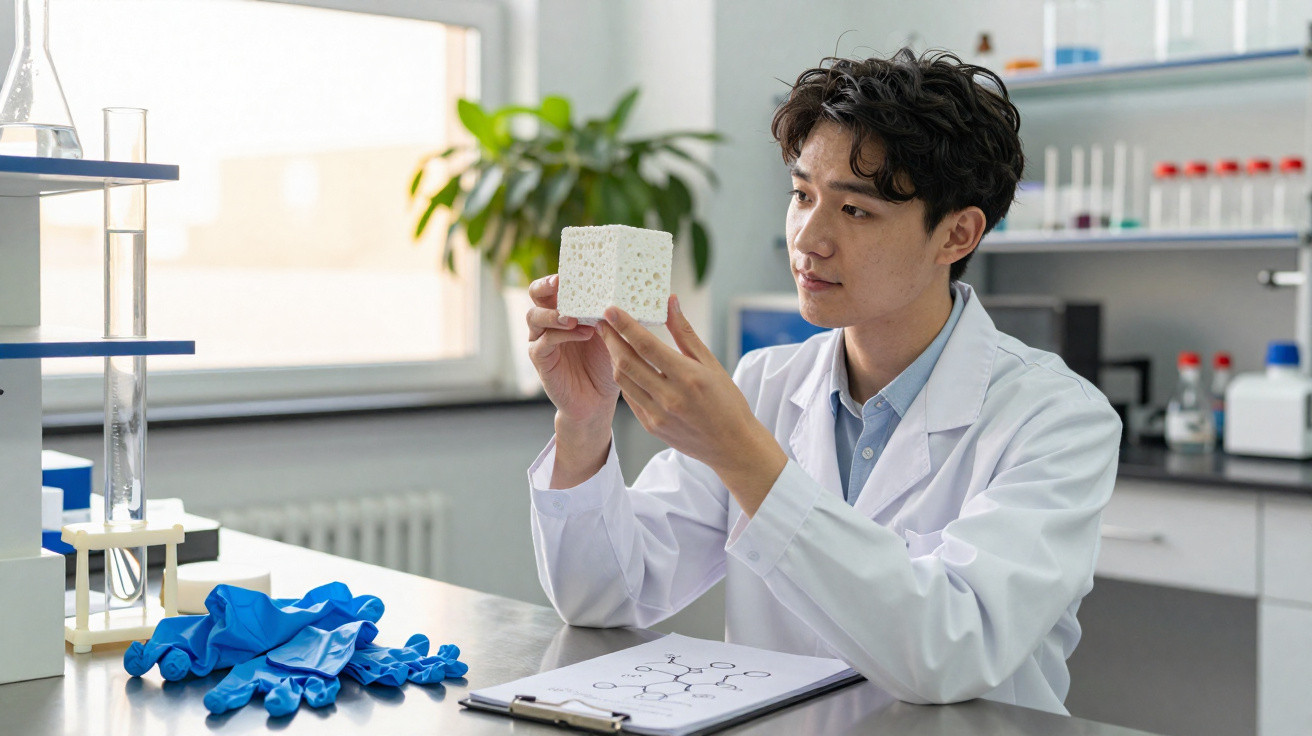
Disposable nitrile rubber gloves are manufactured in vast quantities each year, with the majority discarded after a single use. This creates a huge and increasing waste stream.
A recent laboratory study points to another possible fate for the material. Rather than incinerating or burying the rubber, scientists can convert it into a solid that captures CO2 and can be used again and again.
The concept is straightforward yet far-reaching: to transform a product seen as a waste-management burden into a means of controlling emissions.
From rubber gloves to CO2 capture
In their study, Simon Kildahl, a postdoctoral researcher at Aarhus University, and his colleagues describe a process that turns discarded rubber gloves into a CO2 adsorbent.
Kildahl says the change could be significant because of the enormous volume of this material and the continued use of incineration for mixed plastics or materials that are difficult to recycle.
“A plastic bottle can be recycled relatively easily, as we know from deposit-return systems,” he said. “But other plastic materials are problematic because they cannot be reused in the same way. Therefore, they often end up being burned, which is currently the case for rubber gloves.”
“In our experiments, we converted the glove so that it could capture CO2 instead of becoming a waste product that releases CO2 and other harmful gases during incineration.”
Tackling hard-to-recycle plastics
Kildahl works in the Skydstrup Group at the Novo Nordisk Foundation CO2 Research Center (CORC), a collaborative initiative based at Aarhus University.
Its wider aim is to identify methods of capturing CO2 or transforming it into useful products, including fuels created through Power-to-X processes.
This emphasis on carbon capture also ties into a question the group has explored for years: how to handle materials generally regarded as unrecyclable.
Earlier, the researchers described approaches for extracting value from polyurethane mattress foam and waste from wind turbine blades, including epoxy and glass fibres.
They are now using similar ideas for nitrile rubber gloves, a problematic material that is vital in healthcare, extensively used and normally thrown away straight afterwards.
The attraction of the approach is its attempt to address two issues simultaneously. It provides a possible treatment for a challenging waste stream while producing a material that could reduce emissions instead of increasing them.
Chemistry reshapes rubber waste
The laboratory process starts with a basic mechanical stage: the gloves are broken into small fragments. Chemistry then takes over.
“Specifically, we shred the rubber glove into small pieces. It then reacts with a ruthenium-based catalyst and hydrogen gas, after which it can capture CO2 from simulated flue gas,” Kildahl explained. “In the real world, this could potentially take place at a power plant.”
Rather than merely melting and reshaping the gloves, the scientists chemically alter them, changing their behaviour and giving the material a different function.
Rubber gloves become a CO2 sponge
The team assessed the material with simulated flue gas. This is important because industrial exhaust contains complicated mixtures of gases rather than CO2 alone.
A practical characteristic also means that the process is not simply a one-off solution. Once the material has captured CO2, it can be regenerated.
By heating the rubber-based product, engineers can release the captured CO2 for underground storage or use in Power-to-X processes. Meanwhile, the material is refreshed, allowing it to capture further CO2.
This repeated cycle of capture and release is crucial for any viable carbon capture technology. If the material deteriorated rapidly or could be used only once, it would merely recreate the waste issue in another form.
Rethinking carbon capture materials
CO2 capture itself is not a new idea. Existing technologies already remove carbon dioxide from exhaust gases and even from the atmosphere directly.
The distinction in the work by Kildahl’s team lies not in the objective, but in the material from which they begin.
Most capture materials involve substantial upstream manufacturing, much of which still relies on fossil feedstocks. When a climate solution requires increased production based on oil, its total benefit may be reduced.
Rubber waste becomes climate resource
Instead of manufacturing a new substance from the beginning, the researchers use waste that would otherwise be sent to landfill or an incinerator.
They present the glove-derived material as a way of avoiding additional fossil inputs into the system. The method also relates to the scale of the task identified by the UN Intergovernmental Panel on Climate Change, which has highlighted the need to remove billions of tonnes of CO2 every year by mid-century.
“That is why it is smart to utilize a waste material available in such large quantities, rather than extracting more oil from the ground,” Kildahl said.
“With the rubber glove, we can create a CO2 capture material where almost every atom in the product comes from waste, except for a small amount of hydrogen.”
This is the central argument behind the chemistry. A glove is turned from a carbon-emitting liability into a resource for carbon capture, while the process seeks to minimise new fossil inputs.
Early stages, big ambitions
At present, the findings are limited to the laboratory, which is an important qualification. Reactions that work exceptionally well in small glass vessels can behave very differently when engineers try to operate them on an industrial scale.
Kildahl describes the project as being at an early-to-intermediate point on the Technology Readiness Level scale, at approximately level three or four.
The group is currently operating at gram scale. Its next obstacle is progressing towards kilogram-scale work, when heat transfer, mixing and cost limitations are much harder to control.
“We are working on a gram scale right now, and reactions can look and behave differently when we scale up to kilograms. But our results look very promising,” he said.
Making the CO2 capture affordable
Expense presents a further challenge. At the moment, the technique uses a costly catalyst. For the process to become practical, it would need a less expensive replacement, much more effective catalyst recycling, or a redesigned system that uses less of it.
Nevertheless, the researchers say they have reached a key milestone: the process works in principle. They are now seeking to make the material tougher, cheaper and more competitive with alternative carbon capture technologies.
The team has demonstrated that the concept works and considers that the technology could soon enter more advanced development stages if it can improve scalability, reduce costs and increase performance.





Comments
No comments yet. Be the first to comment!
Leave a Comment