

A low-cost cupboard staple can bring surprisingly quick clarity to greasy kitchen cupboards.
Many people only notice the problem when light falls at an angle across the cupboard fronts: they look dull, greasy and difficult to clean. Rather than buying costly specialist products, a simple item from the kitchen cupboard is often enough. An unassuming powder that most households already have can break down grease more effectively than many branded cleaners.
Why grease clings so stubbornly to kitchen cupboards
When frying, cooking or deep-frying, tiny droplets of fat continually rise into the air. They settle as a fine film on surrounding surfaces, particularly on cupboards close to the hob. There, they combine with dust to form a sticky layer that ordinary wiping barely removes.
A sticky mixture of grease and dust builds up especially above the hob and beside the extractor hood, and water alone does little to dissolve it.
Over time, this coating becomes increasingly thick. Even people who wipe down regularly usually clean only the most visible areas. The tops of wall cupboards, handles and frames are easily overlooked – and this is precisely where dirt can seem baked on.
The simple household remedy: how bicarbonate of soda tackles grease and dirt
Bicarbonate of soda, also known as baking soda or baking bicarbonate, is a versatile household product. The powder is mildly alkaline and has a gentle yet noticeable abrasive effect. Mixed with water, it creates a cleaning paste that loosens grease effectively.
Mixing a bicarbonate of soda paste: step by step
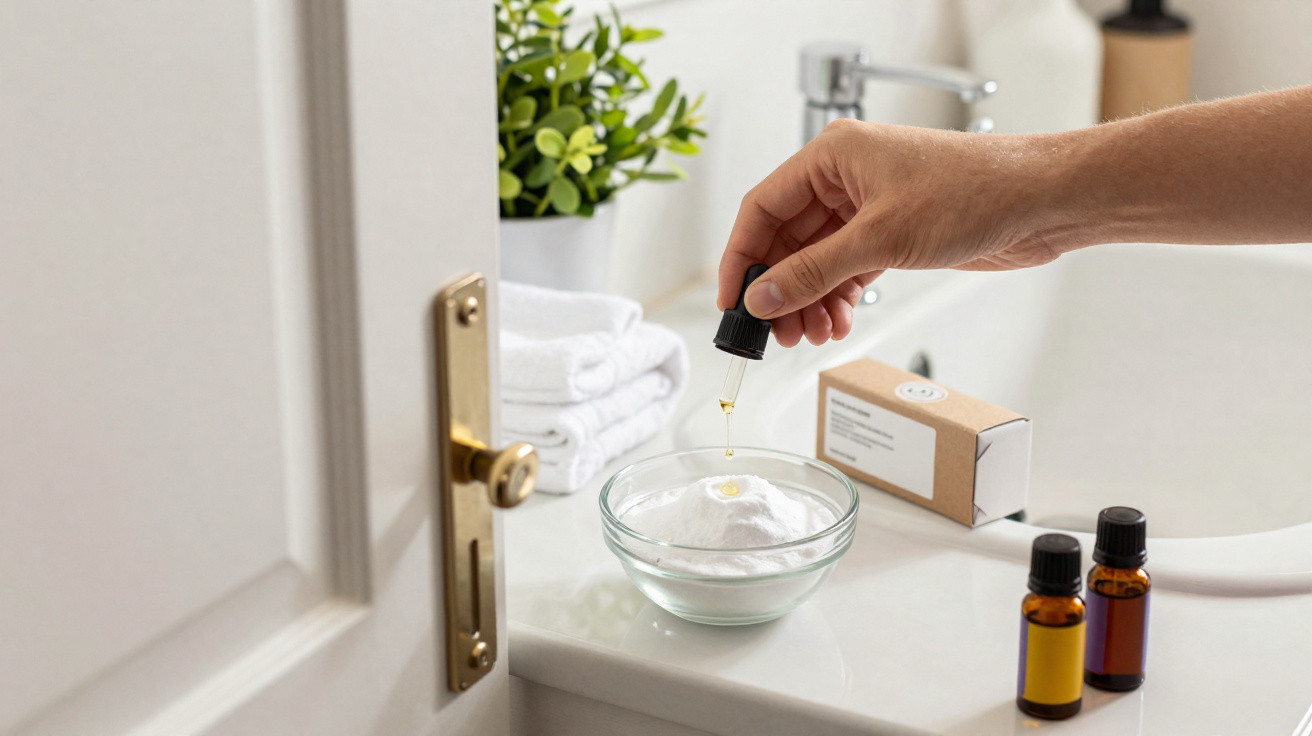
- Put 1–2 tablespoons of bicarbonate of soda into a small bowl.
- Add lukewarm water a drop at a time until a thick paste forms.
- Pick up the paste using a soft sponge or microfibre cloth.
- Apply a thin layer to the greasy areas of the cupboard fronts.
- Leave it to work for 1–3 minutes, without allowing it to dry out.
- Wipe away with a damp cloth, then wipe again with clean water.
For heavily soiled areas, a splash of washing-up liquid in the bicarbonate of soda mixture can further boost its grease-cutting effect. Washing-up liquid helps the dissolved fat disperse in the water instead of settling back onto the surface.
Bicarbonate of soda loosens resinous grease without attacking most kitchen cupboard fronts – an advantage over many aggressive spray-on degreasers.
Do not use abrasive sponges or scouring pads. The mechanical action of bicarbonate of soda is sufficient to remove the layer. Pressing too firmly can damage delicate finishes such as high-gloss cupboard fronts or painted wood.
Which surfaces can be cleaned with bicarbonate of soda – and where caution is needed
Many kitchens contain a range of materials, including foil-wrapped fronts, lacquered finishes, solid wood, stainless steel and glass. Not every surface responds equally well to every cleaning product.
| Material | Suitability for bicarbonate of soda | Note |
|---|---|---|
| Foil-wrapped and plastic cupboard fronts | Well suited | Use a mild paste, avoid heavy pressure and always wipe afterwards |
| Lacquered cupboard fronts | Use with caution | Test first in an inconspicuous area |
| Oiled solid wood | Suitable only to a limited extent | Use very sparingly, then re-oil the wood |
| Glass surfaces | Possible | Apply an extremely thin paste and rinse thoroughly straight away |
| Stainless steel | Well suited | Always wipe in the direction of the grain |
If in doubt, test the bicarbonate of soda paste first on a spot that is rarely visible in everyday use, such as the inside edge of a cupboard or beneath a shelf.
Other household remedies that dissolve kitchen grease
Bicarbonate of soda is not the only way to remove stubborn grease marks. Other kitchen staples can also work reliably when used correctly.
Vinegar water: powerful against grease, but unsuitable for some surfaces
Vinegar mixed with warm water removes grease, limescale and light discolouration. Its acidity also has an antibacterial effect. This solution is particularly suitable for ceramic tiles, glass and certain plastics.
- Mix 1 part vinegar with 3 parts warm water.
- Apply it with a cloth and leave it briefly to work.
- Wipe with clean water to remove the smell and any acidic residue.
However, vinegar can cause damage to sensitive materials such as natural stone and some lacquered finishes. Dull surfaces or pale marks are typical consequences of overly strong acid. In these cases, bicarbonate of soda is the considerably gentler option.
Lemon: fresh fragrance and grease-cutting power
Like vinegar, lemon juice works through acidity, but it is slightly milder and leaves a pleasant scent. Many people use it on lightly soiled cupboard fronts, refrigerator handles or worktops.
For a gentle cleaning mixture, use:
- the juice of half a lemon
- around 250 millilitres of lukewarm water
- optionally, one drop of washing-up liquid
This solution is useful for a quick clean between deeper cleans, when the grease film is not yet particularly old or stubborn. For dried-on marks, bicarbonate of soda generally remains the more effective choice.
How to stop the grease film building up again
Anyone who only thinks about kitchen cupboards every few months will face a larger cleaning job each time. A few simple routines can postpone that point considerably.
Wipe down regularly after cooking
Even a brief wipe of cupboard fronts with a damp microfibre cloth after cooking can make a substantial difference. At that stage, grease particles are still loose and can be removed without cleaning products.
- Wipe the cupboard fronts around the hob after frying or deep-frying.
- Wipe down the outside of all wall cupboards at least once a week.
- Do not forget the tops of wall cupboards – this is where particularly large amounts collect.
A thin oil layer as a protective film
One practical tip is to apply an extremely thin layer of cooking oil after a deep clean. Sunflower oil or rapeseed oil both work well, and a few drops on a soft cloth are enough.
The fine oil layer acts like a separating film – new dirt adheres less firmly and can be wiped away more easily later.
The key is to apply only a very thin coating. Too much oil causes streaks and attracts dust again. This method should be tested cautiously on high-gloss cupboard fronts, as it can slightly alter their shine.
How often a deep clean is worthwhile
The right frequency depends heavily on cooking habits. Those who fry almost every day should clean their cupboards thoroughly about every four to six weeks. In households where little cooking is done, an interval of two to three months is usually sufficient.
A sensible sequence for a larger cleaning session is:
- Wipe cupboard fronts with a damp cloth to remove coarse dust.
- Apply bicarbonate of soda paste or vinegar water, depending on the surface.
- Leave it to work, then wipe thoroughly.
- Clean handles, edges and top surfaces separately.
- Allow the surfaces to dry and, if required, apply a thin oil layer.
What the terms bicarbonate of soda, soda crystals and baking powder mean
Household remedies can be confusing: bicarbonate of soda, soda crystals and baking powder sound similar, but they do not work in the same way. Bicarbonate of soda is pure sodium bicarbonate and is ideal for gentle cleaning. Soda crystals, often sold as washing soda, are much more alkaline and have a more aggressive effect. They should be used in the kitchen only with great care and never on delicate materials.
Baking powder does contain bicarbonate of soda, but it also includes acidic agents and starch. It can be used in an emergency, although its cleaning action is weaker and often stickier because the starch leaves residues behind. For kitchen cupboards, pure bicarbonate of soda is therefore the better choice.
Practical examples: where this household remedy is especially useful
Cleaning with bicarbonate of soda is particularly effective where grease has been sitting for a long time. A classic example is wall cupboards above older hobs where the extractor hood was rarely used. The difference after treatment is also especially noticeable on handles that are regularly touched with slightly greasy hands.
Anyone preparing to let or sell their kitchen can achieve a visible improvement with this type of deep clean. The cupboard fronts look fresher and the kitchen appears better cared for, without the immediate need for new furniture.
Improving ventilation while cooking, for example by using the extractor hood consistently and airing the room briefly with windows open, also reduces the amount of grease that reaches the room in the first place. Combined with the simple bicarbonate of soda trick, this can keep kitchen cupboards clean over the long term – without harsh chemicals.




Comments
No comments yet. Be the first to comment!
Leave a Comment