
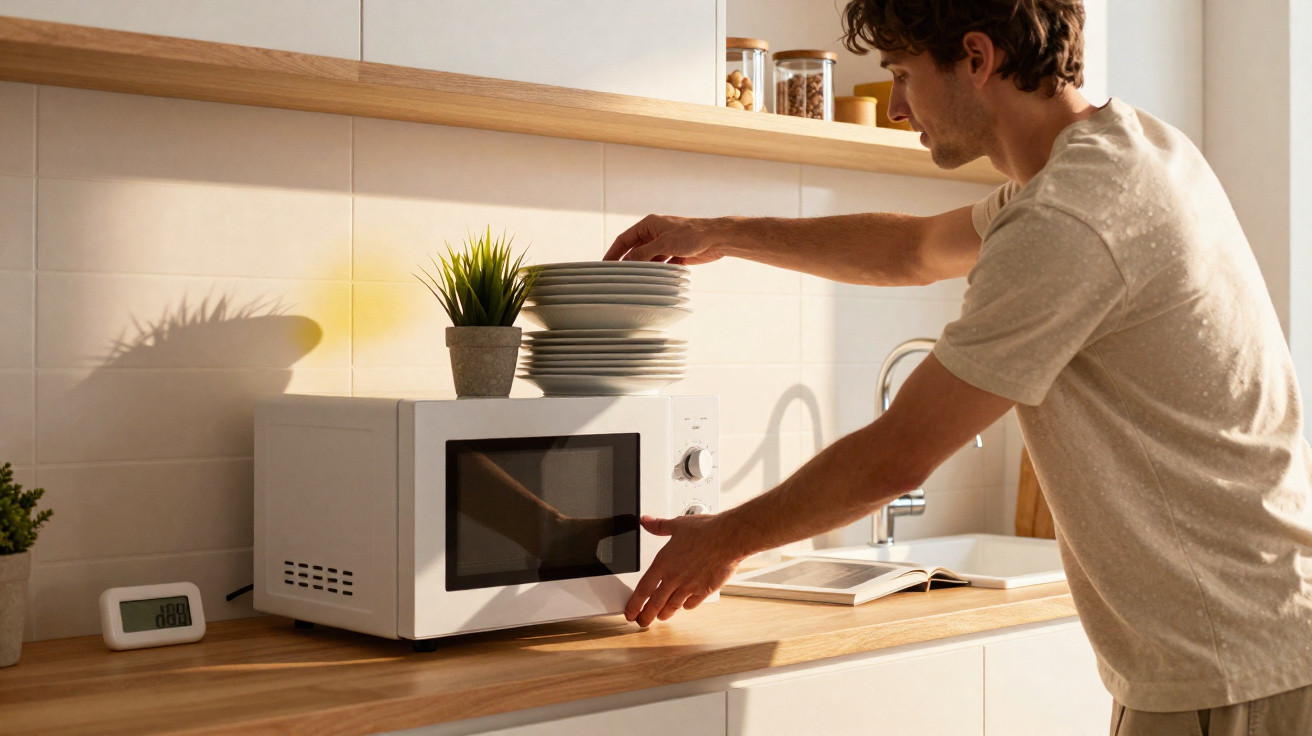
Yet this very space-saving trick can prove costly and dangerously fire-prone.
In many kitchens, the microwave is no longer used solely for heating food. It becomes a handy storage surface, a stand for other appliances or a place to leave crockery. Although this may seem like an efficient use of space, it can put considerable strain on the technology inside and, in the worst case, create a genuine safety risk.
Why a microwave does far more than heat leftovers
Most households now have a microwave. It is affordable, compact and fits even in very small kitchens. It can take on several tasks there: reheating meals, defrosting frozen food, cooking vegetables, gently softening butter or melting chocolate for a cake – all at the press of a button.
Because it is so versatile, the appliance is often used several times a day. High voltage, electronics and a ventilation system work closely together inside it. Whenever the turntable rotates and the familiar hum begins, heat and energy are produced that need somewhere to go.
“A microwave is not a stupid metal box, but a precisely coordinated heating and ventilation system – anyone who blocks it interferes directly with this process.”
Hidden air vents: the overlooked risk
Like a computer or refrigerator, a microwave needs air to release excess heat. Ventilation slots are located at the rear, on the sides or on the top. Cool air flows in through them while hot air is expelled.
If that airflow is interrupted, heat builds up. The consequences include:
- Electronics and cables become excessively hot.
- Components wear out much sooner.
- Safety mechanisms activate earlier and switch the appliance off.
- In the worst case, there is a risk of smouldering or an electrical fire.
Many of these openings barely register in daily use. They may sit close to the wall, be concealed by decorative items or disappear beneath an appliance placed on top. This is precisely why so many people underestimate the issue.
Do not put anything on top: why the microwave top should stay clear
Worktop space is almost always limited in small kitchens. That makes it tempting to use the top of the microwave. Before long, it may hold a small coffee machine, an air fryer, a toaster, a stack of plates or a pile of mugs and cookbooks.
There are two clear reasons not to do this:
1. Ventilation is obstructed
Many microwaves release some of their heat through the top. Placing items there creates a kind of thermal blanket. Heat can no longer escape properly, so the casing becomes progressively hotter. Temperatures rise particularly noticeably during longer use, such as defrosting or cooking.
“Anyone who clutters the top causes the microwave to stew in its own heat – a recipe for premature faults.”
2. Weight can damage the structure
Microwaves are not designed to serve as shelves. Their metal casings are generally relatively thin. Inside are the magnetron, transformer, electronics, turntable and motor. Extra weight on top can slightly compress the casing and may:
- distort the frame;
- affect the door seal;
- obstruct mechanical parts such as the turntable;
- place unnecessary stress on screws and mountings.
Even if a coffee machine or air fryer does not seem particularly heavy, its weight rests permanently on the structure for months or years. Any jostling or shifting while the appliance is being used makes the effect worse.
What commonly ends up on a microwave – and why it is a problem
| Item | Typical problem |
|---|---|
| Coffee machine | considerable weight, vibration while brewing, and substantial heat directly on the casing |
| Air fryer | produces significant heat itself, obstructs ventilation and greatly increases the fire risk |
| Toaster | upward heat, crumbs, and a smouldering or fire risk on a sensitive appliance |
| Stack of plates or mugs | weight, a risk of falling when vibrations occur, and blocked upper air vents |
| Cookbooks, magazines or paper | easily combustible, traps heat and can slip into ventilation openings |
Effects on safety and lifespan
Anyone who keeps their microwave permanently boxed in is, in effect, signing up for gradual total failure. The components inside are designed to operate within a specific temperature range. If heat repeatedly accumulates, they deteriorate much faster.
Typical signs of trouble include:
- The casing becomes unusually hot during operation.
- There is a noticeable smell of hot plastic.
- The appliance switches off midway through use and only works again after cooling down.
- Unusual sounds or humming occur.
“Many people assume it is simply an ‘age-related fault’, when years of incorrect use have often contributed.”
There is also a risk from objects falling down. Opening and closing the door inevitably causes some movement in the appliance. Stacks of plates or glasses can slide off, break or, in the worst case, injure someone.
How to position the microwave correctly
Anyone wanting to use their microwave for the long term should give it its own well-ventilated spot. A few straightforward rules make a major difference:
- Leave several centimetres of clear space around the appliance – at the back, sides and top.
- Do not place other electrical appliances directly on it.
- At most, allow only very light, flat items, such as a thin silicone mat – although nothing is better.
- Check regularly that ventilation slots are clear and clean.
- Follow the instruction manual: many manufacturers expressly prohibit placing any load on top.
Ideally, the microwave should sit on its own shelf or a sturdy base unit. In some kitchens, a small additional cupboard above the microwave is worthwhile for storing items that would otherwise have been placed on top of it.
How microwaves work technically – and why heat is their enemy
Inside a microwave, a component called a magnetron generates high-frequency waves. These make water molecules in food vibrate, creating heat within the food itself. This process requires a great deal of energy, not all of which is ‘used up’ by the food.
Some of that energy becomes heat in the magnetron and electronics. This is where the cooling system comes in: fans maintain airflow, metal panels conduct heat away and the casing acts as a large cooling surface.
“When the outside of the microwave feels warm, the cooling system is working – when it becomes very hot, that is a warning sign.”
Persistent overheating can cause hairline cracks in solder joints, burnt contacts, brittle plastic parts and weakening fans. Many appliances then appear to fail ‘suddenly’, even though the damage has developed slowly over time.
Practical alternatives to using the microwave as a shelf
Anyone short on space needs options other than the microwave lid. Some simple ideas are:
- Fit narrow wall shelves above the worktop for mugs, glasses or spices.
- Use a pull-out shelf beside the microwave, such as a slim rolling storage unit.
- Add stacking baskets or shelf inserts in cupboards to create extra levels.
- Store rarely used appliances, such as a raclette grill, fondue set or waffle maker, in higher cupboards.
If you absolutely want the weight of other appliances near the microwave, fit a dedicated shelf just above it. This keeps the ventilation and casing clear while making practical use of the space overhead.
When the microwave should be replaced
If a microwave has been obstructed for years, it is worth inspecting it carefully. Typical warning signs that make a replacement worth considering include:
- Discoloured or scorched areas on the casing or rear.
- Rust inside the appliance, especially on the walls or door.
- The door no longer closes properly, with visible gaps around the seal.
- The appliance switches itself off or on unpredictably.
Older appliances in particular may have less sophisticated safety systems. If clear signs of heat damage are already visible, replacement is the safer option – especially as modern microwaves are often more energy-efficient and quieter.



Comments
No comments yet. Be the first to comment!
Leave a Comment