
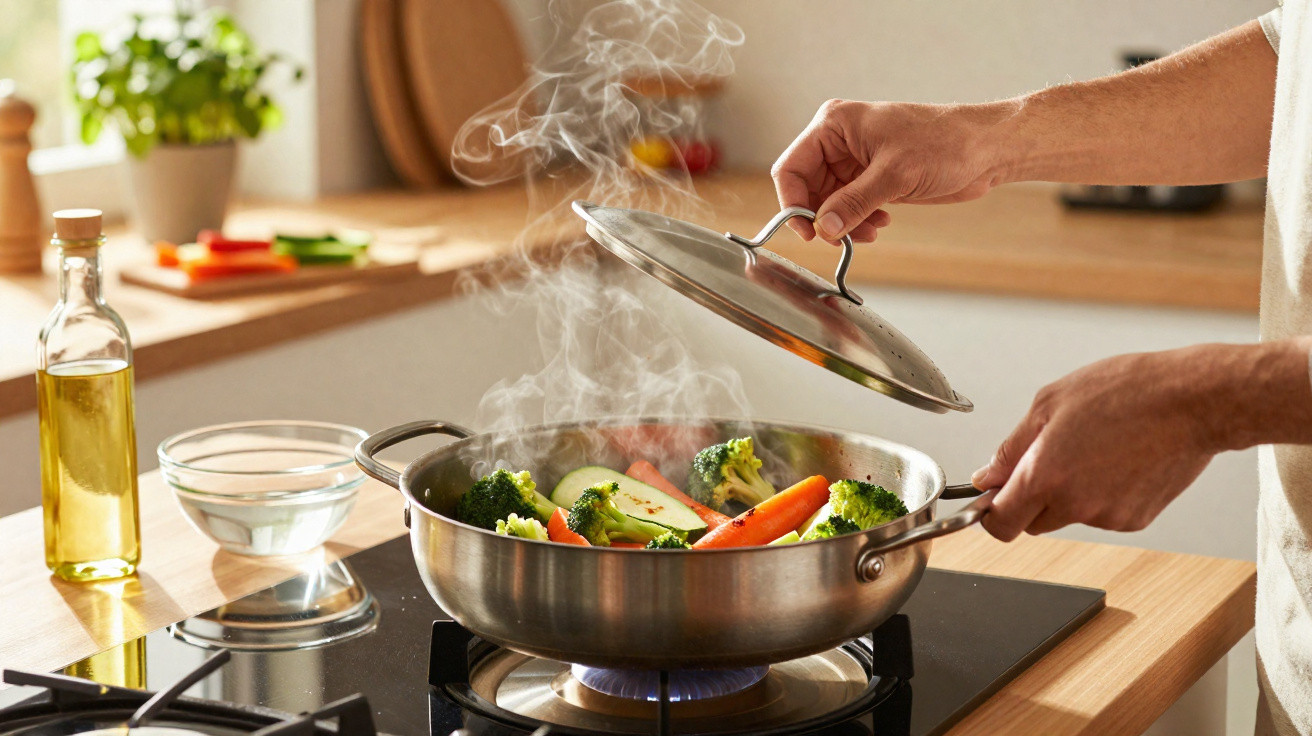
A heavy cast-iron casserole, a special lid, expensive accessories?
That is exactly what I used to think – until a kitchen trick involving an entirely ordinary saucepan changed my mind.
Many home cooks assume that gentle cooking without water and fat requires costly, high-end cookware. Yet the real “magic” lies not in the material, but in the food itself. Once you understand how to use the natural moisture in vegetables and fish, an everyday casserole can produce remarkably good results.
Gentle cooking without water: what really happens in the pot and pan
The principle behind this method is almost disarmingly simple: every piece of vegetable, every apple and every fish fillet naturally contains water. That moisture takes over the job normally done by tap water or stock.
As the ingredients heat up, their internal water begins to evaporate. With a close-fitting lid in place, the moist heat is retained inside the pot. Rather than frying fiercely, the food cooks gently and evenly.
“The food cooks in its own juices – with no added water, no bath of fat, and a much more intense flavour.”
The process follows a straightforward cycle:
- Heat causes the moisture in the vegetables to evaporate.
- The humid air rises and reaches the slightly cooler lid.
- The steam condenses there into tiny droplets.
- These droplets fall back onto the food, continually moistening it.
As a result, nothing dries out, even when not a single drop of water has been added to the pot. Temperatures generally sit at around 60 to 80 degrees. This is lower than vigorous frying, yet sufficiently high to break down cell structures and make the food tender.
Why a cast-iron casserole is not necessary
Many brands market specialist pots for precisely this technique, often with a hefty price tag. In practical terms, however, a sturdy everyday pot is enough if it has two key features:
- A reasonably thick base that distributes heat evenly
- A lid that fits well so steam cannot escape
Whether you use a stainless-steel casserole, a traditional deep-sided frying pan or a simple stew pot, the material itself is not the deciding factor. What matters is the combination of even heat distribution and a good steam seal.
The unassuming kitchen-towel trick
There is one issue almost everyone knows: the lid rattles, steam hisses out around the sides, and something still ends up catching. This is where a surprisingly simple solution comes in: a damp kitchen towel.
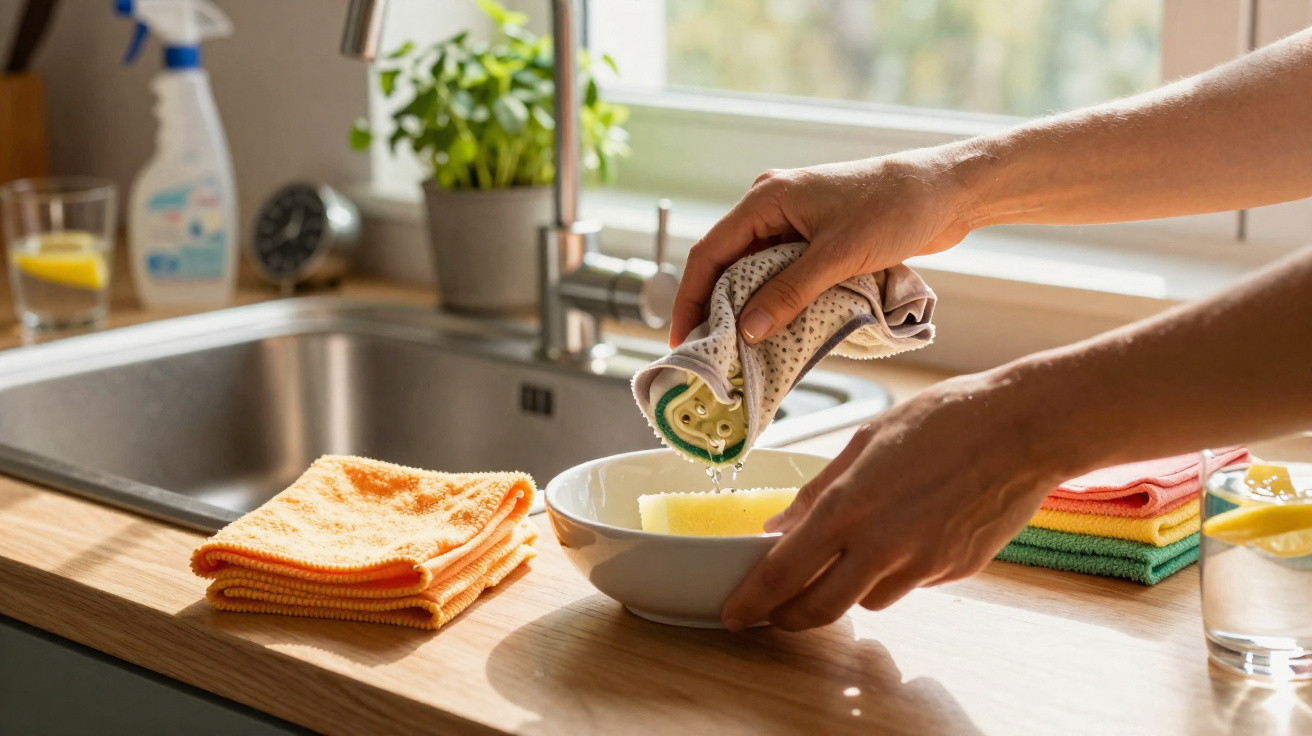
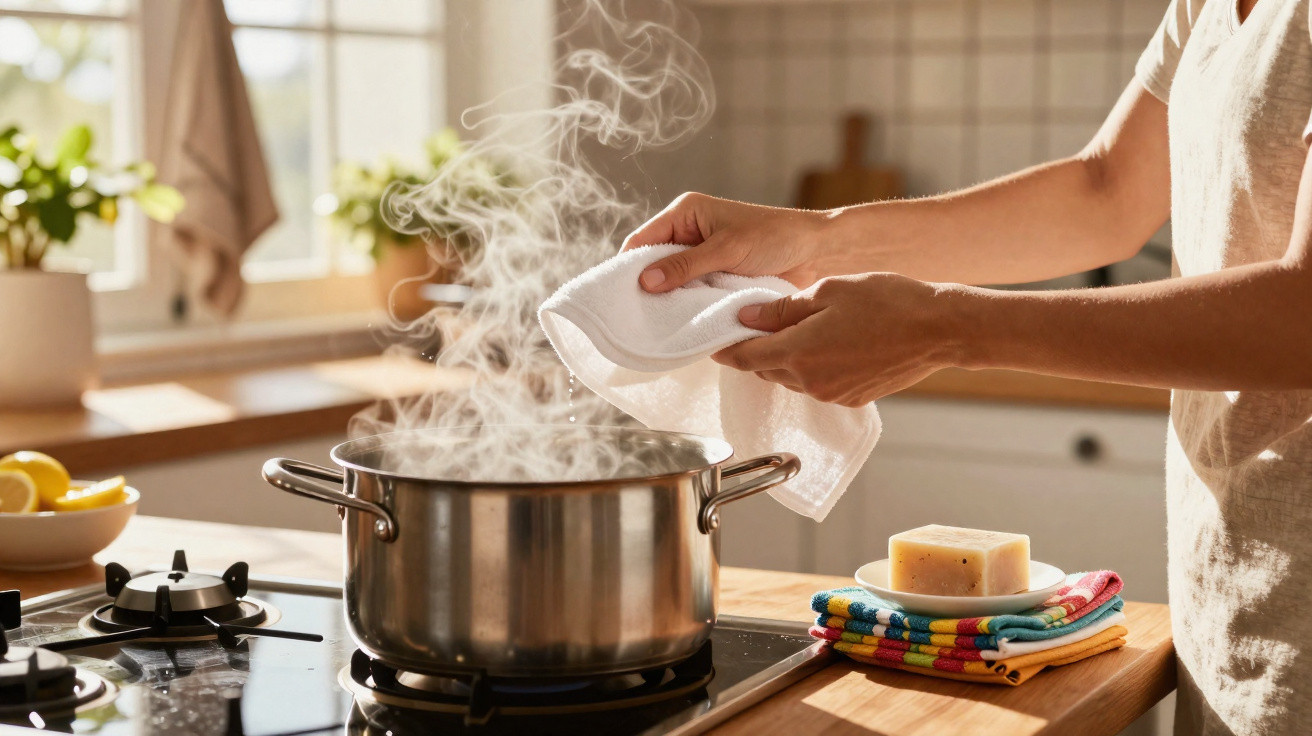
Place a well-wrung, slightly damp towel between the rim and the lid to create a kind of seal. Steam remains in the pot instead of escaping so easily. Two points are important:
- Never allow the towel to hang near a flame.
- It should be damp rather than soaking wet.
“A simple kitchen towel can turn an average pot into almost a ‘light steam cooker’ – without buying anything new.”
Which foods are particularly suitable
This style of cooking comes into its own especially in spring and summer. Fresh vegetables contain plenty of moisture of their own and can react badly to excessive heat, making them ideal for this gentle approach.
Vegetables that love this cooking method
- Carrots – stay sweet with a slight bite
- Leeks – develop a strong flavour without falling apart
- Cabbage and Savoy cabbage – become tender without seeming watery
- Endive or chicory – taste less bitter when only lightly cooked
- Asparagus – retains more of its own flavour than when cooked in water
- Courgettes – become creamy rather than mushy
Fruit works surprisingly well too. Apple wedges, quartered pears or plums can be cooked in moments into a kind of “instant compote”, requiring no sugar when the fruit is ripe.
Fish in its own steam: tender rather than dry
Anyone who has removed a dry fish fillet from a frying pan knows how sensitive fish is to heat. At a moderate temperature beneath a lid, it remains noticeably juicier:
- Salt the fillet briefly and, if desired, pair it with a few slices of vegetables.
- Put it into the pot, close the lid tightly and raise the heat gradually.
- As soon as steam collects on the lid, reduce the temperature.
The key is to leave the lid firmly closed. Every curious check releases steam and heat – and ultimately reduces the quality.
Step by step: getting started with water-free and fat-free cooking
A simple spring vegetable dish is a good place to begin. One possible basic combination is:
- 600 g carrots
- 2 leeks
- 1 onion
- 1 pinch of salt
- Pepper
- Fresh seasonal herbs, such as parsley or chives
The most important preparation takes place on the chopping board. Cutting the vegetables into fairly even pieces ensures that they all cook at the same time. Very tiny cubes release their liquid too quickly and turn mushy, while large pieces take far too long.
The method can then proceed as follows:
- Cut the vegetables into slices, batons or small pieces.
- Put everything into the pot and sprinkle with a pinch of salt.
- Put on the lid, using the towel trick if it does not seal perfectly.
- Begin over medium heat until steam is visibly forming inside.
- Turn down the heat and allow the ingredients to continue cooking gently.
- Avoid opening the lid wherever possible; rely instead on the smell and a quiet “simmering” sound.
- Finish by adding fresh herbs and pepper.
“Anyone who uses their nose hardly needs to watch the clock: when the smell of cooked vegetables becomes more intense, the critical point has usually been reached.”
Common mistakes and how to avoid them
In practice, the method rarely fails because of the theory, but because of the same three stumbling blocks:
| Problem | Possible cause | Solution |
|---|---|---|
| Vegetables catch on the bottom | Heat too high, lid not sealed | Turn down the heat sooner, use a towel seal and choose a pot with a thick base |
| Everything remains hard | Pieces too large, cooking time too short, lid opened too often | Cut smaller, keep the lid closed and allow a little more time |
| Vegetables turn mushy | Heat still too high, cooked for too long | Lower the temperature, check doneness earlier and listen for a gentle simmer |
Three guiding ideas are useful here: a good seal, gentle heat and patience. Constantly adjusting the temperature or repeatedly lifting the lid disrupts the steam cycle.
Flavour, nutrients and everyday practicality: what makes this method appealing
In daily life, it is not just the “wow” factor that matters; the real question is whether it is worthwhile in the long run. Several aspects make the water-free and fat-free cooking method appealing:
- More flavour: Nothing is washed out in water, so vegetables taste more concentrated.
- Less fat: No oil is required for the cooking process itself, although a few drops of good olive oil can be added afterwards if desired.
- Gentler treatment: Lower temperatures can better preserve delicate flavours and heat-sensitive vitamins.
- Predictable texture: Depending on the cooking time, the bite can be controlled fairly well, from crisp to very soft.
There is another advantage: when you arrive home tired in the evening, there is no need to prepare a complicated sauce. One pot, a little chopping, lid on – and the rest largely takes care of itself. While the vegetables cook in their own juices, there is time for other tasks in the kitchen.
What to know about the risks and limitations
Attractive as it sounds, this approach cannot replace every other cooking method. A few considerations are worth keeping in mind:
- Proper browned flavours still require conventional searing.
- Meat with a thick layer of fat is only suitable to a limited extent, as it prefers substantially higher temperatures.
- If you are using vegetables with very little moisture, a tiny splash of liquid can help – for example, one tablespoon of stock or white wine.
Hygiene also remains important: fish and poultry in particular must be cooked through completely. A simple kitchen thermometer offers reassurance here, particularly when working at very low temperatures.
Combinations can be particularly interesting: first sear the food briefly at high heat to create browned flavours, then lower the temperature, put on the lid and finish cooking in its own steam. This brings together depth of flavour and juiciness without requiring much additional fat.
Once you become accustomed to this quiet, moist heat, you will often look at your kitchen cupboard differently. Suddenly, there is no need for an expensive specialist pot; what matters most is a feel for steam, temperature and patience – and that can be developed a little further with every portion of vegetables.

Comments
No comments yet. Be the first to comment!
Leave a Comment