
The shower screen seemed to taunt me every morning.
I would climb in armed with a clean sponge, a miracle-promising bottle of cleaner and the optimistic belief that, this time, the soap scum might stay away for longer.
By Thursday, however, the streaks had returned like phantom fingerprints. Hard-water marks dotted the glass, a cloudy layer dulled the tiles, and there was that slight sour odour that only became noticeable once the water heated up. I kept on scrubbing, spraying, rinsing and starting again.
Then, in the middle of a frantic Saturday cleaning session, I paused and looked at the sodden sponge in my hand. A surprisingly clear realisation hit me.
It was not the frequency of my cleaning that was the issue.
I had been missing one straightforward step all along.
The overlooked shower-cleaning mistake
For years, I had only two settings for dealing with the shower: use it, then fight it later.
After getting out, I would toss my towel over the rail, open the window if it occurred to me and promise myself a proper clean “at the weekend”.
Every weekend then became its own small battle.
I scrubbed the walls until my shoulders hurt, worked my way through every cleaner available at the supermarket and even tested vinegar tips that left the bathroom smelling like a salad bar.
For a day or two, the shower looked spotless.
Then, right on schedule, the glass turned cloudy once more.
I assumed I was simply being lazy.
In reality, I was overlooking one crucial action.
The moment of clarity came from a friend with three children and a bathroom that somehow always has the finish of a hotel.
While we were talking in her kitchen, I casually asked which product made her shower glass so clear.
She laughed and said, “Oh, the product doesn’t matter that much.”
I will admit that I did not believe her. I pressed for details: the brand, the technique, the secret spray.
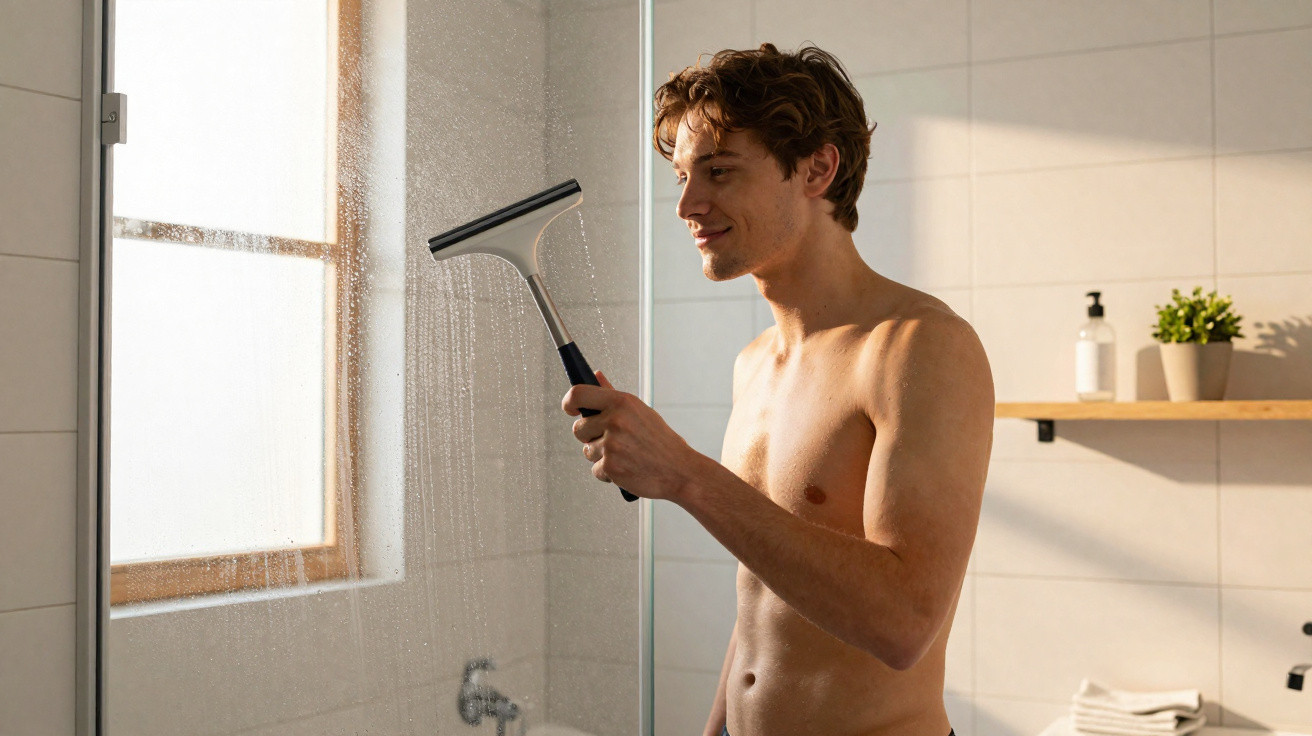
She led me into her bathroom and pointed, not to a bottle, but to a cheap and rather unattractive plastic item hanging from a hook.
It was a basic shower squeegee.
There was nothing special about it: no fancy design or brand partnership, only a curved blade with a handle.
“I barely scrub anymore,” she said. “I just changed what I do right after I shower.”
I kept thinking about that remark all the way home.
It made me realise that I only ever considered cleaning the shower after it was visibly dirty.
My entire approach had been built around rescue jobs.
I let the water evaporate, allowed the minerals to set hard and gave the soap time to stick itself to the surface, before going in with cleaning products and effort.
It felt ordinary because it is what most people do.
The reasoning is brutally straightforward.
Water + heat + soap + time = a fine but stubborn coating that no spray removes completely without some effort.
The real change does not happen during the Saturday scrub.
It happens in the 30 seconds after the water is switched off.
The shower squeegee step that changed everything
The following morning, I put my friend’s suggestion into practice.
I hung an inexpensive squeegee inside the shower at eye height, where it was impossible to miss.
Once I had showered, I did not step straight out.
Instead, I stayed put and drew the blade down every glass panel from top to bottom, using one smooth pass at a time.
There was no need to hurry or press hard; gravity simply helped the water run downwards.
I did the tiles, followed by the glass, then the small shelf where shampoo bottles always leave a ring.
The whole thing took 40 seconds.
I timed it while feeling part doubtful and part optimistic.
It seemed far too simple to make any real difference.
I did not spot the first change on day one; it appeared on day four.
Usually, the glass would begin to look hazy by the middle of the week, particularly in the areas hit most directly by water.
This time, the glass still appeared almost… new.
It was not dazzlingly flawless or magazine-perfect, but it was clear enough that I did not feel that familiar creeping guilt on entering the bathroom.
The tiles also felt smoother when I ran my hand over them, rather than having the slightly tacky texture that clearly says “film”.
Of course, no one really manages this every day with military-level consistency.
I missed it one morning and forgot after an evening shower.
Even so, after two weeks of my imperfect routine, the difference was undeniable.
My “deep clean” was no longer an emergency. It had become more of a light refresh.
Eventually, I understood that this was not truly about the squeegee itself.
It was about moving the timing from “later” to “now”.
While water is still fresh on the glass, there is no hardened mineral layer.
There is no dried soap scum or body oil that steam and time have baked onto the surface.
Taking away that fine layer of water before it dries stops the issue at its source.
A cleaning product will always claim to offer a shortcut.
But the unglamorous daily action quietly outperforms the most powerful chemical.
Rather than battling built-up layers, you are simply maintaining a surface that is already clean.
That means less scrubbing, fewer products and less quiet irritation whenever you look at the shower door.
How to make the habit work without becoming a cleaning robot
If even the word “routine” feels exhausting, keep the starting point small.
Place a squeegee or microfibre cloth inside the shower, where your hand naturally reaches once you turn off the tap.
The important thing is to attach it to something you already do.
Water off, one quick breath, then three motions: glass, tiles, shelf.
There is no need to fixate on every last corner.
Concentrate on the main splash areas and the glass panels.
On rushed mornings, I only tackle the glass.
In the evening, when I have a little more patience, I run the blade over the tiles as well.
That small, almost effortless habit prevents serious grime from gaining a foothold.
A few quiet pitfalls can undermine the trick.
The first is putting the squeegee in a cupboard “for aesthetics”.
If it is out of sight, it will not get used.
Keep it hanging somewhere visible, even if it clashes slightly with your Pinterest vision.
The second problem is expecting flawless results immediately.
When a shower already has old layers of build-up, a week of swiping will not wipe away the past.
Begin with one thorough reset clean, then move into maintenance mode.
And do not blame yourself when you miss a day.
This is not a religion; it is a tool.
Some days you’ll skip it, and that’s fine.
The important part is your new normal, rather than the occasional lapse.
A cleaner I spoke to while working summed it up perfectly:
“People think I know some magic product. Mostly, I just don’t let gunk win on day one.”
That sentence stayed with me, so I made myself a simple visual prompt and stuck it inside the cupboard.
It was not a quotation, just a short list of the things that most help my future self:
- Keep a squeegee somewhere you can genuinely reach it
- Wipe the glass as soon as the water stops
- Quickly go over the tiles when you have 20 spare seconds
- Do a more thorough clean when surfaces begin to dull, rather than waiting for a disaster
- Pick a routine you can sustain, not one you will give up after a week
The list looks obvious on paper.
In everyday life, though, it subtly transforms the feel of the entire bathroom.
When shower cleaning no longer feels like a punishment
The biggest surprise was not the clear glass.
It was how such a small, low-effort practice changed the way I felt when I walked into that room.
I used to look towards the shower and immediately feel a quiet “ugh, I really need to do that”.
Now, on most days, I simply get in.
There is no unspoken task list and no guilt about when I last scrubbed it.
The room feels calmer, even when the grout is far from Instagram-perfect.
We have all experienced the point when household jobs build up and each room feels like evidence of something left undone.
This one adjustment did not turn me into a minimalist cleaning expert.
It merely turned down the mental noise by one level every morning.
Perhaps your own “shower squeegee” will be something else.
For one person, it might be wiping the sink before bed; for another, clearing the kitchen worktop while the kettle boils.
The underlying idea is identical: turn one job from an “event” into a “gesture”.
Spend 30 seconds at the right time instead of 30 minutes once everything has dried, spread and multiplied.
You do not have to reinvent your personality or suddenly start enjoying housework.
You only need one action that stops mess becoming proof that you are “bad at cleaning”.
For me, that action hangs from a plastic hook inside the shower.
And when the rest of the house is chaotic, at least the glass still shines back quietly.
| Key point | Detail | Value for the reader |
|---|---|---|
| Change the timing | Wipe or squeegee immediately after showering, before the water dries | Stops soap scum and limescale forming in the first place |
| Keep tools visible | Hang a squeegee or cloth inside the shower at arm’s height | Helps make the habit automatic and difficult to forget |
| Think “gesture”, not “deep clean” | 30–40 seconds of daily maintenance, alongside occasional light scrubs | Requires less effort overall and keeps the shower looking clean most of the time |
FAQ:
- How often should I still deep-clean my shower? For most households, every 2–4 weeks is enough once you are drying or using a squeegee after each use.
- Can I use a microfibre cloth instead of a squeegee? Yes, a dry or slightly damp microfibre cloth works well, particularly on tiles and fittings.
- Do I need a special cleaner if I squeegee daily? No, a standard bathroom cleaner or a mild vinegar solution is generally sufficient for periodic cleaning.
- Will this help with hard-water stains? It will not remove old stains, but it significantly slows the formation of new ones by taking away mineral-rich water before it dries.
- What if I always forget to do it? Put the squeegee somewhere you have to touch it to get out, or set a brief phone reminder for a few days until the habit becomes automatic.

Comments
No comments yet. Be the first to comment!
Leave a Comment