
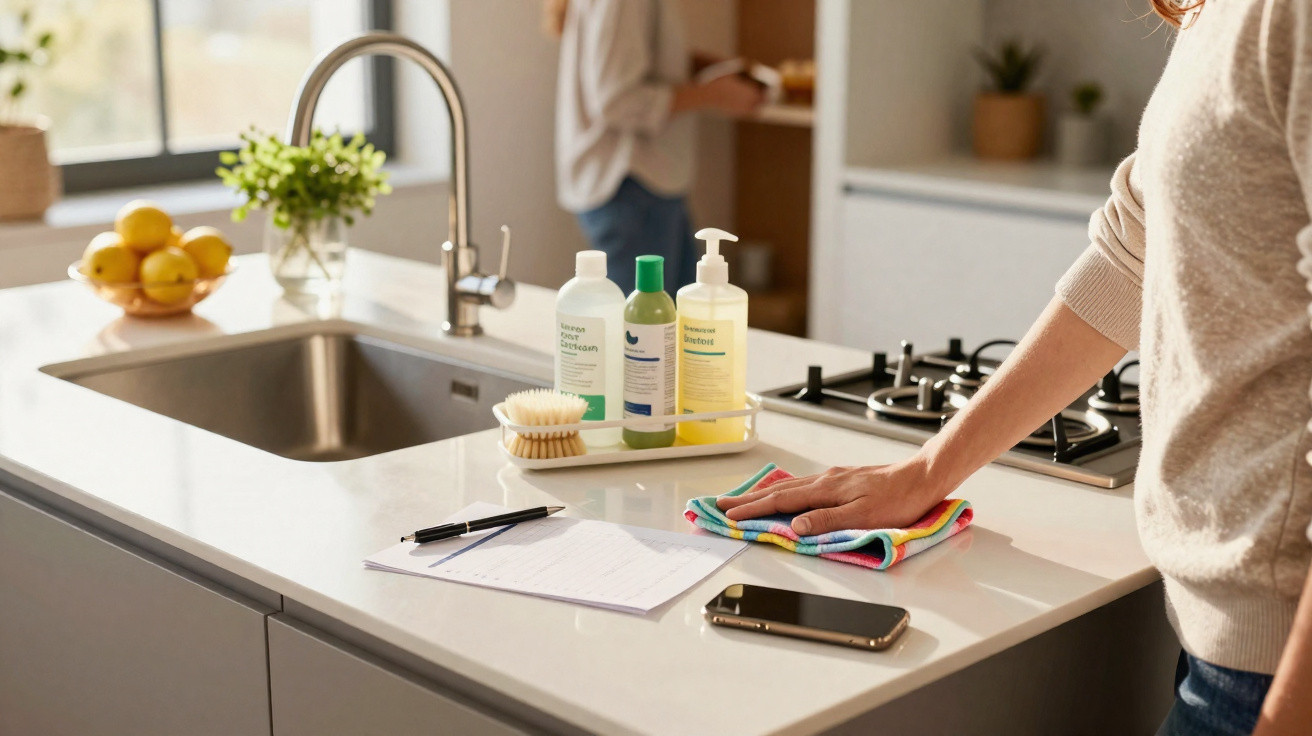
You do not need to spend all day scrubbing or hope for a miracle: you need a straightforward plan that delivers quickly and looks genuinely professional. This is the 90-minute (or less) kitchen reset that hosts rely on when guests are nearly at the door.
The first time I saw a cleaner tackle a kitchen this way, it felt like watching a magic trick unfold in slow motion. A caddy landed on the worktop, a tea towel was thrown over one shoulder, and a timer flashed like a tiny personal trainer. There was an organised approach to the mess that I had not realised was possible under pressure: every move was purposeful, working from top to bottom, left to right, and around the room in a zigzag that still seemed remarkably relaxed. Steam from the kettle lingered in the room, garlic sat on the hob, and fingerprints marked every glossy surface. Yet, in less than an hour, the kitchen went from “busy week” to “come in, we’ve been expecting you” - without an overpowering bleach smell or a frantic atmosphere. Crumbs disappeared, grease lost its sheen, the sink became reflective, and the entire room seemed to breathe out. Ready to make the change?
The countdown mindset that changes everything
Professionals do not begin by attacking individual marks; they first bring the room back to neutral. Start with a speedy declutter, move on to dry dusting, then degreasing, and finally the detail work. Clean from top to bottom. Begin with ceiling corners and light fittings, then open shelves, cupboard fronts, worktops, the hob and sink, leaving the floor until last. A basic kitchen timer breaks the task into manageable sections, and that sense of urgency helps you keep going instead of over-focusing on minor details.
Treat it as triage rather than a quest for perfection. When my neighbours messaged to say they were “15 minutes away”, I used a shortened version: 5 minutes for the bin and clearing surfaces, 3 minutes for dry dusting and light fittings, 7 minutes to wipe and degrease high-touch areas, 4 minutes to polish the sink, and 3 minutes for a quick sweep of the floor. When they arrived, they said, “Smells fresh.” The 80/20 rule is reliable in a kitchen: most of what visitors notice is in the upper layer of visible surfaces and the overall scent.
This sequence succeeds because grease drops, dust floats, and liquid carries dirt downwards. Wiping with water too soon creates a paste that takes far longer to remove. Microfibre traps particles without spreading them around, allowing spray time to loosen dirt that would otherwise need elbow grease, while the final polish makes metal and glass streak-free. The order of the tasks, rather than force, multiplies your results.
The 90-minute kitchen reset: steps and exact tools
Pack a compact caddy so you only need to travel around the kitchen once rather than six times. Include two microfibre cloths - one for dirt and one for polishing - a non-scratch scrub sponge such as Scrub Daddy or similar, a blade scraper for marks on a glass hob, fine baking soda, a cream cleaner such as Bar Keepers Friend, a plant-based degreaser that cuts through oil such as Dawn Powerwash or diluted washing-up liquid in a foaming bottle, glass cleaner or a 1:1 vinegar-and-water mix for non-stone surfaces, stainless-steel spray such as Weiman or a drop of oil, plus a compact broom or cordless vacuum. Leave products to sit. That contact time is the helper you do not see.
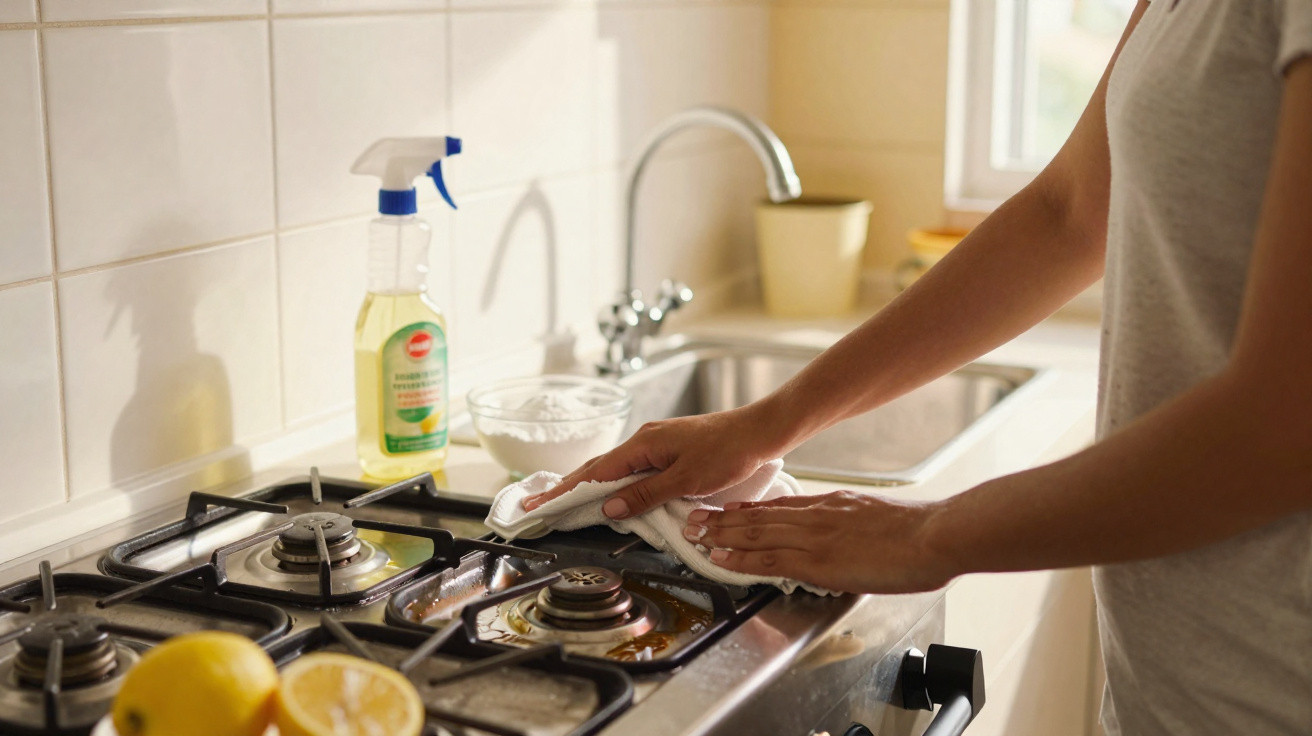
Begin with immediate improvements: empty the bins, load the dishwasher or stack dishes neatly to one side, and clear the worktops. Next, dry-dust from high to low with a clean microfibre cloth, including pendant lights and the upper edge of the extractor hood. Lightly apply degreaser to the hob and allow it to work while you clean cupboard handles and appliance fronts. Return to the hob, remove dirt with the scrub sponge using straight strokes, lift hardened marks with the blade, and buff with a clean cloth that is only slightly damp. We have all faced a sink that appears beyond saving; fill it with hot water, add a squeeze of washing-up liquid, and soak the racks and grates as you wipe other areas. Honestly, no one does this every day.
A shine is what makes a kitchen look “clean”, so reserve the finishing details for last. Apply a little cream cleaner or baking-soda paste to the tap and sink, scrub using the soft side of the sponge, then buff with a dry microfibre cloth until mirror-like. Give glass and the splashback a light spray and wipe in a Z pattern, repeating if necessary. On stainless steel, wipe in the direction of the grain, then use a pea-sized drop of oil on a cloth to restore a showroom-style shine.
“You’re not polishing for Instagram; you’re removing the last 10% that tricks the eye into seeing 100%,” says Maya R., a pro cleaner who’s done 1,000+ kitchens.
- Fast kit: two microfibres, non-scratch sponge, degreaser, cream cleanser, glass cleaner, stainless-steel spray or oil, blade scraper.
- Order: declutter, dry-dust, degrease, detail, floors last.
- Time-savers: dwell time, straight-line wipes, one clean cloth for polish only.
Finishing touches guests actually notice
The final 10 minutes establish the atmosphere. Open a window for two minutes, close it again, then simmer a slice of lemon in a small amount of water. Alternatively, mist a neutral fabric spray into the room rather than onto surfaces. Replace the tea towel with a clean one, fold it once, and hang it somewhere visible. Set a small plant or bowl of limes on the worktop you have just cleared; it looks deliberate without feeling staged.
The floor is your final flourish. Quickly dry-sweep or use a cordless vacuum, reaching beneath the kickboards with a narrow attachment, then make one damp-mop pass across the visible route through the room. Do not try to reach every last corner. Guests notice the first three metres they walk through, not the far-left area beneath the stand mixer. For a hotel-style detail, pull the bin three centimetres forwards and line up the breadboard with the worktop edge; visual alignment appears tidy immediately.
Sound and lighting influence a room just as much as its smell. Run the extractor on low for a minute to remove lingering odours, lower one light source, and switch on a warm lamp if you have one. Take one breath before answering the door. Small, human touches work better than perfection every time, and people judge kitchens as much by how they feel as by their finish.
Having a repeatable rhythm creates a particular sense of calm - not merely having a tidy kitchen. A plan allows you to stop when the timer finishes, which is half the challenge when you are both cooking and hosting. If a friend arrived right now, they would see a kitchen that feels lived in and loved rather than chaotic. You may even find that you enjoy spending time in it yourself.
| Key point | Detail | Benefit for the reader |
|---|---|---|
| Work top-down | Dust and wipe in one direction, from lights down to floors | Avoids cleaning the same area twice and saves minutes you cannot spare |
| Use dwell time | Spray a product, then clean another area while it loosens grime | Requires less scrubbing and produces better results for the same effort |
| Shine last | Polish the sink, taps and glass during a final pass | Creates the “spotless” appearance guests notice first |
FAQ
What products are safe on stone worktops? Avoid vinegar, lemon and any acidic product on marble or certain granites. Choose a pH-neutral stone cleaner, or mild washing-up liquid and water, then dry straight away to prevent water marks.
How do I adapt this if I only have 20 minutes? Use the express version: clear and empty the bin (4 min), dry-dust visible sightlines (3 min), wipe handles and worktops (6 min), quickly shine the sink (4 min), then sweep the walkway (3 min). Leave everything else.
What’s the best way to tackle burnt-on hob spots? Allow degreaser to sit for 3–5 minutes, then use a blade scraper at a shallow angle on glass hobs. For enamel, sprinkle baking soda over a damp sponge. Rinse and buff, and do not use steel wool on stainless steel.
Can I do this with natural products only? Yes. Use hot water and washing-up liquid as a degreaser, baking soda as a mild abrasive, and a 1:1 vinegar-and-water solution for glass and tiles, but not stone. A drop of olive oil or mineral oil can finish stainless steel.
How do I deal with kitchen odours fast? Briefly open a window, wipe the sink and drain, then simmer water with lemon peel or a cinnamon stick for five minutes. If odours persist, an enzyme drain cleaner left overnight can help.

Comments
No comments yet. Be the first to comment!
Leave a Comment