
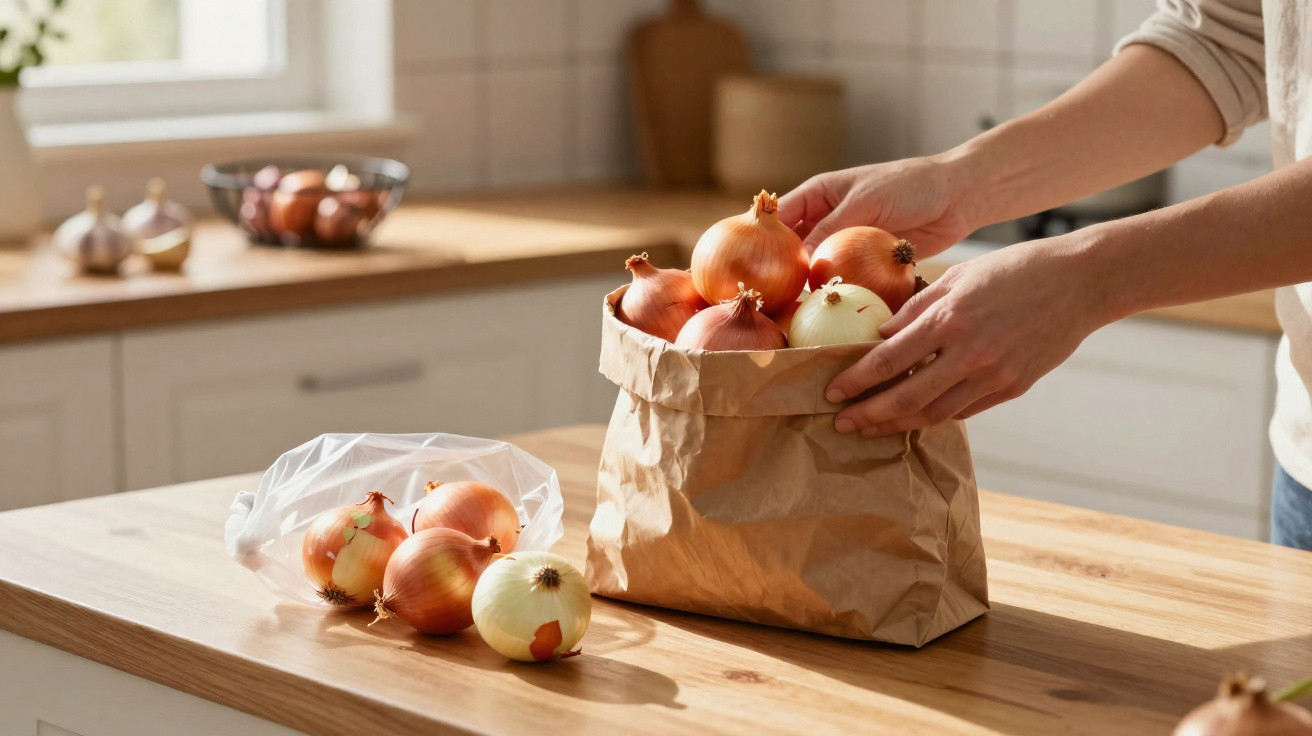
The plastic bag gave a depressing rustle as Emma opened the pantry.
The onions that had looked so promising the previous week were now soft, blotchy and giving off the faintly sour odour that says, “You waited too long.” She sighed, lifted one out and saw its papery skin sticking to the damp flesh beneath, like a raincoat that had stopped doing its job.
They had not been cheap onions. She had expected them to last the month. Instead, the plastic had held in everything: humidity, condensation and the bulbs’ own slow respiration. Left at the back of a dark shelf, they had little hope of surviving.
Later that day, Emma opened a drawer at her neighbour’s house and spotted something unusual: loose onions, each placed in a simple brown paper bag with a few holes punched through it. There was no condensation and no smell, only dry, firm bulbs waiting to be used. Her neighbour shrugged and said, “They keep longer this way. And there’s another perk nobody talks about.”
Emma could not stop thinking about that remark.
Why a paper bag makes all the difference for your onions
Look at the way onions are displayed in any supermarket: in open crates, mesh sacks or loose heaps exposed to the air. Then consider what many of us do after bringing them home. We put them in plastic, push them into the fridge or leave them forgotten in an airless drawer. The contrast is almost amusing.
Onions are still living organisms, even when they appear dry and dormant. They continue to respire, releasing moisture and minute amounts of gas. Plastic traps this little environment in much the same way as a greenhouse. A basic paper bag does the reverse: it allows the onion to breathe without making it dry out too quickly.
That modest move from sealed storage to breathable storage can dramatically affect how long onions remain firm, sweet and useful.
A story from a small town often circulates among zero-waste enthusiasts. One family decided to avoid food waste for a month, recording every item that spoiled. Leafy greens and berries were high on the list, as were onions. The onions were not there because they naturally spoil fast, but because they had been stored poorly week after week.
Once the family changed to paper bags marked with the purchase date, they noticed an unexpected result. Their onion waste nearly vanished. They could buy larger amounts when prices were low and still use the whole bag before any bulbs became mushy.
One family member said it was like finding money in an old coat pocket: the same food budget and ingredients, but suddenly there were more meals, more stews and more quick omelettes on late evenings. It was a small, quiet pantry triumph.
The reasoning is straightforward, almost too simple. Plastic retains moisture. As onions age, they naturally give off water vapour and a little gas. In a plastic bag, this becomes condensation that dampens the outer layers. That moisture encourages mould and speeds up decay.
A paper bag, particularly an unbleached brown one, gently takes in excess moisture. It also permits enough air circulation to keep each bulb dry, while shielding it from strong light that encourages sprouting. For an onion, it is rather like leaving a hot, crowded room for a quiet, cool corridor.
The outcome is slower deterioration, fewer soft patches and flavours that stay cleaner and sharper for longer. Rather than racing against time, your onions can take things slowly.
How to store onions in paper bags and make the habit stick
The technique could hardly be easier. Take an ordinary paper bag, such as one from a bakery or supermarket, and make several small holes with a pen, fork or hole punch. There is no need for anything elaborate; the aim is simply to allow air to move gently in and out.
Put a small number of onions inside, preferably without packing them tightly together, fold the top over loosely and keep the bag somewhere cool, dry and dark. A pantry shelf, a low cupboard away from the oven or a ventilated drawer are all suitable. No costly containers or complicated arrangement is required.
If you want a little more organisation, use one bag for older onions and another for newly bought ones, noting the date on the front. It takes 10 seconds and can prevent you from finding a forgotten, collapsed bulb three weeks later.
Most people do not struggle with food storage because they do not know what to do. Life simply gets in the way. You arrive home exhausted, put the shopping wherever there is room and tell yourself you will “sort it later.” Let’s be honest: nobody really does that every day.
That is why any useful storage tip needs to involve almost no effort. Paper bags succeed because they are forgiving and easy to use. If your holes are not perfectly placed, the bag still helps. If it becomes creased or slightly torn, it remains useful. You do not need an immaculate pantry to see genuine results.
Avoid a few familiar errors: do not store onions alongside potatoes, as they cause one another to spoil more quickly; keep bags away from the dishwasher and oven, where conditions are too warm and damp; and do not cram 10 kg of onions into one enormous bag. More bags and less crowding are better. In return, the onions will quietly last longer.
There is also a subtle emotional benefit to this uncomplicated change. Opening a dry paper bag and finding firm, usable onions weeks later can alter how you feel about your kitchen. You feel slightly more in control and more intentional. On a busy weekday, that can matter more than we tend to admit.
“The first time I stopped throwing away slimy onions, I realised I wasn’t just saving food. I was saving the energy it took to plan, shop, cook – and then feel guilty when things rotted in the dark,” confessed a home cook from Manchester who switched to paper bags during lockdown.
We have all had that experience of pulling out a spoiled onion and feeling a strangely disproportionate surge of irritation. It is seldom about the few pence lost. More often, it is the sense that your home is slightly out of step with your intentions.
- Paper bags will not solve every problem, but they can reduce those “I forgot this and now it’s trash” moments.
- They also reduce plastic use, which brings a quiet sense of satisfaction whenever you unpack the shopping.
- Above all, they can turn a disorganised pantry into a space that supports you rather than working against you.
The unexpected benefit of storing onions in paper bags
Here is the unexpected part: the greatest advantage of paper bags is not simply that onions last longer. Their flavour and texture also remain more consistent over time. An onion that has gradually sweated inside plastic can taste dull, faintly sour and almost watered down once cooked.
An onion kept cool and dry in paper retains its crispness. When sliced, its layers pull apart neatly, its juice stings your eyes a little and its aroma stays bright. Sauces caramelise more effectively, stir-fries release less steam and roasted onions become richer, sweeter and more complex.
You are doing more than preserving onions; you are preserving the flavour of every dish they go into.
There is another understated advantage. People who change to paper bags often say they cook more on impulse. When onions are reliably ready to use, rather than half-rotten or sprouting excessively, it becomes easier to make a quick soup, a last-minute curry or a tray of roasted vegetables.
Cooking begins to seem less like a task and more like a set of tools that is always available. The temptation to think “I’ll just order something” becomes a little easier to resist. Over the course of weeks and months, this small routine can influence how you eat, what you spend and how you feel in your own kitchen.
It is a minor adjustment with a wider effect, rather like shifting a piece of furniture and suddenly realising the whole room feels different.
You may read this and think, “It’s just onions.” On one level, that is true. But the small ways we handle ordinary things reveal much about how we live. Choosing a paper bag over plastic is not a revolution; it is a gentle prompt.
It is a prompt away from waste, disappointment at the back of the cupboard and the familiar guilt of putting food in the bin. It is a prompt towards a pantry that feels calmer, more deliberate and almost as if it is working in your favour.
The next time you unpack the shopping and reach for that crumpled plastic bag, you may pause briefly and choose paper instead. That tiny choice could mean fewer unpleasant surprises, better flavours and a kitchen that quietly supports the life you are trying to create, one humble onion at a time.
| Key point | Detail | Benefit for the reader |
|---|---|---|
| Gentle ventilation | The holes in the paper bag allow the onion to breathe without condensation building up | Onions stay firm for longer and are less likely to rot in hidden corners |
| Moisture control | Paper absorbs excess moisture rather than trapping it as plastic does | Better texture, fewer slimy layers and more dependable ingredients for last-minute meals |
| Everyday impact | A simple arrangement: date the bags, keep them separate from potatoes and store them somewhere cool and dark | Less waste, more flavour and a kitchen that feels calmer and easier to manage |
FAQ
- Can I store onions in the fridge if they’re in a paper bag? Whole, unpeeled onions are best kept in a cool, dry cupboard rather than the fridge. Refrigerators are too humid and can make them soften more quickly.
- How many holes should I make in the paper bag? Several small holes on each side will do. Aim for 6–10 small punctures, not a sieve. You only need gentle airflow.
- Can I mix onions and potatoes in the same paper bag? It is best to store them separately. Potatoes release moisture and gases that cause onions to sprout and spoil sooner.
- How long will onions last in a paper bag? In a cool, dark and well-ventilated place, good-quality onions can last several weeks and sometimes up to a couple of months.
- Do I need special food-grade paper bags? No. Any clean, dry and unscented paper bag is suitable, including plain supermarket or bakery bags without a plastic lining.

Comments
No comments yet. Be the first to comment!
Leave a Comment