
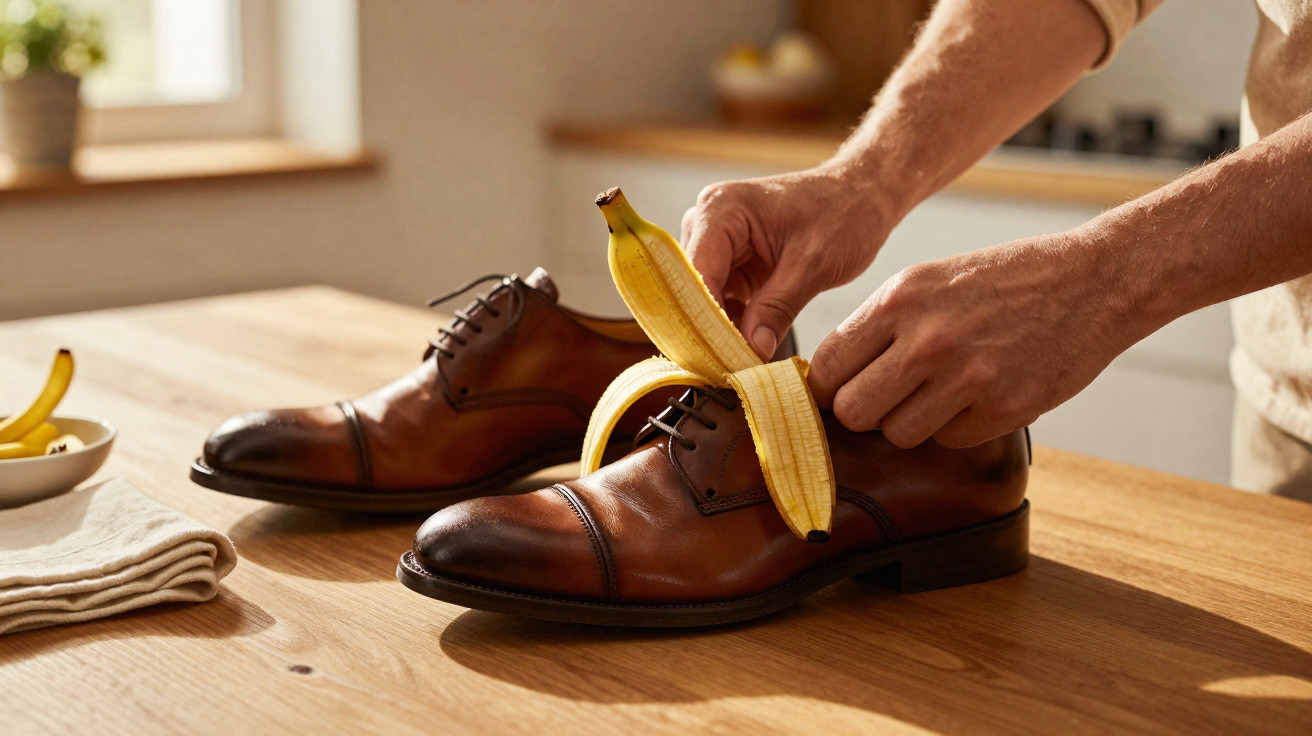
Scuffed toes, lacklustre sides and that weary, “I’ve seen some things” appearance that is hard to disguise. On a cramped kitchen table, there was no premium polish or gentle brush - only a breakfast banana, half peeled, and a hazy recollection of an odd tip spotted online late at night.
That was enough to start the test. The inner side of the peel was cautiously swept across the right shoe, first around the toe and then along the side. At first, the leather became slightly darker; then it began to catch the light again, as though several months of neglect had been quietly lifted away. The left shoe received the same treatment, with rather more confidence.
Five minutes on, the shoes were not as-good-as-new, but they looked revived. They seemed cleaner, fuller in colour and almost rather pleased with themselves. The peel was thrown into the bin, the shoes went to the meeting, and no one suspected the secret.
Why using a banana peel on leather makes surprising sense
The shine is not the first thing you notice when a banana peel touches leather. Instead, it is the unexpectedly soft, gentle nature of the process. The moist inner surface moves across the shoe like an unhurried sponge, leaving a fine oily layer that gradually settles into the material.
You can almost see the leather absorb it. Dry creases at the sides appear less severe, while a toe that looked flat moments earlier begins to reflect light as you move your foot. There is something strangely satisfying, even meditative, about turning an item destined for the bin into an instant shoe-care solution.
There is also a quiet, slightly childish delight in using something that seems completely “wrong” and discovering that it works remarkably well.
Picture a shared flat on a Sunday morning. One housemate is making banana bread, while another is urgently searching for something remotely presentable for a last-minute job interview. Their only respectable leather shoes are in the corner, dusty and marked from the previous winter.
There is no polish in the cupboard and no brush to use - only a half-eaten banana on the worktop. Somebody laughs and says: “Use the peel, it works, I swear.” At that level of desperation, almost anything is worth trying. After a few soft strokes, the leather looks smoother and deeper in colour, less like a neglected possession and more like a deliberate part of an outfit.
The interview candidate leaves feeling a little more composed. The shoes have not magically become new, but they no longer announce: “I got dressed in five minutes and gave up halfway.”
There is no magic behind this modest transformation; it is kitchen chemistry in disguise. Banana peels contain natural oils, starch and small traces of potassium, all of which interact surprisingly well with leather. The oils help to condition the surface and create a softer appearance, while the peel’s mild fibrous abrasiveness can lift some surface dirt from the grain.
Starch works as a very light polish, smoothing over tiny flaws and helping the leather bounce back light more evenly. With proper buffing using a clean cloth, the result is a shine rather than a greasy residue. What you’re really doing is feeding the leather with a kind of homemade, ultra-light conditioner.
It cannot match conventional products for strength or durability, but it is oddly effective as a rapid fix.
How to clean and shine leather shoes with a banana peel
This may look like a TikTok stunt, but it works best if you approach it as a genuine shoe-care routine. Begin with shoes that are dry and at room temperature. Remove loose debris by knocking the soles together or gently wiping them with a dry cloth. You do not want to combine mud with banana.
Choose a ripe banana that is neither green nor excessively brown. Eat the fruit or set it aside, then tear or cut the peel into easy-to-handle sections. Rub the inner surface over the leather in small circles. Start with scuffed or dried-looking sections, before covering the rest of the shoe to keep the finish even.
Do not saturate the shoe. The aim is a light, consistent coating, as if you were gently painting moisture and oil onto the leather.
After using the peel, the shoe may look a little streaky or cloudy. This is the point at which some people worry that they have ruined it. Do not panic. Take a clean, soft cloth - an old cotton T-shirt is ideal - and buff in soft circular movements.
Section by section, the dull banana layer lifts away and leaves behind a more even, understated shine. This is the stage that makes the method work. Miss it out and your shoes will simply appear sticky and strange, making the whole trick seem like an unfortunate life hack.
Let’s be honest: nobody really does this every day. Still, as an occasional rescue measure during a chaotic morning or in a hotel room before a meeting, it is reassuringly useful. It encourages you to see the kitchen as an emergency kit rather than merely somewhere for leftovers.
A few familiar mistakes crop up time and again. People use a blackened, mushy banana and rub it directly onto pale leather. Others fail to remove dust and grit first, effectively making an abrasive banana paste. Some skip buffing altogether, then complain that the shoe “feels sticky”.
Perfection is unnecessary; a little patience and care are enough. Pick bananas that are ripe but not collapsing. Keep the method away from suede and nubuck, which dislike moisture and can become patchy. If the leather is fragile or very light, test a concealed area first. Never soak the seams or stitching either - a gentle pass is sufficient to refresh the colour.
When it succeeds, it can feel like a small, private win against planned obsolescence and costly routines that we rarely keep up. On an exhausting weekday, this no-pressure technique can resemble self-care in disguise.
“I started doing it in hotel rooms before events,” confides a stylist I met backstage at a menswear show. “Room service coffee, a banana from the buffet, and suddenly the shoes look like someone loved them.”
There is something faintly rebellious about turning food waste into a care product. It invites you to reconsider what normally goes straight into the bin, as well as the drawer filled with half-used tins and bottles.
- Use only the inside of the peel - it is the white, moist surface that works, rather than the glossy outer skin.
- Buff thoroughly afterwards - this is when the shine develops and any residue is removed.
- Treat it as a backup technique - it is not a complete substitute for deep cleaning, recolouring or waterproofing.
What this small banana peel trick reveals about caring for possessions
After trying it a few times, shining shoes with a banana peel feels less like a gimmick and more like a modest philosophy. You start to notice how many belongings are “almost fine” but could benefit from a little attention: a bag improved by a quick wipe, a jacket missing one button, or a belt beginning to crack.
Choosing a peel instead of a product makes you improvise. It is a reminder that maintenance does not always mean a trip to the shops or a lengthy task list. Sometimes, it simply means looking at what is already available and thinking: this will do for today. That small act of care can change how you leave the house.
At a deeper level, it challenges how we think about waste. A strip of banana peel that would normally be discarded without thought is given another purpose. It will not solve the climate crisis, of course, but it brings a little intention to an everyday action. You feel marginally less like a consumer and slightly more like someone who can make do.
We have all caught our reflection in a shop window and realised that our shoes look oddly worn out, as though they belong to someone who stopped trying midway through the day. When that happens at home next time, the answer may not be hidden in a cupboard full of barely used products. It could be waiting in the fruit bowl.
And perhaps the next person scrolling on their phone, wondering why their leather boots always appear dull, will come across this peculiar tip and share it. That is how these little rituals spread - from kitchen tables to office corridors, from crowded trains to wedding dance floors.
| Key point | Detail | Benefit for the reader |
|---|---|---|
| Banana peel as a natural polish | Uses the peel’s oils and starch to clean and brighten leather | Provides a free, accessible option when shoe polish is unavailable |
| Straightforward step-by-step method | Rub with the peel, then buff carefully using a soft cloth | Offers a quick, practical way to revive dull shoes at home or while travelling |
| Limits and best practice | Suitable only for smooth leather, in light layers, and not a replacement for deep care | Helps prevent damage or disappointment while setting realistic expectations |
FAQ:
- Can I use a banana peel on all types of leather shoes? Use it only on smooth, finished leather. Avoid suede, nubuck and highly delicate untreated leathers, as they do not respond well to moisture.
- Will my shoes smell like banana afterwards? No, provided you buff them properly. Any faint scent disappears once the peel residue has been removed and the leather has dried.
- How often can I polish with a banana peel? Use it now and then as a quick fix. For ongoing care, pair it with suitable cleaning, conditioning and, where required, professional products.
- Can this trick replace real shoe polish completely? It is better viewed as an emergency or minimalist alternative. Traditional polish still offers stronger protection, a more durable shine and colour renewal.
- Is it safe on light-coloured leather? Usually, yes, but always test it on a hidden spot first. Choose a ripe rather than overripe banana to reduce the chance of staining.
Comments
No comments yet. Be the first to comment!
Leave a Comment