
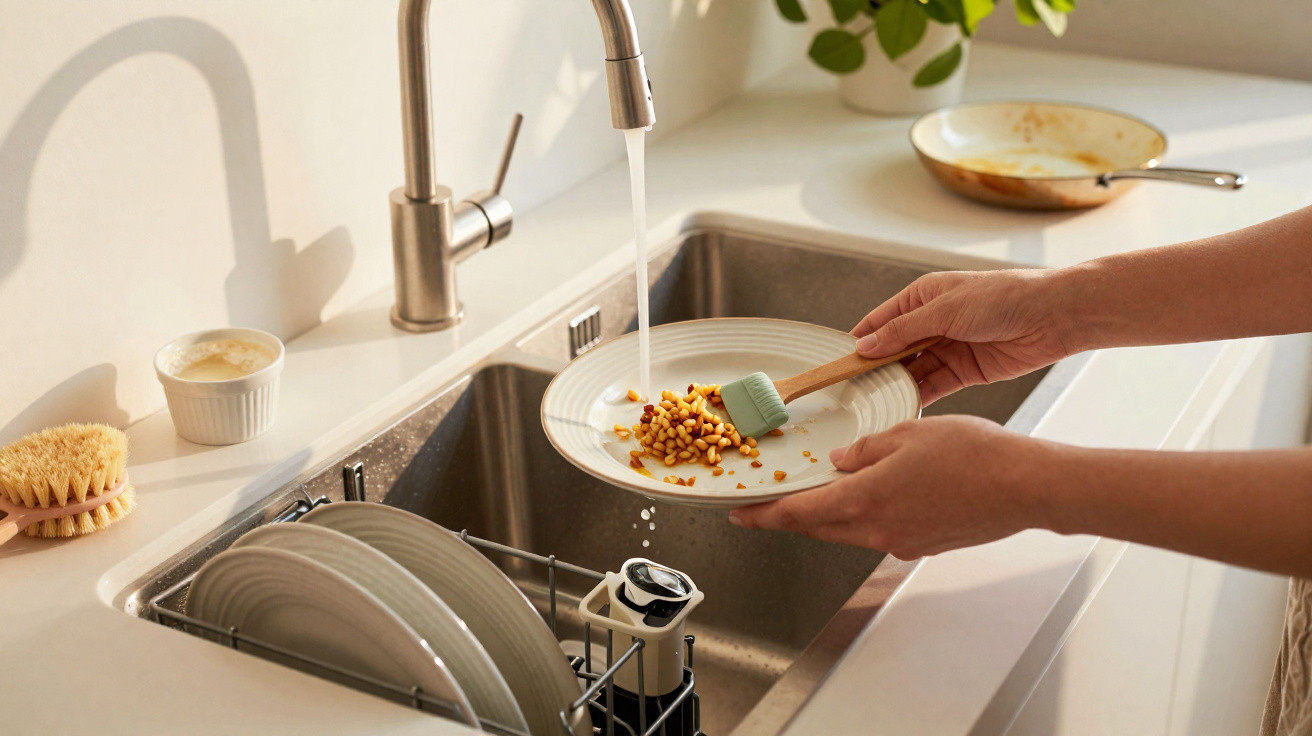
The tap is blasting, crockery is clanging in the sink, and someone is hurrying to “help” by removing every final smear of sauce before a plate enters the dishwasher.
The kitchen carries the mixed scent of tomatoes and washing-up liquid. Water lands on the floor, cutlery vanishes beneath frothy dishes, and amid the commotion comes the familiar claim: “You have to rinse them or they don’t get clean.”
It sounds sensible. It looks hygienic. Yet it is also almost completely mistaken.
Unnoticed in the corner, the machine is quietly assessing us. Not because our dishes are dirty, but because of what we do to them before we press Start.
Why rinsing “clean” plates can still leave poor results
Pre-rinsing has the appearance of proper effort: soaked cuffs, partly washed plates, and that small routine involving a sponge, tap and leftover food. It feels as though you are assisting the dishwasher, acting responsibly and not asking too much of the technology. The catch is that the more thoroughly you scrub and rinse, the less effectively your dishwasher can perform its own task.
Modern dishwashers are built to detect dirt. Quite literally.
They measure the cloudiness of the water, then tailor the programme by changing its duration, temperature and intensity. If the plates you load already appear immaculate, their sensors assume there is very little work to do. The cycle may become shorter and less intensive, leaving you to question why the glasses are dull after a wash that sounded costly.
In one suburban kitchen I visited, a couple disagreed over a lasagne dish. He removed the cheese scraps, placed it in the lower rack and left it there. She immediately took it out again, ran the tap and scrubbed until it looked almost unused. They selected a normal programme. By morning, the “pre-rinsed” plates had strange white streaks, while the visibly grubby dish was properly clean. They blamed the detergent brand, although the real problem was how they had “prepared” the load.
Manufacturers have noticed the pattern. Whirlpool once reported that around 70 % of people still rinse dishes beneath running water before loading them, while some wash them completely. This is not merely a waste of time and litres of hot water; it can directly disrupt the way the dishwasher selects a programme. It is rather like confusing a smart thermostat by repeatedly opening the windows: the technology cannot work properly when its own logic is constantly overridden.
The underlying science is straightforward, if not especially thrilling. Dishwashers depend on grease and food particles to activate detergent enzymes. Without residue, there is no effective chemical reaction. When dishes enter nearly spotless, the detergent has little meaningful material to work on. The result can be excessive suds, residue, cloudy glassware and odd odours. People then respond by rinsing even more, creating a loop of good intentions and disappointing results.
The correct way to “rinse” dishes - without actually rinsing
The essential rule is almost blunt: scrape, don’t rinse.
This is the approach favoured by professionals, engineers and, frankly, people who prefer less work but still want spotless dishes. Scrape the larger scraps from a plate into the bin or food-waste caddy, perhaps use a fork or the back of a knife to remove thick sauce, then stop. There is no need for a rushing tap, foam or a guilty 30-second scrub beneath very hot water. Leave behind a light layer of food: a small sauce smear, a streak of gravy or a trace of egg. That is precisely what the dishwasher is designed to deal with.
For stubborn dishes such as baked pasta, dried rice or crusted porridge, avoid the halfway-house of nearly washing them by hand. Give them a short soak instead. Ten minutes in warm water in a shallow tray or the sink is enough, with no fuss required. Then place them in the racks while they are still visibly dirty.
In practical terms, many rinsing errors are actually problems of timing. People worry that food will dry on, so they race against the clock under the tap. It is better to let the dishwasher tackle this with heat and water pressure. Arrange dishes with their dirtiest surfaces facing the spray arms rather than concealed behind rows of bowls. Do not bunch spoons together like flowers in a vase. Do not lay every item flat, where water simply deflects away. A dishwasher is not magic; water still needs a clear route to the surfaces you expect it to clean.
Psychologically, rinsing often comes down to control. Many of us grew up hearing warnings about “crusted” pans and “dried sauce you’ll never get off”. That is why people leave the tap running while carefully eliminating every mark. The trouble is that this old concern does not reflect what today’s machines are designed to manage. They are intended to strike dried food with hot water and targeted jets, not to delicately wash plates that are already clean. Scraping keeps odours under control without undermining performance. More often than not, rinsing is about reassuring our inner neat freak rather than improving the wash.
One engineer from a major appliance brand told me a line that stuck with me:
“When you pre-rinse, you’re paying twice – once in water and time, and again in poorer results.”
He was not exaggerating. Laboratory tests frequently indicate that avoiding the rinse can save dozens of litres in each cycle while improving detergent activation. That saves money, energy and irritation. We simply enjoy the sensation of “helping”.
There is also a degree of social judgement attached to dishwasher use. People may feel embarrassed if visitors see a machine filled with plates carrying dried sauce. They worry about seeming lazy or “dirty”. At its worst, the rinsing routine becomes a performance rather than a practical requirement. It is hygiene theatre at the kitchen sink.
When you want a simple guide before reaching for the tap, use this mental checklist:
- Large food scraps in the bin or food-waste caddy - yes.
- A thin film of food left on the dish - yes.
- Running water, vigorous scrubbing and foam everywhere - no.
- Soaking only dishes that resemble cement - sometimes.
- A detergent tablet and the appropriate programme - always.
What works in a dishwasher - and what to change tonight
One small change of habit makes the real difference: replace “clean before the machine” with “prepare for the machine”. In practice, this changes what your hands do at the sink. Pick up a spatula or fork for scraping rather than a sponge. Check plates for large lumps of food instead of admiring their shine before loading. Above all, stop feeling guilty about putting a plate with visible sauce straight into the rack. That guilt belongs to outdated technology.
A useful system adopted by many families is the “dirty corner” rule. Put used dishes on one side of the sink, scrape them quickly into the bin, then load them directly into the dishwasher. Avoid piling them in cold, greasy water or creating towers of half-rinsed crockery. The less time dishes spend in the uncertain space between eating and loading, the less likely you are to start half-washing them by hand.
On a human level, much of our rinsing comes from routine and a touch of anxiety. We have heard tales of dishwashers leaving spinach welded to forks or producing glasses with mysterious marks that guests will secretly notice. So we compensate too much. Let’s be honest: nobody does this every day with perfect discipline, not even those who insist that they do. Life is untidy. Sometimes dinner ends with a heap of plates pushed into the dishwasher at midnight and a shrug. And the world does not end because a plate enters with a streak of bolognese still on it.
The habits that commonly cause trouble are the ones that say, “I know better than the manual”: using half a tablet to save money, selecting eco mode for a disastrous load of baked cheese, or hand-washing glasses while trusting the dishwasher only with the easiest plates. Modern detergents and programmes are designed to work together on actual dirt. Remove one part of that arrangement and the outcome worsens. People then start rinsing more, convinced that the dishwasher itself is at fault.
As one home economist told me, almost apologetically:
“The machine isn’t the one doing it wrong. We are.”
It is slightly uncomfortable to hear. Nobody enjoys learning that their attempt to “help” is making things worse. But it is encouraging news too: you can genuinely do less and achieve a better result. That is an unusual promise in domestic life.
If you prefer a quick visual reminder, these are the changes that can make a practical difference tonight rather than in some idealised future:
- Stop fully rinsing: scrape, load and leave it there.
- Allow detergent to meet real food residue so its enzymes can function.
- Load intelligently: aim plates towards the spray, separate cutlery and put plastics on the top rack.
- Choose a suitable hot programme for genuinely dirty loads rather than the briefest option.
- Accept that dishes looking dirty when they go in is exactly how they emerge clean.
Let go of the tap - and the urge to “help” the dishwasher
Once you notice it, pre-rinsing seems to be audible everywhere: the anxious rush of water before a dinner party, the automatic routine in a friend’s kitchen of plate, tap, foam and scrub, despite a quiet stainless-steel box waiting just beside them. This soundtrack of wasted water is so familiar that we scarcely register it. Breaking the habit can feel faintly rebellious.
The next time you clear up after a meal, run a small experiment. Scrape only. Do not turn on the tap or attempt any heroics. Load the dishes while they still look disgraceful. Select a reasonably long programme, add a full detergent tablet and walk away. When you open the door later, pay attention to what truly happened rather than what you feared might happen. That modest space between fear and reality is where new habits begin.
On a calm evening, the dishwasher can become a slightly strange mirror. It shows what we believe about effort, cleanliness and control. Some of us overdo things because we learnt that effort equals virtue, even when the effort works against the very appliances we bought. Others would rather press Start sooner and do less, but feel criticised by an imaginary chorus of grandparents who never owned a dishwasher. Letting dirty plates enter the machine is a small act of trust: in technology, certainly, but also in the belief that not every problem requires extra labour.
We are unlikely to stop debating the “right” way to load a dishwasher any time soon. Couples will continue rearranging each other’s racks the moment the other person leaves the room. Friends will still insist that their personal rinsing ritual “just works better.” What may change is the quiet certainty of the person who leaves the tap alone, knowing that the dishwasher needs a little mess to produce that satisfying, steamy wave of clean. That is the person everyone else will quietly observe when the dishes start to pile up.
| Key point | Detail | Why it matters to the reader |
|---|---|---|
| Scrape, don’t rinse | Remove only large food scraps and leave a thin layer of residue | Less work at the sink and improved cleaning performance |
| Let the sensors work | Dirt tells the dishwasher how long and how hot it needs to wash | Cleaner dishes, with fewer streaks and cloudy glasses |
| The right programme for real dirt | Use a full detergent dose and suitable programmes for genuinely dirty loads | Saves water and energy while avoiding the need to wash again |
FAQ:
- Do I really not need to rinse plates at all? For most modern dishwashers, removing large pieces of food is sufficient. Leaving a light residue helps detergent enzymes work properly.
- What about dried-on food that has been sitting all day? If it has become rock hard, a brief soak in warm water is more effective than fully pre-washing it. Then load it dirty and use a normal or intensive programme.
- Won’t my dishwasher clog if I stop rinsing? Filters are made to trap food particles. Clean the filter routinely, and do not load bones, stones or large shells.
- Is pre-rinsing ever useful? Only in particular situations, such as severely burnt pans or dishes coated in very sugary sauces that may caramelise. Even then, think “quick loosen”, not “completely clean”.
- Why do instructions say to remove excess food? This refers to large scraps that might obstruct the filter or spray arms, not every remaining trace of sauce. A visible smear is fine; a mound of mashed potato is not.




Comments
No comments yet. Be the first to comment!
Leave a Comment