
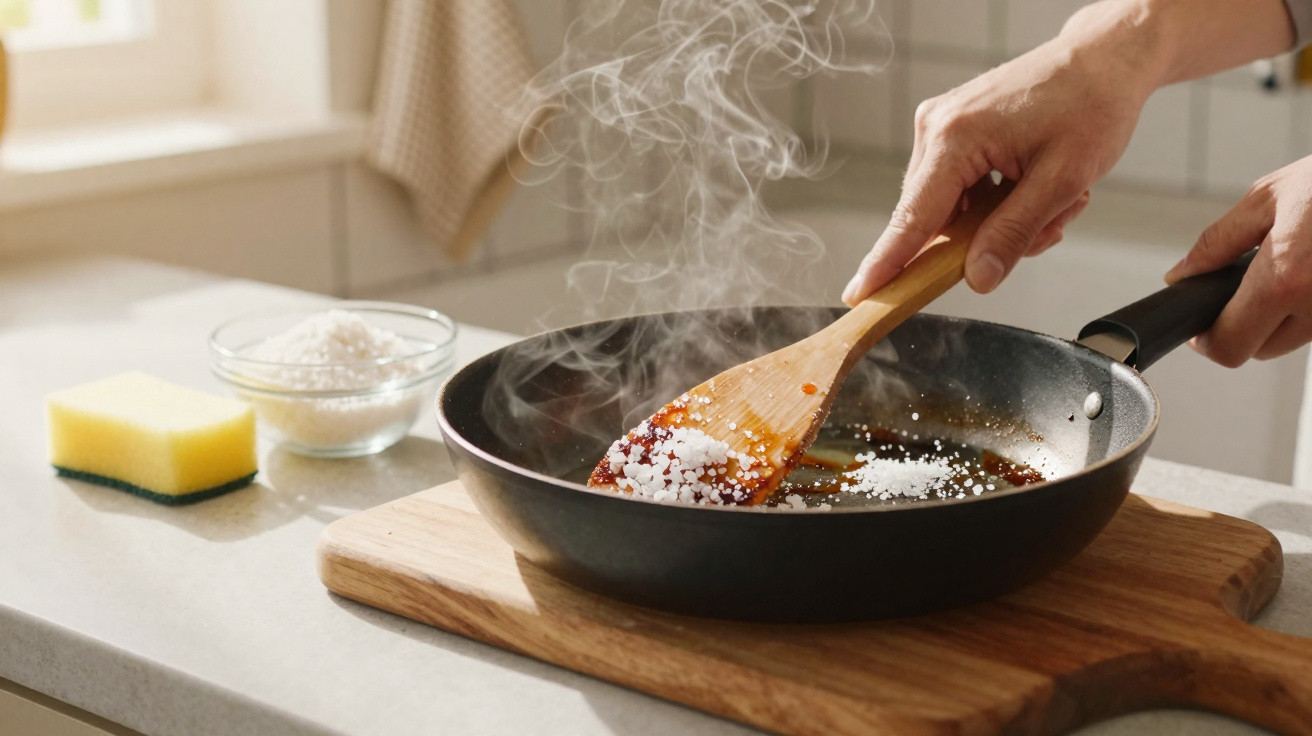
Sprinkle a little coarse salt over the grease in a hot frying pan: this tip has attracted attention in many kitchens, particularly among people looking to use less washing-up liquid and avoid scrubbing for ages. It relies on an inexpensive, everyday household ingredient to make burnt-on residue and built-up grease easier to remove, especially after heavier frying, while also helping to protect certain types of coating.
How does coarse salt work on grease in a hot frying pan?
When coarse salt is applied to grease that is still hot, its crystals soak up some of the oil while acting as a mild abrasive. Rubbing the surface with kitchen roll or a cloth creates friction between the salt and the pan, helping to lift crusted residue and food particles without much effort.
Unlike pouring cold water into a hot frying pan, salt does not create thermal shock and can reach the small areas where grease tends to collect. With cast-iron frying pans, this approach can also help maintain the seasoning layer, as it reduces the need for frequent washing-up liquid and thorough rinsing.
Watch a video on the Patricio Carvalho YouTube channel about quick kitchen tricks for cleaning greasy utensils with the absorbent power of dry ingredients:
https://www.youtube.com/watch?v=R9_mD-XN9U0
Which types of frying pan work best with coarse salt?
The coarse-salt trick is most effective on sturdier frying pans that cope well with heat and friction, including cast iron, stainless steel and thicker aluminium. On these materials, salt can help remove stubborn grime without damaging the metal’s structure or relying as heavily on abrasive scouring pads.
Non-stick frying pans require extra care, as salt may scratch the coating if it is rubbed too firmly or used repeatedly. For that reason, it is best reserved for more persistent dirt and should always be used with kitchen roll or a soft cloth, never with hard utensils.
- Most suitable: cast-iron, stainless-steel, thick aluminium and copper frying pans;
- Use in moderation: good-quality, well-maintained non-stick frying pans;
- Avoid: very thin, delicate surfaces or pans already damaged by deep scratches.
How to use coarse salt in a hot frying pan step by step
For the best outcome, it is important to pay attention to both the pan’s temperature and the way the salt is rubbed in. The surface should be hot, but not so hot that kitchen roll or a cloth would immediately burn during a quick touch.
Once the heat has been turned off, pour away the excess oil into a suitable container, leaving only a thin film of grease behind. Scatter 2 to 3 tablespoons of coarse salt over the surface, then rub it in using folded kitchen roll in circular motions, repeating if needed. Finally, discard the used salt and, if preferred, give the pan a quick wash with a small amount of warm water and washing-up liquid.
Why can coarse salt be better than a scouring pad and washing-up liquid?
Using coarse salt straight after cooking works while the grease is still warm and easier to loosen, cutting down the time spent scrubbing. It also reduces wear on scouring pads and the need for steel wool, which can scratch some materials.
A further benefit is that it saves water and washing-up liquid, since much of the grime is removed before the final wash. In kitchens where frying is frequent, keeping a container of coarse salt near the hob turns the method into a useful everyday “kitchen tip”, making cleaning quicker, more predictable and less tiring.

Comments
No comments yet. Be the first to comment!
Leave a Comment