
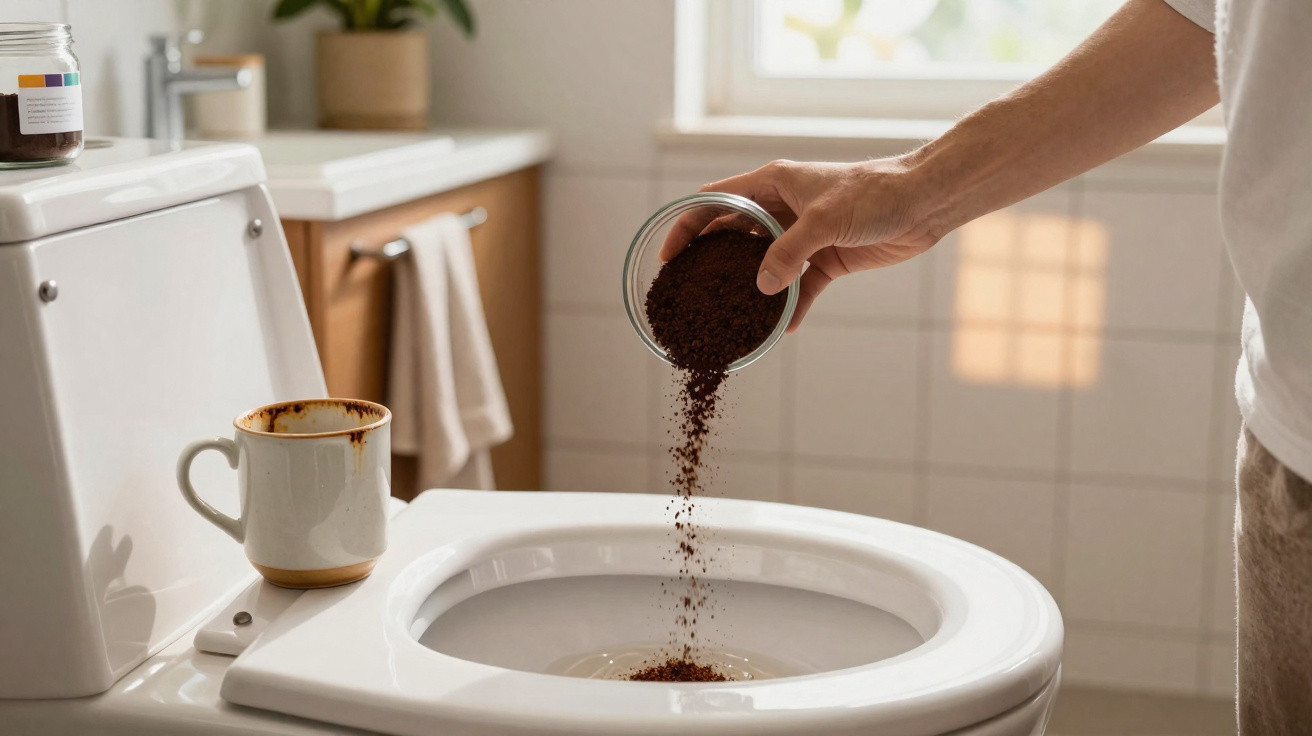
Who would have thought that the residue left in the coffee maker each morning could become a useful bathroom-cleaning aid? Coffee grounds in the toilet are among the household tips that have circulated most widely in recent months, attracting attention because they combine waste reuse, savings and practical day-to-day results.
What happens when you pour coffee grounds down the toilet
Coffee grounds consist of fine particles that do not dissolve fully in water but readily cling to the inner surfaces of pipework. This is precisely what makes them so appealing: they work as a mild abrasive, helping to lift light residue from the ceramic and the internal walls of pipes.
A second perceived advantage is odour neutralisation. The porous structure of ground coffee traps the molecules that cause unpleasant smells, acting as a natural deodoriser. This can leave the bathroom feeling fresher without the need for harsh chemical products.
- Gentle abrasion: ground coffee can lift superficial marks from the ceramic without scratching the toilet bowl's finish.
- Odour neutralisation: the grounds' porous structure captures bad-smell molecules from the pipework.
- Pipe cleaning: the particles can help loosen grease residue built up on pipe walls.
- Sustainable reuse: it turns household waste into a cleaning product, reducing kitchen rubbish.
- Monthly savings: it reduces how often industrial disinfectants and drain-unblocking products are used.
From the kitchen to the bathroom in under a minute
Using it is straightforward and requires no special preparation. Once you have made coffee, set the used grounds aside in a small container and allow them to cool completely. Then put one or two tablespoons straight into the toilet bowl, spread them around the inside with the brush, and leave them for several hours without flushing, ideally overnight.
In the morning, simply flush as usual. The whole process takes under two minutes and makes use of something that would otherwise go straight into the bin. For anyone seeking household cleaning with fewer chemicals and greater environmental awareness, it fits easily into the routine.
When coffee grounds in pipework become a problem: the overlooked risks
Despite the advantages, using coffee grounds in pipework calls for restraint. Unlike ordinary soap, the particles do not dissolve in water, and excessive amounts can collect in bends in the pipes, particularly where plumbing is old or water pressure is low.
What experts say about the trick
Moderation is essential to avoid creating a bigger problem.
Coloproctologist Danilo Munhóz warns that, from a medical perspective, a toilet should receive only faeces, urine and toilet paper. Regularly adding solid waste may contribute to build-up in the plumbing, increasing the risk of blockages and even sewage backflow, which can create an unhygienic environment.
According to plumbing specialists, the golden rule is never to exceed one or two tablespoons per use and to avoid doing it every day. If the grounds encounter grease or hair trapped in the pipes, they may form compact clumps that require the help of a professional plumber.
The general advice is to use coffee grounds in the toilet only once or twice a week. In newer plumbing with good water pressure, the risk of blockage is low when the recommended quantity is followed. However, anyone living in an older property should take extra care and choose alternative uses for the waste.
Other areas of the home that benefit from coffee grounds
Coffee grounds have uses well beyond the bathroom. In the fridge, a cup of dried grounds effectively absorbs strong odours from cheese, fish and leftovers. Rubbing them over your hands can remove lingering garlic and onion smells better than ordinary soap. Bins and shoe cupboards can also smell more neutral when a small bag of dried grounds is placed inside.
Those with a home vegetable patch can also use them as a natural fertiliser, as the grounds are rich in nitrogen and improve soil structure. These are safer options for people with older plumbing who would rather not take the risk, while still enjoying household reuse and its benefits.
Myth or fact? What science actually confirms
Research into reusing coffee grounds supports their potential as odour absorbers and mild abrasives on a range of surfaces. However, there are currently no specific scientific studies recommending that grounds be disposed of in the toilet to control odours. According to experts, the effect is more aesthetic and sensory than proven to be germicidal or hygienic.
That does not make the habit invalid, but it puts the trick in its proper place: an occasional aid for sustainable cleaning, rather than a miracle solution. When used in moderation, it can form part of a household routine without causing complications.
Ultimately, coffee grounds are one of those simple resources already found at home that few people would imagine using in this way. Applied sensibly, they can help keep the bathroom fresher, the plumbing clearer and kitchen waste slightly lower at the same time.
If this household trick surprised you, share it with someone else who also enjoys finding smart ways to make use of what they already have at home.
Comments
No comments yet. Be the first to comment!
Leave a Comment