
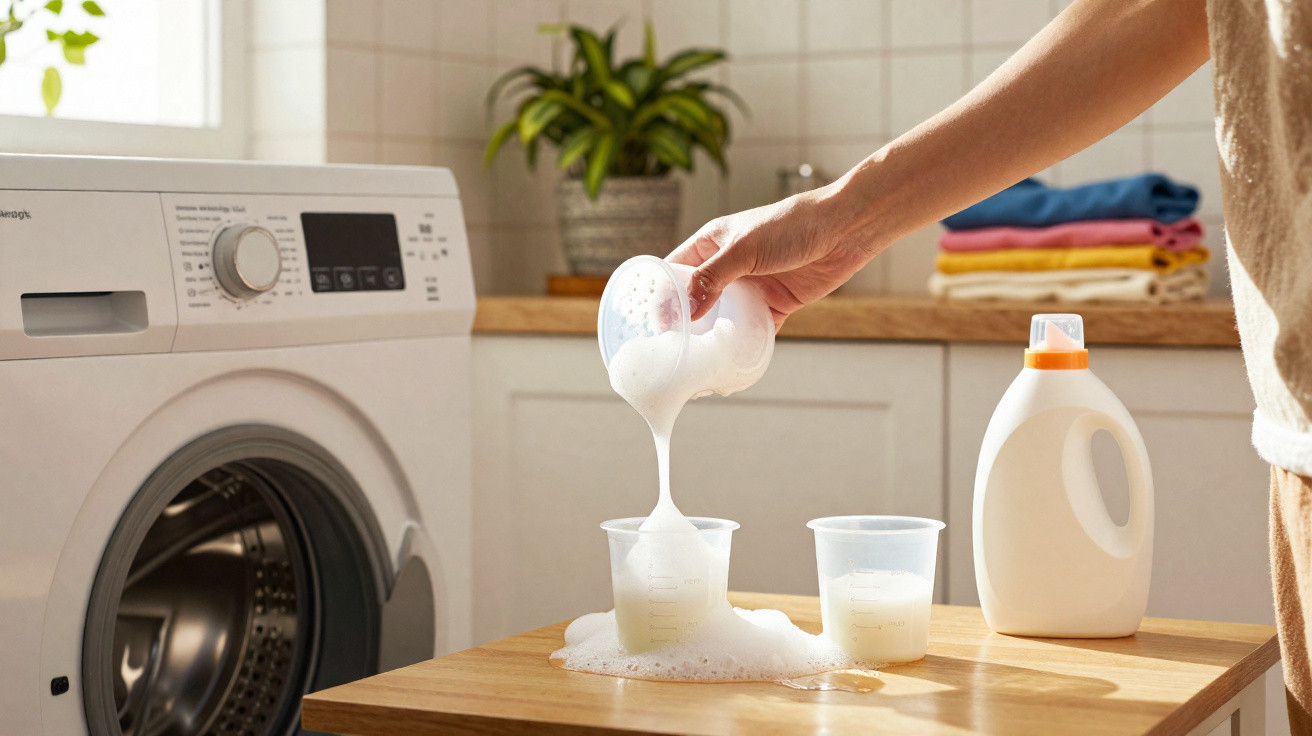
It is Saturday morning in the laundry room of an entirely ordinary block of flats. Three machines are running, a tumble dryer beeps somewhere, and among laundry baskets, scent boosters and XXL bottles of detergent, the room feels like a quiet stage for everyday life. One neighbour stands at her machine, opens the drawer and pours in the blue liquid “by feel” – a thick, glossy stream that slowly disappears. “Better to use a bit more, then it gets properly clean,” she murmurs without looking. Another neighbour puts two pods straight into the drum, “because the sports kit smells so musty”. Nobody reads the tiny dosage scale on the packaging. Nobody wonders what this extra portion is really doing inside the machine. Yet there is a nagging suspicion that will not simply wash away.
Why we like using too much detergent
Standing in front of the washing machine is rarely a rational moment. More often, we are tired, stressed and fed up with a pile of laundry that never seems to shrink. Our hand reaches for the bottle almost automatically, the cap becomes the measuring device, and a more generous splash than intended ends up in the drawer.
The belief is deeply ingrained: more detergent equals cleaner, fresher, “better” laundry. It is a little like cooking: if you like salt, it is tempting to add an extra pinch. With detergent, though, overdoing it has consequences that are not immediately visible. We see foam, smell “freshness” and briefly feel as though everything is under control.
A scene from a city launderette tells the story almost cartoonishly. A young mother with two huge IKEA bags full of children’s clothes nearly tips half a box of powder into the detergent compartment. The older woman beside her hesitates, then says: “You know you only need half of that, don’t you?” The mother laughs awkwardly and replies: “Honestly? I have no idea. I just always do it this way.” According to surveys, only a small proportion of consumers actually read the dosage guidance on the pack, let alone the water-hardness chart.
Many of us unconsciously copy how our parents or grandparents did the washing. Back then, dirt was more visible, washing machines were less efficient and stains were more stubborn. In that world, “an extra spoonful” was sometimes genuinely necessary. Today’s machines use precise sensors and highly concentrated detergents that work with far smaller quantities. Our instincts have remained in the past while the technology has long moved on. The result is that we pour nostalgia into a modern drum – then wonder why our towels turn grey.
What too much detergent really does to your laundry
Anyone who opens the washing-machine door immediately after a cycle will know the sight: a whitish film on the rubber seal, a sticky residue clinging to the detergent drawer and a faintly musty smell from the drum. This is where some of the excess detergent ends up when it cannot dissolve completely in the water. The machine rinses and rinses, yet some residue always remains.
The effect on laundry itself often becomes apparent only later. T-shirts gradually become stiffer, towels feel less absorbent and sportswear starts to smell sooner. What appears to be ageing fabric is often simply an invisible coating of surfactants, fragrances and bleaching agents. The fibres can no longer breathe properly, while skin residue and bacteria cling to them more easily. Paradoxically, we then use even more detergent next time.
Let us be honest: nobody gives their washing machine a thorough clean every week. That neglect combines perfectly with excessive detergent. Together, they create a habitat of moisture, residue and warmth in which bacteria and fungi thrive. Studies show that excessively foamy wash cycles can impair the machine’s mechanics, putting long-term strain on seals and bearings. Instead of rinsing freely, the motor has to work against a foamy resistance. So this is not merely “a little residue in the drum”, but gradual damage that often ends in an expensive engineer call-out.
How to use the right amount of detergent – without being a maths genius
The good news is that dosing like a professional is less complicated than the back of a detergent pack makes it seem. One surprisingly straightforward first step is to measure the detergent cap just once. Many caps hold considerably more than a standard load requires. Filling one to the brim almost automatically means overdosing.
A practical everyday trick is to use one fixed, small measuring aid, such as a tablespoon or an old yoghurt pot with a marked line. Begin with the manufacturer’s lower recommendation for lightly soiled laundry and medium water hardness. Then watch the next three or four washes: does the laundry smell neutrally fresh, do the fabrics look clean, and are there no visible traces of residue? If so, you are very close to your ideal amount.
Many people feel guilty about using “too little” detergent because they fear their laundry will not be hygienically clean. Here is an open secret: modern heavy-duty detergents are designed for the average case and tend to allow rather generous quantities to avoid complaints. If you live in a soft-water area or rarely wash heavily soiled workwear, you can manage with noticeably less. A classic mistake is confusing fragrance with cleanliness. A T-shirt without a strong perfume smell can still be clinically clean – our noses are simply accustomed to the artificial “freshness boost”.
“The cleanest laundry is laundry that smells of nothing – except air,” a textile cleaner who has washed workwear for 30 years once told me.
A few simple guidelines can help you maintain the balance day to day:
- Less foam is better: a light amount of foam in the door window is entirely sufficient.
- Check your water hardness: soft water needs noticeably less detergent.
- Do not overload the machine: leave space for three fingers at the top of the drum.
- Use delicates or sports detergent for sportswear, rather than increasing the dosage.
- Once a month, run an empty 60°C cycle with a little powder – not a fragrance extravaganza.
What changes when we wash with “enough” rather than “more”
At some point, many households have this unremarkable moment of realisation. They reduce the amount, perhaps reluctantly because detergent has become expensive or because they heard a tip. A few weeks later, they notice that towels absorb water better again. Black T-shirts look less washed out. The machine smells neutral. There is less of a guilty feeling when the next XXL bottle remains on the shop shelf.
This small everyday change has a quieter, deeper dimension. We take a step back from the automatic belief that “more” is always the answer. We start observing our own habits: how often do I actually wash, how tightly do I cram the drum, and what part do my desire for fragrance, control and “doing everything right” play? Suddenly, the washing machine represents more than housework; it becomes a kind of mini laboratory for our routines.
Then there is the environmental footprint we barely see, but contribute to with every capful of detergent. Surfactants, fragrances and bleaching agents reach rivers and lakes, even though wastewater treatment plants capture a great deal. Using less not only saves money but also reduces environmental impact, without requiring any major sacrifice. Perhaps in a few years we will tell ourselves new stories in front of the washing machine. No longer stories about fearing dirt, but about the calm confidence of doing exactly enough – no more and no less.
| Key point | Detail | Benefit for the reader |
|---|---|---|
| Too much detergent damages laundry and the washing machine | Residue in the drum and seals, coatings on fibres, odours developing more quickly | Avoids grey towels, musty clothes and costly repairs |
| Modern detergents are highly concentrated | Old habits meet new formulas, and dosage recommendations are often already generous | Saves real money per wash and extends the lifespan of textiles |
| Simple dosage tricks work in everyday life | Small measuring cup, starting at the lower limit, taking water hardness into account | Makes washing less stressful, clearer and more environmentally friendly |
FAQ:
- How can I tell that I am using too much detergent? Typical signs include greasy residue in the detergent drawer, a sickly-sweet, musty smell in the machine, strongly perfumed but “heavy” laundry, and clearly visible foam in the door window.
- Does more detergent make laundry more hygienically clean? No. Hygiene depends chiefly on the temperature, wash duration and the machine’s mechanical action. Too much detergent can even cause dirt and bacteria to remain trapped in residue.
- Is liquid or powder detergent better for avoiding overdosing? Both can work. Powder is usually slightly easier to measure precisely, while liquid detergent is often overdosed “by feel”. A clear measuring reference matters more than the format.
- Is a quick programme enough if I use less detergent? Yes, for lightly soiled everyday clothing. For towels, bed linen or heavily soiled washing, longer programmes and suitable temperatures are important, regardless of dosage.
- Do I need to clean my washing machine if I have overdosed for years? A thorough reset helps: run one or two empty 60°C or 90°C cycles with powder, clean the detergent drawer and seals, then consistently use less detergent. Many problems improve within just a few weeks.





Comments
No comments yet. Be the first to comment!
Leave a Comment