

The woman in the navy-blue coverall moves through the hotel lobby at a pace that nearly makes me dizzy. While I am still deciding whether I would clean the glass tabletop or the floor first, she has already done both - thoroughly. There is no frantic rushing and no theatrical fuss. Just a calm, almost relaxed routine. We all know that Saturday-morning moment of looking around the flat and thinking: this will take hours. When I say so, she simply laughs and briefly leans on her mop. “No,” she says. “You are simply cleaning the wrong way.” The remark sticks with me. Perhaps the time problem we have with cleaning is not about lazy excuses at all, but one straightforward, almost unremarkable piece of advice.
Professional cleaners’ most important advice: cleaning is a route, not a spontaneous trip
Watch professionals at work and one thing becomes obvious very quickly: they never begin just anywhere. They follow a set order every time, like a mental map for moving through each room. First the broad jobs, then the finer ones. Top to bottom. Dry tasks before wet ones. Nothing is left to chance. There is no, “Oh, I’ll quickly wipe this bit too.” For them, cleaning is a process, not a battle with mess. That alone saves an extraordinary amount of time. Every pause, every walk back to the kitchen for a cloth and every hunt for the glass cleaner costs minutes which, by the end, feel like an extra hour.
One cleaner who works in offices and holiday lets showed me her standard method: she always works her way around every room clockwise. Every single time. She opens the door, looks to the left, then systematically circles the room: wiping surfaces, picking up visible rubbish and roughly sorting items. No back and forth, no zigzagging. In an average three-room flat, she says this saves around 20 minutes on each visit. Add that up over a year, and many of us are literally spending days walking in circles. Instead, she has a plan so simple that it is almost annoying not to have thought of it yourself.
The reasoning behind it is remarkably matter-of-fact. Our brains use energy whenever we have to make decisions. “Where do I start? What should I do next? Have I finished the bathroom already?” This constant mini-conversation in our heads makes us tired and slows us down. Professionals remove those questions by sticking to a fixed route. They do not need to think; they simply follow their system. Let us be honest: nobody really does this every day. But anyone who establishes a basic route - always left to right, for instance, and room by room - removes the stress of making on-the-spot decisions while cleaning. That is when getting things clean suddenly starts to feel less daunting.
A small professional cleaner’s trick with a big impact: prepare as if packing a toolkit
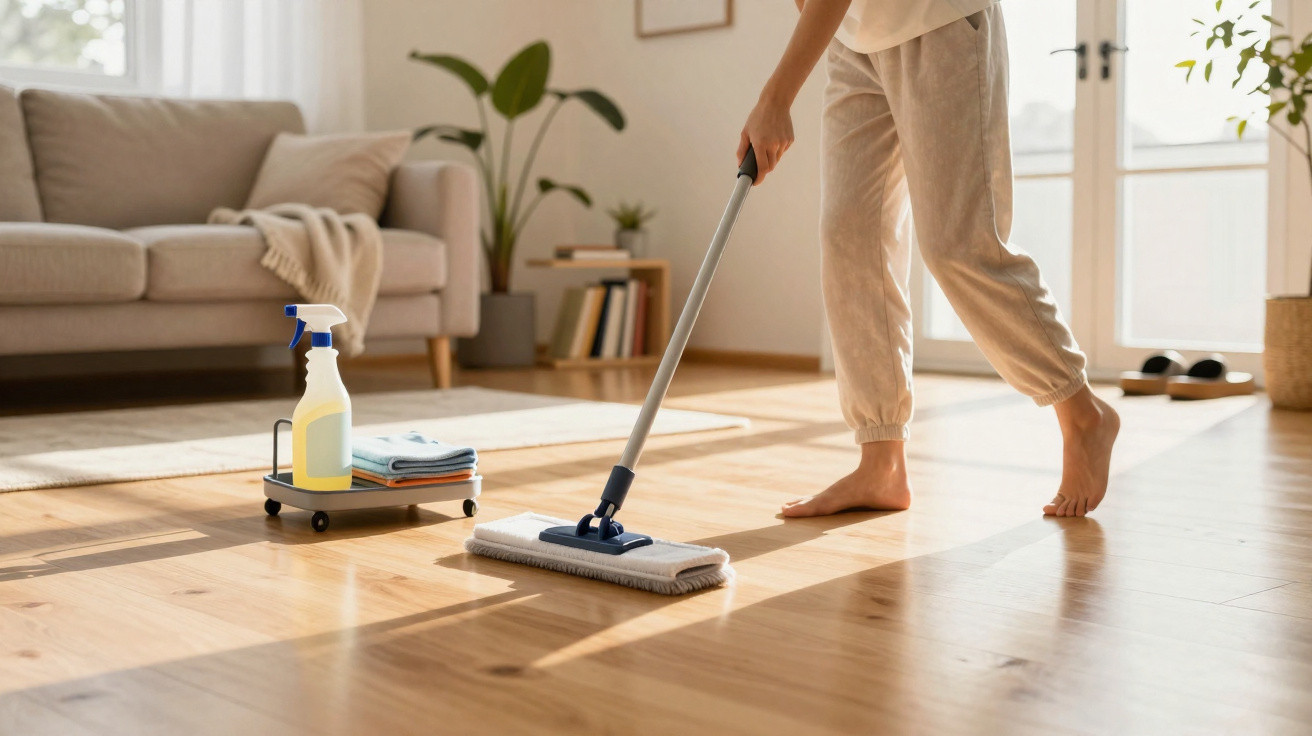
The second thing professionals say time and again is: “You lose more time looking for things than cleaning.” That is why many of them bring a trolley, or at least a cleaning caddy, containing everything they need: all-purpose cleaner, glass cleaner, cloths in different colours, bin bags, a sponge and a microfibre cloth. Once it is packed, the caddy simply goes from room to room. No more shuttling between the bathroom and kitchen because the good sponge is “over there”. A professional never starts until their supplies are ready. In principle, this is the simplest advice for cleaning faster: prepare once, then keep going.
Most of us do exactly the opposite. We spot a mark on the floor, grab any old cloth, realise it is damp, then look for the bucket, notice a vase of dried flowers along the way and put that away for a moment… then, suddenly, we are standing in an entirely different room ten minutes later. These little detours feel productive, but they are actually time traps. Many professionals therefore advise pausing for two minutes first, taking a deep breath, checking your supplies and making a short mental list. It sounds strict, but it is freeing. And if the bathroom is the only task for that day, then it really is only the bathroom - not the hallway as well, “just quickly”.
An experienced care-home cleaner put it like this:
“You underestimate how much time a forgotten cloth costs. I don’t. I only make one trip.”
She relies on three simple basics, which she repeats almost like a mantra:
- Put everything you will need into a caddy at the start - not as you go.
- Give every room a fixed direction, such as always working clockwise.
- Touch every surface only once, never twice without a reason.
Anyone who consciously tries these rules a few times will soon notice something: the flat is not only clean more quickly. It also feels less intimidating when the next cleaning session comes around.
The art of doing less - but doing it consistently
Another piece of advice offered by many cleaners sounds almost provocative: stop trying to make everything perfect at once. Professionals work in clear stages. One day is for floors and visible surfaces only. Another is for thoroughly tackling the bathroom and kitchen. This division is not laziness; it is a realistic way of managing energy. We all know the usual scenario: you enthusiastically begin a deep clean, get absorbed in scrubbing the grout behind the toilet, and two hours later the living room still looks exactly as it did before. Frustration is inevitable.
Many professionals say it is better to do a little more often than a huge clean only occasionally. Ten to fifteen minutes of a daily cleaning round, covering only the essentials, can replace a weekly marathon. Wipe the main surfaces once, collect crumbs and dust, and deal with the most obvious grime. It is not glamorous, but it is remarkably effective. Here is the sober statement you hear from people who clean every day: Perfectly clean homes exist only in magazines and show homes. In real life, it is entirely enough for a home to be clean enough that you can breathe easily.
One practical professional trick is the “final-look walk-through”. Before finally putting down the cleaning cloth, walk slowly through the flat once, as a guest would. Open the door and scan briefly: is anything still in the middle of the way? Does the washbasin look reasonably clear? Has the worst dust gone? This walk-through takes two to three minutes and sorts out the final small jobs. Making it a regular routine prevents precisely those irritating little problem areas that you otherwise notice in the half-light of the evening and ignore in annoyance. And yes, let us be honest, nobody does this walk-through every day. But even doing it once a week can completely change how your own flat feels.
What we can genuinely learn from professional cleaners
It is not miracle products from television adverts that help us clean faster. It is the quiet, practical routines of people who see dirt every day as part of their job - and remove it without any drama. Their work shows that cleanliness has less to do with perfection and more to do with making clear decisions. A route instead of chaos. One caddy instead of five unnecessary journeys. A brief, honest look at what genuinely needs doing today - and what can wait.
Perhaps that is the most relaxing realisation of all: we do not need to clean “better”, only differently. More like someone who has done it a hundred times and knows when enough is enough. Anyone willing to apply this unsentimental professional perspective to their own flat suddenly takes away the pressure. Cleaning stops being a test of whether you are “functioning” as an adult, and becomes a practical tool that you can switch on and off. And perhaps, the next time we dust, we will catch ourselves quietly thinking: I am only making one trip now. Like the professionals.
| Key point | Detail | Benefit for the reader |
|---|---|---|
| Fixed cleaning route | Move through every room in the same pattern, for example clockwise and from top to bottom | Less mental clutter and less time lost constantly deciding what to do next |
| A cleaning caddy instead of going back and forth | Gather all cleaning products and cloths in advance, then take them with you | Faster routines, no searching and no unnecessary journeys |
| Realistic stages | Divide the flat into blocks of tasks, such as short daily rounds rather than infrequent deep cleans | Less overwhelm and a consistently clean baseline |
FAQ:
- How often do professional cleaners actually clean at home? Many openly say they are much more relaxed in private: a more thorough clean once a week, with only brief tidying and wiping rounds in between.
- Which three things save the most time when cleaning? A fixed route, a well-packed cleaning caddy and the principle of dealing with every surface only once.
- Which cleaners do professionals prefer to use? Often a simple all-purpose cleaner, a limescale-removing bathroom cleaner and a glass cleaner - fewer products and clearer uses.
- How long can an ordinary flat clean take? Many professionals allow 60–90 minutes for a solid basic clean of a three-room flat, without using “perfection mode”.
- What is the most common cleaning mistake made by non-professionals? Jumping aimlessly between rooms and tasks - and trying to make everything perfect in one day.

Comments
No comments yet. Be the first to comment!
Leave a Comment