
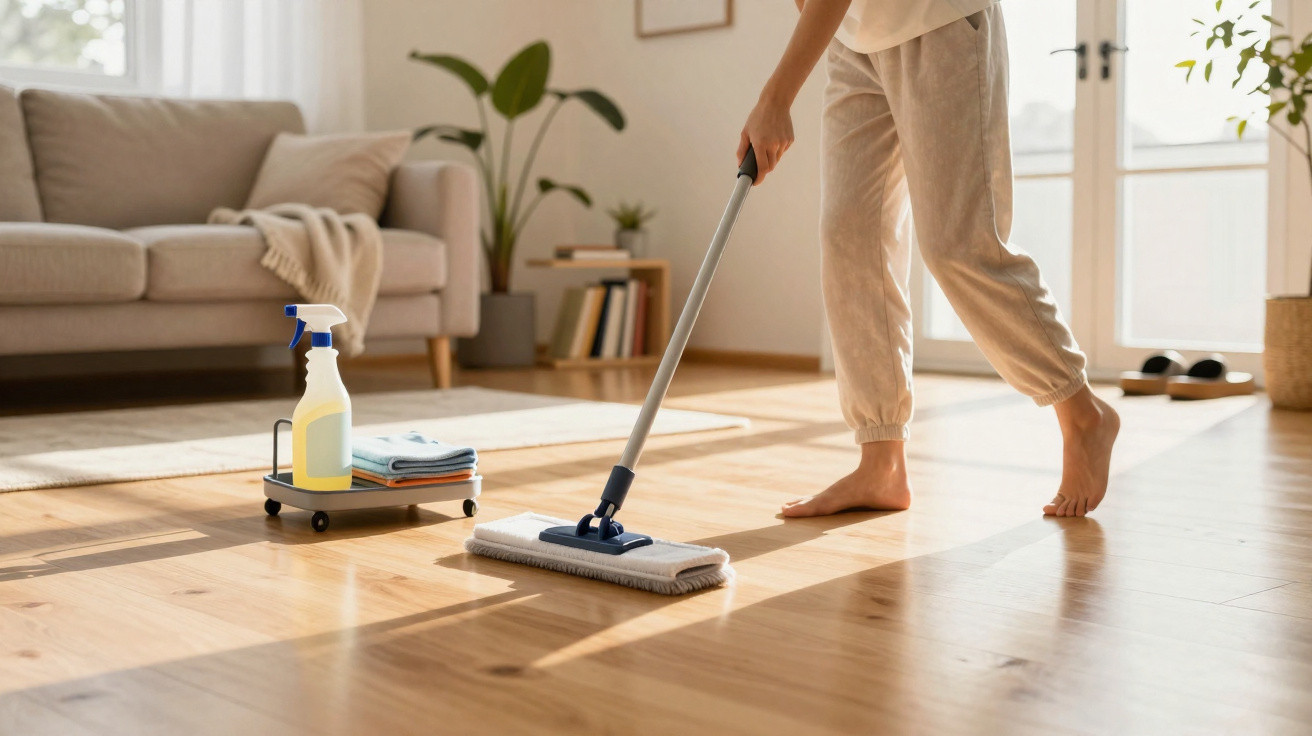
It often begins with the faint crunch of something beneath a bare foot.
A breadcrumb, a shred of dry leaf, an unexplained speck that certainly did not drop from the ceiling.
You glance down and take in the entire floor at once: dust gathered along the skirting boards, pet hair rolling into the corners like miniature tumbleweeds, and the slightly tacky mark beside the fridge that you have avoided for three days.
Then you notice the worktop piled high, shoes dotted about, and the laundry basket waiting in the hall like a quiet reproach.
Before you have even reached for the broom, your shoulders are already tightening.
You are not merely seeing a floor.
You are seeing the household job that quietly influences everything else.
The invisible backbone of a calm home
You sense it within the first few seconds of entering any home.
It is not about the wall colour or expensive décor.
It is the floor.
When it is unobstructed, swept and reasonably looked after, the whole home feels “under control”, even if folded washing is stacked on the sofa.
When it is dusty, scattered with crumbs or covered in stray socks and toys, your brain detects disorder before you can explain what feels wrong.
That is the understated influence of floor care.
It is the job that rarely demands attention but subtly affects how every other job feels.
Think about the last time you went into the kitchen to make a meal.
Perhaps the worktops were crowded, but you cleared and wiped enough room to begin.
Even so, the grit beneath your feet was irritating, wasn’t it?
A 2023 survey by a European cleaning brand found that people ranked “vacuuming and sweeping” among their least favourite chores.
However, 68% also said that “clean floors” made their entire home seem more organised, even when other rooms were untidy.
That is no accident.
One mother I spoke to said she could tolerate unfolded washing for a week.
“But if my feet stick to the floor,” she said, “my whole mood goes down the drain.”
There is a straightforward reason for that.
The floor is the biggest visible surface in your home.
Both your body and your eyes are continually connected to it, even when you are not actively aware of it.
A dirty floor makes every other task seem more demanding.
Cooking turns into navigating around crumbs.
Sitting on the floor to play with children becomes less inviting.
Working from home is more difficult when every walk to the kitchen highlights the sweeping you have put off.
Clean floors provide a neutral backdrop for everyday life.
They cannot magically fix clutter, bills or work-related stress.
What they can do is take away a low-level annoyance that would otherwise seep into everything else.
How to make floor care your anchor habit
The unexpected approach is to see floor care as an “anchor” task, rather than an extra you tackle only after everything else is complete.
Reverse the usual thinking.
Choose one or two areas that genuinely support your everyday routine, most often the kitchen and entrance hall.
Crumbs, mud, pet hair and daily debris build up fastest in these spaces.
They are also the first surfaces your mind notices when you come indoors.
Next, attach a small floor-care routine to something you already do.
Spend three minutes sweeping just after loading the dishwasher.
Use the vacuum after making your morning coffee.
This is not a complete deep clean.
It is simply a daily reset that reminds you that the space is yours again.
The familiar mistake is to wait until the entire house feels chaotic, then spend an exhausting Saturday trying to “catch up”.
At that stage, you are likely to be resentful, worn out and a little embarrassed.
We have all experienced that moment of looking around and wondering: how did it become this bad?
A kinder, more achievable routine is more effective.
Small actions that may look almost lazy, but stop the floor crossing the unseen boundary between “lived-in” and “sticky disaster”.
One sweep beneath the dining table after dinner.
A quick pass by the door when you spot dried mud, rather than acting as though it is not there.
Let us be realistic: nobody manages this every single day.
You will miss days.
There will be weeks when life takes over.
The important thing is for floor care to become your natural response, rather than an emergency measure.
The aim is not perfection; it is relief.
“Once I stopped chasing a spotless house and focused only on the floors in the kitchen and hallway, everything else felt lighter,” says Léa, 34, who works full-time and has two kids.
“I still have clutter, I still forget the laundry sometimes.
But walking on a clean floor gives me this weird sense that I’m not failing at adulthood.”
- Begin small: select one high-traffic area and make it the priority.
- Keep it brief: 5–7 minutes with a broom or vacuum is sufficient for a reset.
- Connect it: tie floor care to an established habit, such as coffee, washing up or the bedtime routine.
- Set a lower standard: target “no visible crumbs or sticky spots”, rather than a magazine-worthy shine.
- Conserve your energy: leave your tools within easy reach, not hidden in a cupboard behind ten other items.
When clean floors change everything else
Once you recognise the connection between your floor and your mental load, it is difficult to ignore.
Those first morning steps, bare feet on a clean surface rather than a dusty one, can shift your inner weather slightly.
You may feel more inclined to cook because the ground no longer resembles a battlefield.
Children may start playing on the rug again instead of choosing the bed or sofa.
You may feel less awkward about answering the door when someone calls unexpectedly.
This single task will not transform you into somebody else.
It merely removes one layer of background noise.
With that noise reduced, you often have a little more patience for everything else: the washing, the emails and the endless life admin.
| Key point | Detail | Value for the reader |
|---|---|---|
| The floor is the home’s “silent signal” | It is the largest visible surface and is continually in contact with your body and eyes | Helps explain why you feel stressed even when only the floor is untidy |
| Small, regular resets are better than major clean-ups | 5–10 minute sweeps in essential areas keep chaos manageable | Makes cleaning feel achievable, even on busy days |
| Anchor habits build momentum | Connecting floor care to daily routines steadies your environment | Offers a practical way to feel more in control without perfectionism |
FAQ:
- Question 1 Is cleaning the floor really more significant than tidying surfaces?
- Question 2 How often should I realistically clean my floors?
- Question 3 What if I have pets and children and the floor never remains clean?
- Question 4 Which tools make floor care easier to maintain?
- Question 5 How can I stop feeling guilty when I cannot keep everything spotless?


Comments
No comments yet. Be the first to comment!
Leave a Comment