
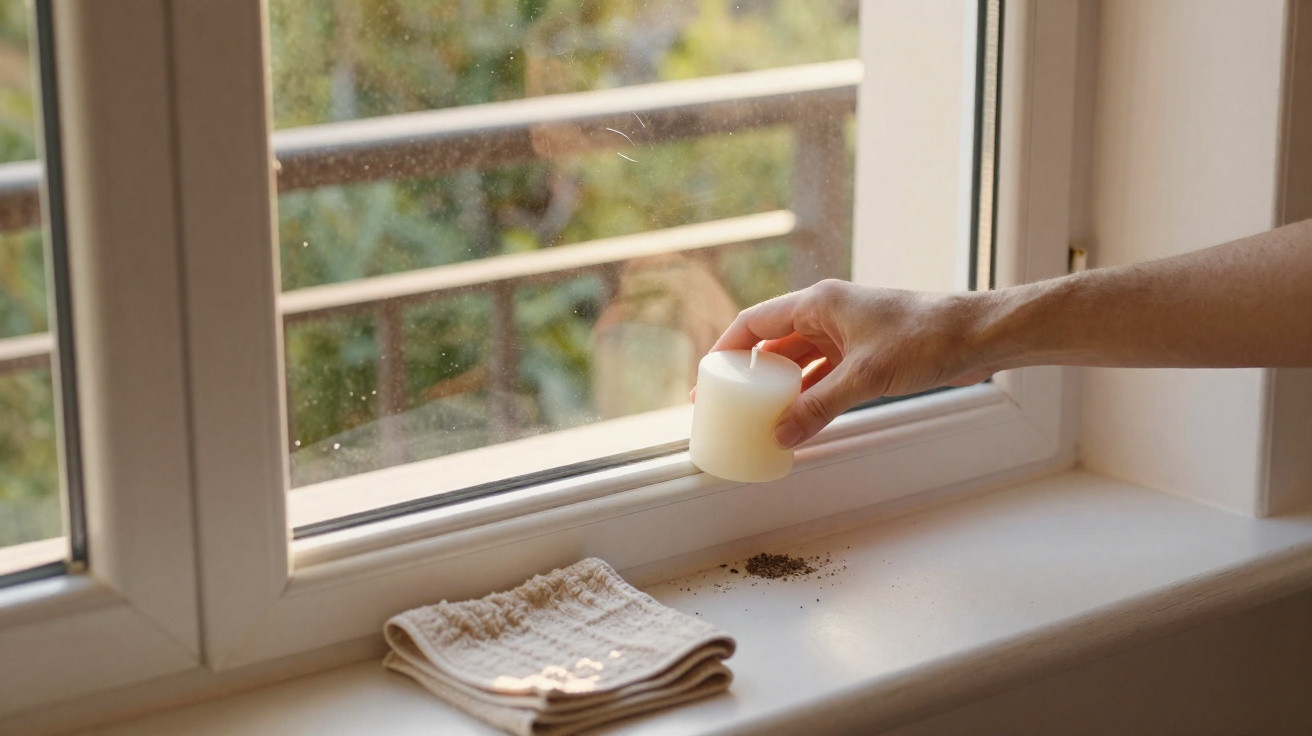
Candle wax can make a sliding window easier to move when dust, sand and debris have increased friction in the track. Once it has been thoroughly cleaned, a white candle leaves a solid coating on the rail, limiting direct contact between the moving parts without creating an oily surface that quickly collects dirt.
Why does candle wax make a window easier to slide?
Most standard white candles are made largely from solid paraffin. Rubbing the wax along a clean rail fills minor imperfections in its surface, creating a thin layer that reduces friction as the sash is opened and closed.
The improvement is usually most noticeable on aluminium windows that remain properly aligned but have become stiff because of dry dirt. Wax will not repair damaged components, but it can restore smoother movement where the issue is limited to contact between the bottom of the sash and the track.
- It lowers friction between the sash and the rail;
- It makes opening easier without leaving the track wet;
- It does not run into the sides of the window frame;
- It generally attracts less dust than oily products;
- It can be reapplied after cleaning again.
Why must the track be cleaned before application?
Applying wax over sand, hair or hardened grime can make the window move worse, as the debris becomes trapped beneath the coating. Ideally, vacuum the corners, loosen dirt with a small brush, then finish with a slightly damp cloth. Dry the sliding window track completely before using the candle.
Applying candle wax correctly to window tracks
Once the channel is clean and dry, take an uncoloured white candle and rub its side over the areas where the sash runs. There is no need to heat, melt or light the candle, since pressure from rubbing deposits enough paraffin onto the metal.
After applying it, open and close the window several times to spread the layer evenly. This attention to clean surfaces is also used when restoring the appearance of wooden furniture, where removing dust and grease beforehand directly affects the finish.
- Vacuum the entire channel, including the corners;
- Remove trapped debris using a soft brush;
- Wipe with a damp cloth and allow the rail to dry;
- Rub the white candle over the contact areas;
- Open and close the window to distribute the wax;
- Wipe away any visible excess with a dry cloth.
Why can oils and sprays make the problem worse?
Liquid lubricants leave behind a sticky film that can catch street dust, sand and particles carried in sea air. Over time, this mixture forms a dark paste in the channel and increases resistance again, particularly on window frames exposed to wind or fitted near main roads and coastal areas.
When will candle wax not fix a jammed window?
Paraffin cannot repair broken rollers, dented tracks, loose screws or misaligned sashes. If the window remains difficult to move after cleaning and application, produces metallic noises or drops towards one side, the rollers and the fit of the window frame will need to be checked.
It is also important to consult the manufacturer’s guidance before putting any product on internal mechanisms or models with a specialist finish. Where the problem is only accumulated dust and surface friction, candle wax acts as a dry lubricant; where mechanical damage is present, forcing the window open may further distort the track and affect how the window closes.


Comments
No comments yet. Be the first to comment!
Leave a Comment