
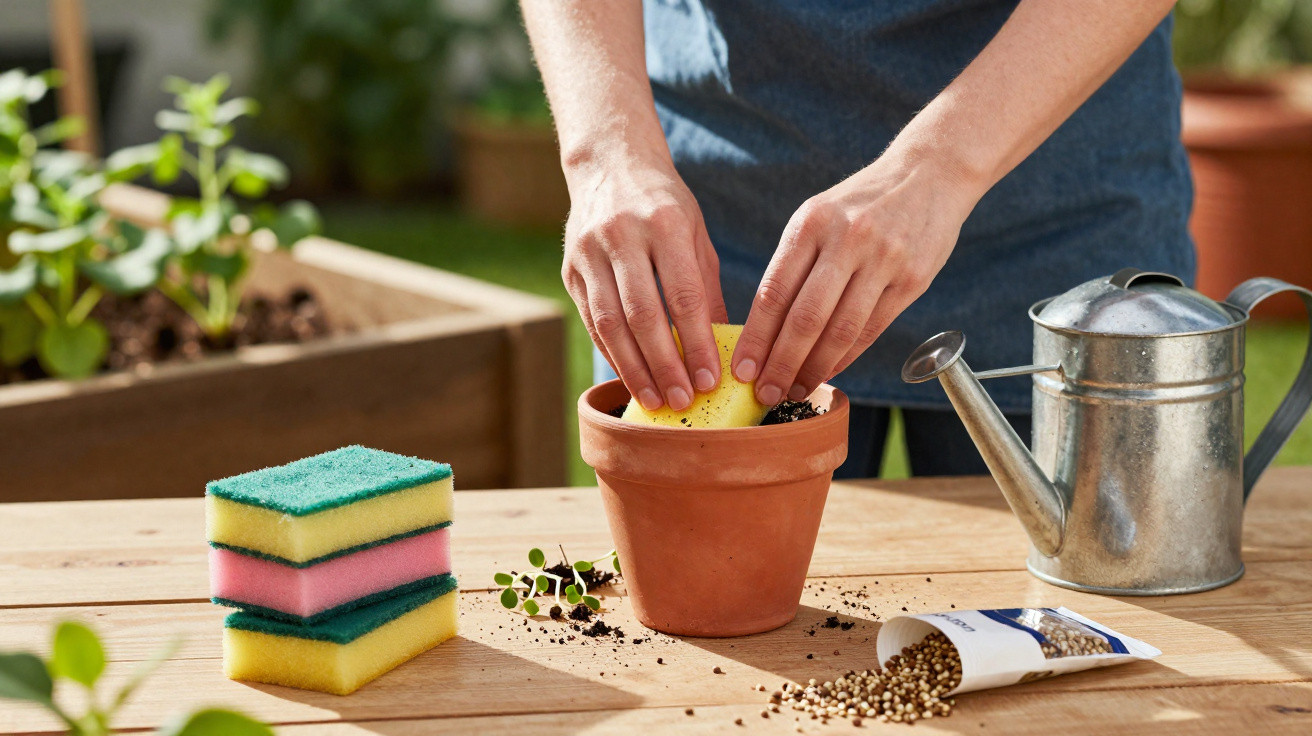
While gardeners are still contending with changeable weather and irregular watering, an everyday household item is usually thrown away without a second thought: the old washing-up sponge. Gardening professionals now recommend giving it a second use in beds, pots and compost – as a small water store and a way to reduce waste.
Why a washing-up sponge helps thirsty plants
In spring, many plants put on fresh growth, their roots are still delicate, and soil dries out quickly in the wind and during the first sunny spells. At the same time, watering regularly is not always possible, especially with window boxes or potted plants.
This is precisely where a discarded washing-up sponge can help. Its porous structure acts as a miniature water reservoir:
“Placed in a pot, the sponge stores excess watering water and gradually releases it back into the soil – ideal for sudden dry spells.”
If a sponge is laid at the base of a pot, immediately above the drainage holes, and then covered with compost or soil, it can:
- absorb surplus water rather than allowing it to run straight out
- keep the soil moist for longer without leaving it permanently waterlogged
- reduce the chance of roots being stressed by sudden periods of thirst
- help window boxes cope better with wind and the first hot spells
For anyone unable to water every day or who travels frequently, this water buffer can make a real difference. It will not replace watering for weeks on end, but it can give plants valuable extra hours before they need watering again.
Compost booster: a sponge as a moisture store in the heap
Potted plants are not the only ones to benefit. Compost also dislikes conditions that are either bone dry or soaking wet. Microorganisms work most effectively when the heap remains lightly moist, much like a wrung-out sponge.
A suitable sponge can fulfil exactly this function in compost.
“Natural sponges stabilise moisture levels in compost while also improving aeration – a benefit for earthworms and microorganisms.”
Cut a natural sponge into coarse pieces and mix it with kitchen scraps, grass cuttings or leaves to achieve several effects:
- it soaks up excess moisture from wet kitchen waste
- it slowly releases moisture when conditions become dry
- it creates small air channels within the heap
- it helps improve the balance between moist, nitrogen-rich ingredients and dry structural material
As a result, the compost heats up more evenly, breaks down more effectively and is less likely to smell rotten. Over time, a sponge made from natural materials will itself decompose into humus.
Which sponges can go in the garden – and which cannot
The material is crucial: not every washing-up sponge is suitable for soil or compost.
| Type of sponge | Use in soil | Suitable for compost |
|---|---|---|
| Natural fibre (cellulose, loofah) | suitable | suitable |
| Conventional yellow plastic sponge | limited use only; do not bury in vegetable gardens | not suitable |
| Sponge with a scourer side (green/blue) | only as a short-term water buffer; do not bury in beds | not suitable |
Natural sponges made from cellulose or loofah, a climbing gourd, gradually break down and are well suited to garden and compost projects. Conventional plastic sponges, by contrast, contain plastics and often additives that have no place in the soil.
If using these synthetic versions, use them only as a temporary water reserve in a pot and remove them later. They do not belong in garden beds, raised beds or compost intended for vegetables.
Preparing a kitchen sponge for garden use
A used washing-up sponge needs thorough cleaning before it is used outdoors. In the kitchen, it collects grease, washing-up liquid residues and, above all, bacteria.
“A damp sponge can become an ideal breeding ground for germs in a short time – it is better off outdoors than beside the kitchen sink.”
To ensure it does not harm the environment, it should first be made kitchen-free:
- Rinse the sponge thoroughly under hot water until no foam remains.
- Boil it in a pan of water for several minutes, or pour boiling water over it.
- Optionally, soak it with a little household vinegar to reduce residues.
- Allow it to dry thoroughly, then clearly label it “garden use only” or store it separately.
Afterwards, the sponge should never return to the kitchen. In effect, it has changed territory – from the sink to the garden bed.
Four clever places to use a sponge in spring
1. Water reservoir at the bottom of a pot
Place one or more sponges at the very bottom of the pot, directly above a drainage layer of gravel or clay pebbles. They cover the drainage holes, are covered with soil and act quite literally as a sponge in a flowerpot.
This is particularly useful for:
- window boxes in full sun
- hanging pots that dry out quickly
- herbs and summer flowers with high water requirements
2. Support for even germination
Small pieces can also be used for raising seedlings. Cut cubes from a natural-fibre sponge and press one seed into each cube. Put the pieces in a tray, moisten them and top up the moisture regularly.
Once the young plant has reached a height of several centimetres, move the entire cube, including the seedling, into a pot or bed. At first, the cube remains in the soil, keeping the soil around the small root ball moist; if it is made from natural material, it gradually breaks down.
3. Moisture protection and light insulation
A sponge laid flat on the soil around a sensitive plant can act as a small protective shield. Held in place with a stone or wooden stick, its upper layer slightly reduces evaporation from the soil and softens the impact of very light late frosts.
If desired, the sponge can be treated with a few drops of essential oils that pests avoid, such as clove or lavender. It is not a replacement for professional pest control, but it can form one part of a gentle plant-protection approach.
4. Moisture anchor in compost
Only pieces of natural sponge should be added to a compost heap or compost bin. Mix them through the material, where they act as a lasting anchor for moisture. When the surface of the heap dries out, the inner areas remain active for longer thanks to the sponges.
Signs that a sponge has reached the end of its life
An old washing-up sponge will not last indefinitely in the garden either. Anyone using one should check its condition from time to time. Warning signs include:
- a strong, unpleasant smell
- visible mould growth
- material breaking down into crumbly flakes
Natural sponges without washing-up liquid residue may be put into the compost once they are no longer wanted in a vegetable bed. Plastic sponges belong in general waste as soon as they become brittle; otherwise, they break down into ever-smaller particles.
How to combine the trick with other water-saving ideas
The sponge trick works especially well when it forms part of a wider watering plan. Useful additions include:
- mulching with bark pieces, grass cuttings or straw so the surface dries out more slowly
- watering in the early morning or late evening
- collecting rainwater in water butts or cisterns
- choosing suitable plants and varieties that tolerate dry spells better
Combining these strategies not only saves tap water, but also means plants experience less stress from constant swings between wet and dry conditions.
For many amateur gardeners, the thought of burying a washing-up sponge may initially seem rather absurd. Yet after the first hot days of the year, it often quickly becomes clear that pots with an additional water store make it through critical periods far more steadily. At the same time, part of the kitchen waste gains a useful second life – right where every bit of moisture matters.


Comments
No comments yet. Be the first to comment!
Leave a Comment