
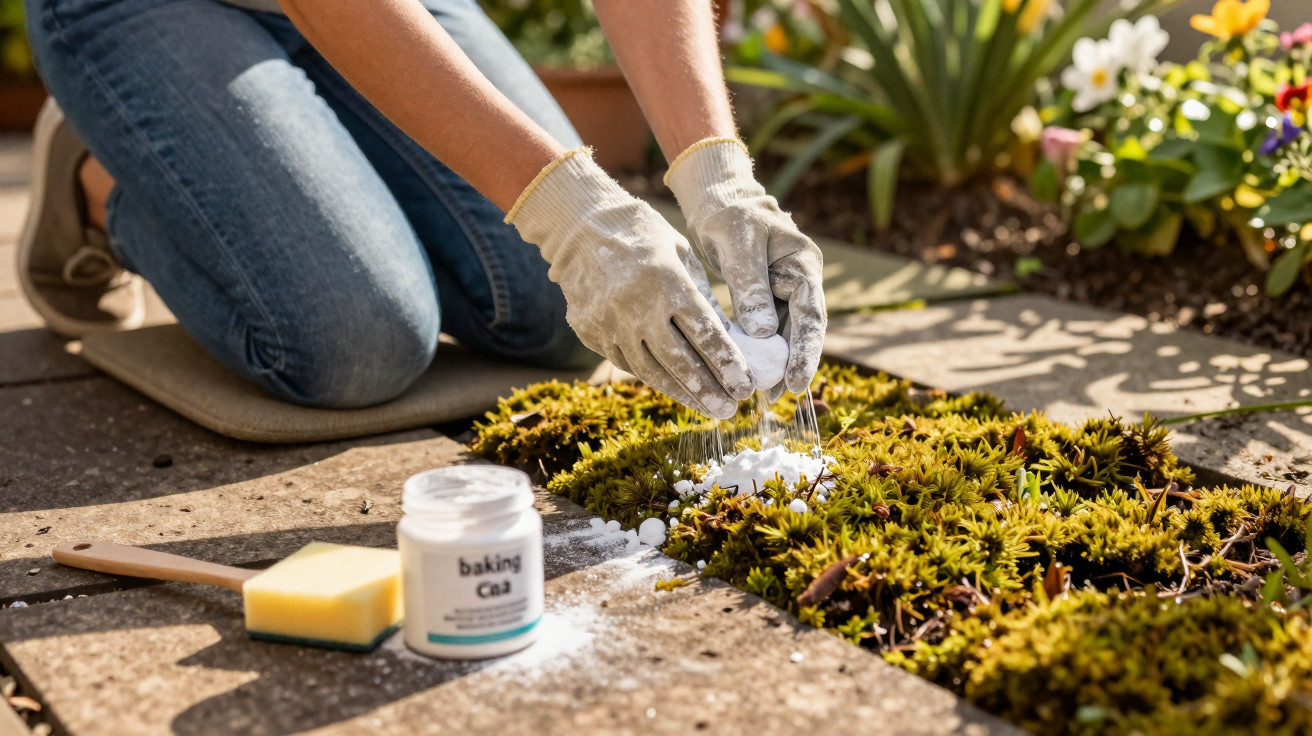
Many people resort to a drastic approach and pour boiling water over paved areas. It looks clean for a short while, yet within a few weeks the green growth returns. A professional gardener recommends a different solution: much kinder to stone and joints, but surprisingly long-lasting – using a simple household product from the kitchen cupboard.
Why boiling water only seems to work on moss
At first glance, boiling water seems ideal: hot, quick and visibly effective. The moss cushions collapse and the surface appears freshly cleaned. However, the effect generally remains superficial.
Moss thrives in particular conditions:
- permanently damp joints and edges
- shady corners with poor air circulation
- rough or porous stone surfaces that give it something to cling to
As long as these conditions remain, moss will return as soon as the weather suits it – regardless of how often hot water is poured over it.
“Anyone who merely ‘shocks away’ the visible layer of moss ends up fighting the same battle again every year.”
There is another issue: boiling water affects more than just the moss. Joints may wash out or crack, while natural stone can become discoloured or develop fine hairline fractures. This “shock effect” can cause damage later on, especially on older patios.
A further consideration is frequently overlooked: slip risk. When hot water loosens dirt and moss residue, it can briefly create a slimy film. Together with remaining dampness, this can make paths and steps even more slippery – the opposite of the intended result.
The gardener’s trick: damp slabs and a simple kitchen aid
The turning point comes from a straightforward practical observation: moss is easier to remove when you work with the conditions rather than against them. Instead of heat, the gardener uses a gentle but effective combination of slightly damp paving slabs and bicarbonate of soda.
“Rather than ‘cleaning through’ in minutes, this method works quietly and releases the moss in around 48 hours.”
The key to this trick is simple:
- The slabs should be damp, but not soaking wet.
- The bicarbonate adheres more effectively this way and stays precisely where the moss is growing.
- It works evenly and is far less harsh on stone and joints than heat or strong chemicals.
With this approach, the moss does not collapse dramatically within a minute. Instead, it gradually loses its grip until, after two days, it comes away almost by itself.
Step by step: how the 48-hour bicarbonate method works
1. Prepare the area
First, sweep away coarse dirt so that the powder can reach the moss and stone directly. Then lightly dampen the surface – rainfall the previous day is often enough. If watering it yourself, use a watering can or a hose with a gentle spray.
2. Apply bicarbonate accurately
Next, scatter a light layer of bicarbonate over the affected spots. Accuracy matters: there is no need to cover the entire patio in a white layer. Concentrate instead on these areas:
- joints between paving slabs
- shaded sides of walls and steps
- corners where water collects
- visible cushions of moss on the stones
If you are unsure, start with a small amount of powder and use slightly more on the next application if needed. Here, “more is better” is more likely to cause waste than improved results.
3. Leave it for around 48 hours
Now, simply wait. During this time, the fine bicarbonate film works on the moss and weakens its attachment to the stone. The surface should ideally stay dry from above, as heavy rain could wash away the effect.
“The hardest part of this method is often the patience – not the scattering.”
4. Finish gently
After roughly two days, the moss will usually have turned grey or brown and look “tired”. A stiff outdoor broom or joint brush should now be enough to remove the loosened residue. Scrub more firmly only where some remnants are still attached.
Finally, rinse the area with water – not using high pressure, but with a watering can or a soft spray. The aim is to clean the stones without blasting jointing material out of place.
Important precautions for sensitive stone
Even a gentle method can have unwanted effects if the surface is delicate. Take particular care with pale natural stone and very old patios.
Practical safety rules:
- Always test the method first on a small, inconspicuous area.
- Do not allow thick layers of bicarbonate to build up.
- For highly porous stone, use two lighter applications rather than one excessive one.
- Do not scrub while the moss is still firmly attached.
Three common mistakes can significantly reduce the result:
- Using too much in the hope of a “turbo effect”
- Brushing too soon, before the moss has lost its grip
- Rinsing aggressively with a pressure washer directly into the joints
Avoiding these pitfalls protects your patio and leaves a more even finish, without rough or damaged joint edges.
Keeping moss away: what really matters after cleaning
Even the best cleaning method achieves little if the causes of moss growth remain unchanged. Two factors almost always drive the problem: standing water and constant shade.
Depending on the property, useful measures may include:
- cutting back overhanging branches above paths
- limiting climbing plants on heavily shaded walls
- adjusting slight gradients so water drains away rather than collecting
- moving planters regularly so that the area beneath does not stay permanently damp
“Every square metre that dries faster and receives more air makes life harder for moss.”
Many gardeners rely on a small “spring routine”: once a year, inspect joints, edges and dark corners thoroughly, then act early when the first green film appears. Those who do not wait until everything is covered in green save both effort and materials.
Why bicarbonate of soda and similar products have become so popular
Bicarbonate of soda, often known simply as baking soda, has long been used for more than baking. In the home, it is used to clean joints, drains and pots; in the garden, it has established itself as a mild alternative to aggressive cleaners.
Its major benefit is that it dissipates and breaks down over time instead of leaving lasting residues. It is also much easier to measure out than many specialist products from DIY shops, whose effects and side effects can often be difficult to judge.
Anyone unsure whether their own patio is suitable should first try the bicarbonate trick in an area that is rarely seen, such as behind a planter. If the test is successful, the method can gradually be extended to larger sections – without risking the whole outdoor area.
This turns the annual “war on moss” into a manageable part of garden maintenance: with less stress, less force against stone and joints, and a result that lasts longer than the usual bucket of boiling water.
Comments
No comments yet. Be the first to comment!
Leave a Comment