
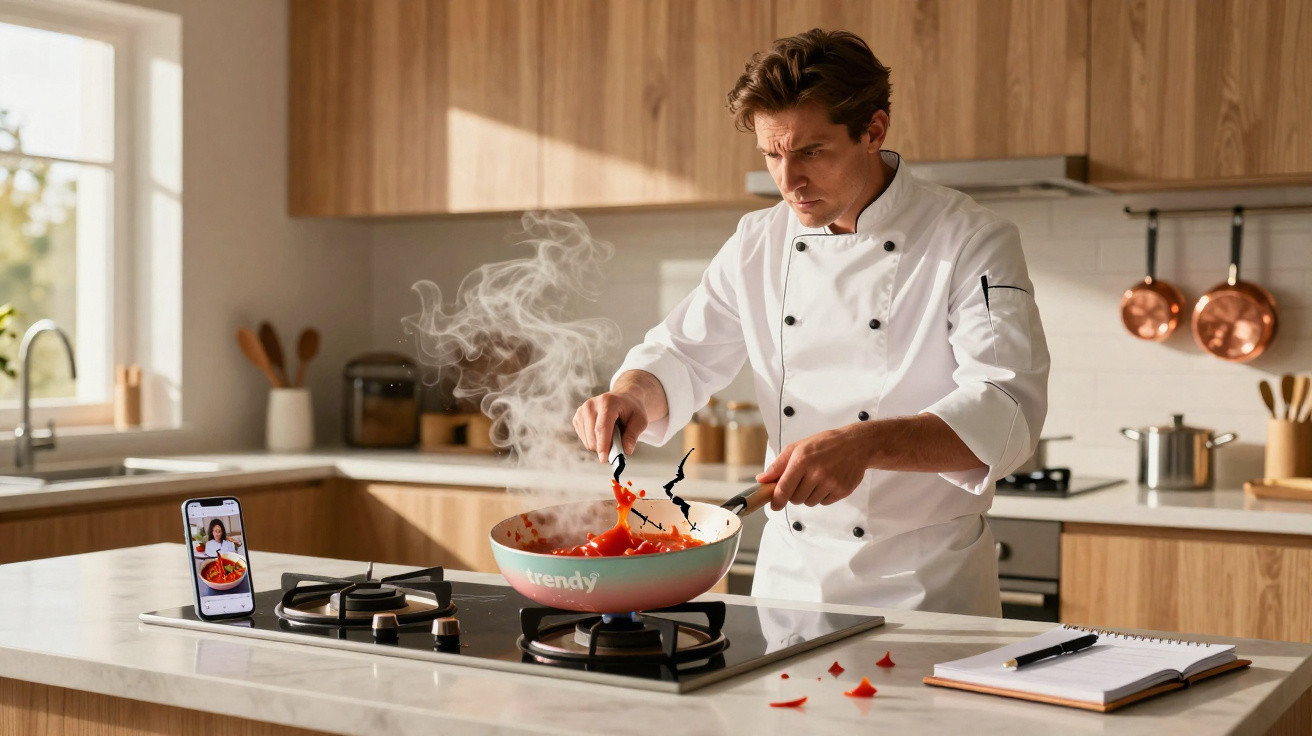
Anyone who watches recipe videos on Instagram, TikTok or YouTube will recognise the scenes: colourful soups bubble away in a glass pot, while pasta swirls elegantly in a transparent pan placed directly over the flame. It looks contemporary and makes an impression in the kitchen – and that is precisely where French celebrity chef Philippe Etchebest’s warning comes in. He has spoken candidly about why he avoids this trendy utensil at home and which classic alternative he recommends instead.
Glass pots as social-media stars
The glass cooking pot, often presented as a design statement, has become a regular feature in countless videos over recent months. Its contents remain visible at all times, making the cooking process resemble an aquarium. For food influencers, it is ideal: every bubble, piece of pasta and strip of vegetable can be shown off perfectly.
What creates beautiful images can become a genuine household risk in everyday life.
Philippe Etchebest also uses glass pots – but only when he is on camera. He stresses that their purpose is purely visual. Viewers can follow the cooking process more easily, seeing step by step how texture and colour change. They work well for professional videos. However, he takes a critical view of them on an ordinary cooker in a family home.
Why the celebrity chef rejects glass pots for everyday use
Etchebest is unequivocal: this fashionable pot has no place in his own kitchen. In his view, the material is too delicate and insufficiently durable for daily use on gas or induction hobs. He considers the danger of breakage to be genuine, particularly when nobody is keeping a constant watch over the cooker.
One issue he highlights is glass’s sensitivity to major temperature changes. Professional kitchens push cookware to its limits – and if an item cannot withstand those demands, it is even less suitable for everyday cooking. His message is clear: anyone who cooks regularly, has children at home or simply wants to avoid accidents should think carefully about whether a glass pot is really a sensible purchase.
When a glass pot explodes from thermal shock
Thermal shock is the key concern repeatedly raised by specialists. Put simply, glass expands when heated and contracts when cooled. If this happens in different areas of a pot at the same time, stresses develop. Once the difference becomes too great, the material can fail.
Typical situations in which things can become dangerous include:
- Placing a hot pot straight from the hob onto a cold stone worktop.
- Pouring ice-cold stock or water into an already heated glass pot.
- Leaving an empty glass pot over a full gas flame or on a high induction setting.
- Positioning the pot partly over the hot zone of the hob and partly over its cooler edge.
A crack does not always develop gradually. There may be a bang, the pot can shatter, and fragments may fly around the kitchen. Such incidents have been documented. In one case, a 36-year-old woman suffered severe burns to her lower body and legs when a glass pot containing hot soup burst while she was cooking. The hot contents and sharp shards struck several parts of her body.
A single moment of inattention is enough to turn a relaxed evening of cooking into an emergency.
The risk of injury comes not only from the heat, but also from broken glass. This is especially concerning when children are nearby, walking barefoot through the kitchen or trying to help a distressed parent.
How safe is heat-resistant glass really?
Many manufacturers use claims such as “heat-resistant” or “oven-safe”. These descriptions generally refer to moderate temperature changes and use in an oven. Conditions there are comparatively even, with heat surrounding the dish from all sides.
A gas hob or induction plate is different. Heat is concentrated beneath the base, sometimes within a narrow area. The edges and handles remain considerably cooler. This uneven strain is exactly what can weaken glass over time.
| Material | Tolerance of temperature changes | Typical use |
|---|---|---|
| Glass | sensitive to major and localised fluctuations | oven, serving bowls, microwave |
| Cast iron | very robust, retains heat for a long time | braising, stews, roasting |
| Stainless steel (Inox) | stable, resilient, suitable for daily use | pasta, soups, general cooking |
Anyone already using glass cookware should ensure temperature changes are gradual, avoid heating it while empty and prevent very cold liquids coming into contact with it when hot. Even then, the risk cannot be completely eliminated.
The stainless-steel alternative professionals rely on
As an alternative to the fashionable glass pot, Etchebest recommends a classic: the stainless-steel pot, commonly known in professional kitchens simply as Inox. The material is considered durable, easy to clean and comparatively long-lasting. Although scratches may affect its appearance, they rarely have much impact on performance.
For the celebrity chef, stainless steel is the only material he is prepared to recommend without reservations for everyday use.
He advises choosing a large, tall pot measuring around 24 centimetres in diameter and roughly the same in height, with a capacity of about ten litres. Such a model is suitable for almost anything served in a family household: pasta, soups, stews, large batches of stock or classic goulash.
Everyday advantages of a stainless-steel pot
- Suitable for gas, induction and often the oven too.
- Hardly warps during normal use and does not break.
- Easy to clean, usually including in a dishwasher.
- Flavour-neutral, with no effect on food.
- A long lifespan with good-quality versions, often lasting decades.
Stainless steel does not distribute heat quite as evenly as cast iron, but a proper sandwich base, usually containing an aluminium core, provides consistent and controllable heat distribution. That is entirely sufficient for most recipes.
What to look for in safe cookware
Anyone unsure whether their cookware is suitable for everyday use should consider more than its appearance. A few practical questions can help when choosing:
- Does the manufacturer provide clear information about use on gas, induction and in the oven?
- How does the material react if it is dropped or knocked?
- Is the handle securely screwed on or glued in place?
- How thick is the base: does it feel solid, or thin and easily bendable?
- Is the pot genuinely the right size for my hob and my family?
With particularly fashionable products, it is worth checking independent user reviews. If reports of chips, cracks or breakages are frequent, caution is advisable – even if the design is appealing.
How to reduce kitchen risks more generally
The warning about glass pots forms part of a wider range of kitchen safety concerns. Many hazards arise at stressful moments: someone is on the phone, tidying up at the same time, or has a child clinging to their leg – and suddenly they are no longer paying attention to what is happening on the hob.
A few straightforward routines can make a significant difference:
- Always turn pot and pan handles inwards.
- Do not leave hot cookware at the edge of the worktop.
- Keep children away from the hob and splashing fat, particularly with gas cooking.
- Keep suitable oven gloves or pan holders nearby rather than reaching for a tea towel at the last minute.
- Dispose of damaged or chipped cookware in good time.
It is also striking how strongly material choice and cooking habits affect one another. People who focus on a solid basic set of pots and pans generally cook more calmly and need to improvise less. This reduces mistakes that can become dangerous when combined with delicate materials.
Glass still has a place in the kitchen: for casserole dishes, baking dishes or storage containers, for example. Temperatures are more controlled in these situations, and the vessels are moved around less hastily. Directly on the hob, over an open flame or strong induction heat, metal pots made from stainless steel or cast iron have a clear advantage – even if they look less spectacular on camera.


Comments
No comments yet. Be the first to comment!
Leave a Comment