
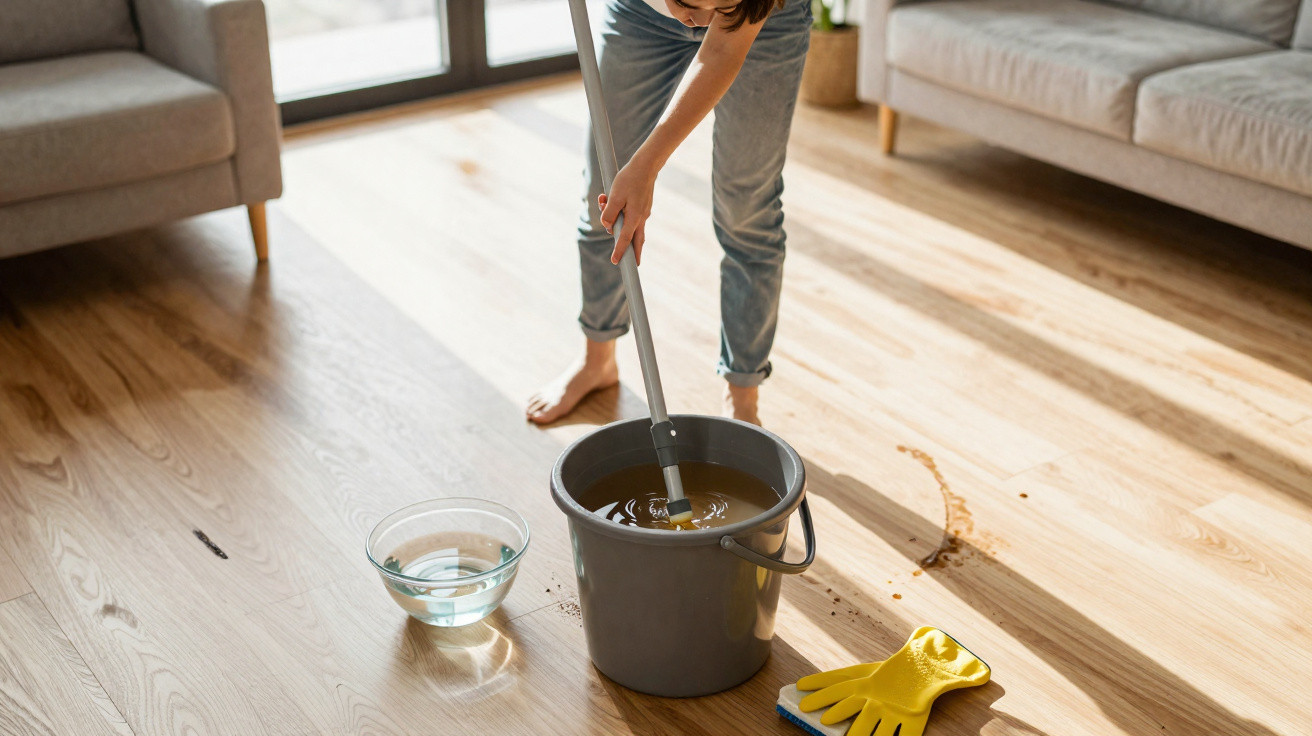
The first time I spotted it, I was barefoot in the kitchen, waiting for the floor to dry. The tiles remained damp, there was a light lemon-cleaner scent in the room, and I could see it: a pale grey line tracing the skirting board, like a grubby highlighter mark. I had only just mopped. I had spent twenty minutes moving back and forth, rinsing and wringing out the mop before going over the floor again. Yet when I finally tipped the water away, the bucket resembled cold coffee.
I looked at that murky water and had a small but horrible realisation.
What if I was not cleaning the floor at all? What if I was simply taking the dirt on a tour around the flat?
I thought I was a clean freak. I was just moving grime around
For years, I followed the same routine: sweep, fill a bucket, add a splash of scented cleaner, then mop as though I were painting cleanliness across the floor. The pleasure came more from the process than the outcome. You know that little burst of pride when you rest on the handle and admire the wet sheen? That was it.
But that shine was deceiving me.
The corners still looked slightly grey, the grout lines became darker, and stubborn sticky patches somehow made it through every “deep clean Sunday”.
Then one day, partly from curiosity and partly from disgust, I paused halfway through cleaning and properly examined the mop water after just one room. It was already cloudy. I emptied the bucket, refilled it with fresh water and mopped a second room; once again, it turned brown. By the third refill, I understood that my old “one bucket for the whole flat” approach was basically a system for distributing muddy water.
Later, I came across a cleaning survey stating that more than half of people reuse the same mop water across several rooms. That was hardly surprising. We are busy, exhausted, and cleaning usually sits at the bottom of the to-do list.
But once you have noticed that grey residue around the edges, it is impossible to ignore.
The principle is painfully straightforward. A mop is essentially a sponge attached to a handle. When you dip it into water, it absorbs dirt from the floor. If that water is already filthy, you are putting the mop straight back into a weak mixture of grime and cleaner. Then you spread it over the tiles again, assuming that the scent means it is doing its job.
Smell is not the same thing as clean.
What my mind interpreted as “fresh” was often merely fragrance sitting on top of a thin layer of residue. That residue catches more dust, pet hair and crumbs, which explains why floors can feel dirty again by the following day.
The day I stopped reusing dirty mop water, everything changed
My major change began with one minor, slightly irritating habit: replacing the water far more often than seemed sensible. I made a mental rule that the moment the water stopped looking almost clear, it was finished.
For my fairly small flat, that meant changing the bucket two or three times. Initially, it seemed excessive. Then I noticed the difference both in the rinse water and across the floor.
The mop moved smoothly rather than dragging, while the tiles dried without that dull, streaked finish.
On days when the floors were especially bad, I also adopted a two-bucket method. One bucket held clean solution, while the other contained plain water solely for rinsing the mop. Dip it in cleaner, mop a small section, rinse it in the plain water, then return it to the clean bucket. It may sound like the sort of thing only your ultra-organised aunt would do, but it really does prevent that “brown tide” from spreading everywhere.
If you have ever wiped a supposedly clean floor with a white paper towel and found it came away grey, that is what is travelling around in your mop water.
The floor did not suddenly resemble a showroom, but it finally felt clean beneath bare feet.
After dealing with the water problem, I realised that the mop head itself was the next offender. I used to give it a quick rinse, hang it somewhere vaguely in the bathroom, then use it repeatedly until the fibres appeared worn out and permanently stained.
Let’s be honest: nobody really does this every single day.
However, a worn mop head cannot release dirt properly. It simply pulls it along. When I moved to a washable microfibre pad that could go in the washing machine after every use, the difference was clear. The mop no longer smelled of “old laundry”, and the floors lost that sticky-cleaner sensation you get in certain shops.
How to actually clean your floors instead of massaging the dirt
These days, my method is technically slower but genuinely quicker, because I am no longer repeating the same job. I begin dry by sweeping, vacuuming or using a dry microfibre flat mop to collect as much dust, hair and crumb debris as possible. That initial step is the difference between washing a dirty plate and rinsing one that has already been scraped clean.
Only after that do I use the wet mop. I work in small sections, apply light pressure and rinse it frequently.
When the bucket water resembles weak tea, it goes.
Another helpful change was using less cleaner. I used to add a generous amount, assuming that “more product, more clean”. Instead, I ended up with a slightly sticky floor that attracted extra dust. Most floor cleaners are formulated for a particular dilution, and using more does not create a more powerful clean; it simply leaves more residue.
I also stopped saturating the floor. A damp mop is more effective than a dripping one, particularly on wood or laminate. Water pooling in cracks can seep in and eventually warp or dull the surface.
We have all had that moment when we assume harder scrubbing and more product will solve what is really a problem with technique.
Sometimes the real shift in “clean” isn’t a new product or a fancy gadget. It’s finally admitting that the way we’ve always done it… wasn’t really working.
- Change the water often
Do not wait for it to turn brown. Even slightly cloudy water means you are already moving dirt around. - Use washable heads or pads
Put them in a hot wash regularly. Old, smelly fibres cannot clean effectively. - Work in small zones
Mop a small area, rinse, and only then continue. Long, broad sweeps simply pull dirt farther across the floor. - Go easy on the cleaner
Excess product leaves residue. Follow the cap or label instructions, even if the amount seems “too little”. - Finish with a touch test
Once it has dried, walk on it barefoot. If it feels gritty or tacky, a film or dirt is still present.
Once you see the dirty water, you can’t unsee it
Since that quiet bucket revelation, I have viewed floors differently. At friends’ homes, in cafés and in rental flats, you can often tell when somewhere has been “perfumed” instead of cleaned. There may be shine, but the edges reveal the truth: the grout, the corners behind doors, the strip beneath the bin.
It is not about judging anyone. Life is hectic, children spill things and pets shed hair. Cleaning is not a personality trait; it is simply survival.
The change for me was not becoming more obsessive. It was being more honest about what happens when a mop meets a floor. The water becomes dirty. Mop heads wear out. Shortcuts seem clever, then quietly work against you.
The amusing part is that when you stop redistributing dirt, you do not need to mop as frequently. The floor remains truly clean for longer because there is no thin, glue-like coating of residue ready to catch every dust bunny drifting past.
And yes, you may still see a grey line in the bucket from time to time. That is not a failure. It is evidence that you have finally lifted the dirt from the floor and sent it down the drain, where it belongs.
Perhaps the next time you mop, you will stop briefly and inspect the water before tackling “just one more room”. Maybe you will run a hand along the skirting board, or wipe a random tile with a white cloth to see what it picks up.
Cleaning is full of small, mildly uncomfortable truths that we would rather overlook. But once we recognise them, they quietly improve everyday life.
Your floor may not become Instagram-perfect. But it could feel a little nicer underfoot. And that sort of clean does not need a filter.
| Key point | Detail | Value for the reader |
|---|---|---|
| Change dirty water often | Replace it as soon as it appears cloudy or tea-coloured | Prevents grime from being deposited back onto the floor |
| Start with dry cleaning | Sweep or vacuum before mopping | Clears loose debris so the mop can focus on actual dirt |
| Use proper tools and dilution | Washable microfibre heads and the correct cleaner ratio | Cuts residue, improves hygiene and protects floor surfaces |
FAQ:
- How often should I change my mop water? Replace it as soon as the water looks even slightly cloudy. In most homes, that means at least once per room, and more often if the floors are particularly dirty.
- Is a traditional string mop worse than a flat microfibre mop? Not necessarily, although string mops retain more water and can be more difficult to rinse completely. Microfibre pads generally release dirt more effectively and can be machine-washed.
- Do I really need two buckets to clean properly? No, but using two-one for clean solution and one for rinsing-greatly reduces the amount of dirt that returns to the floor, especially in large or very dirty areas.
- Why do my floors feel sticky after mopping? This usually happens because of too much product or insufficient rinsing. Excess cleaner leaves a film that collects dust and makes the floor feel tacky.
- How often should I replace or wash my mop head? Wash it after every serious mopping session. Replace it if it remains stained, still smells after washing, or its fibres look flat and worn out.

Comments
No comments yet. Be the first to comment!
Leave a Comment