
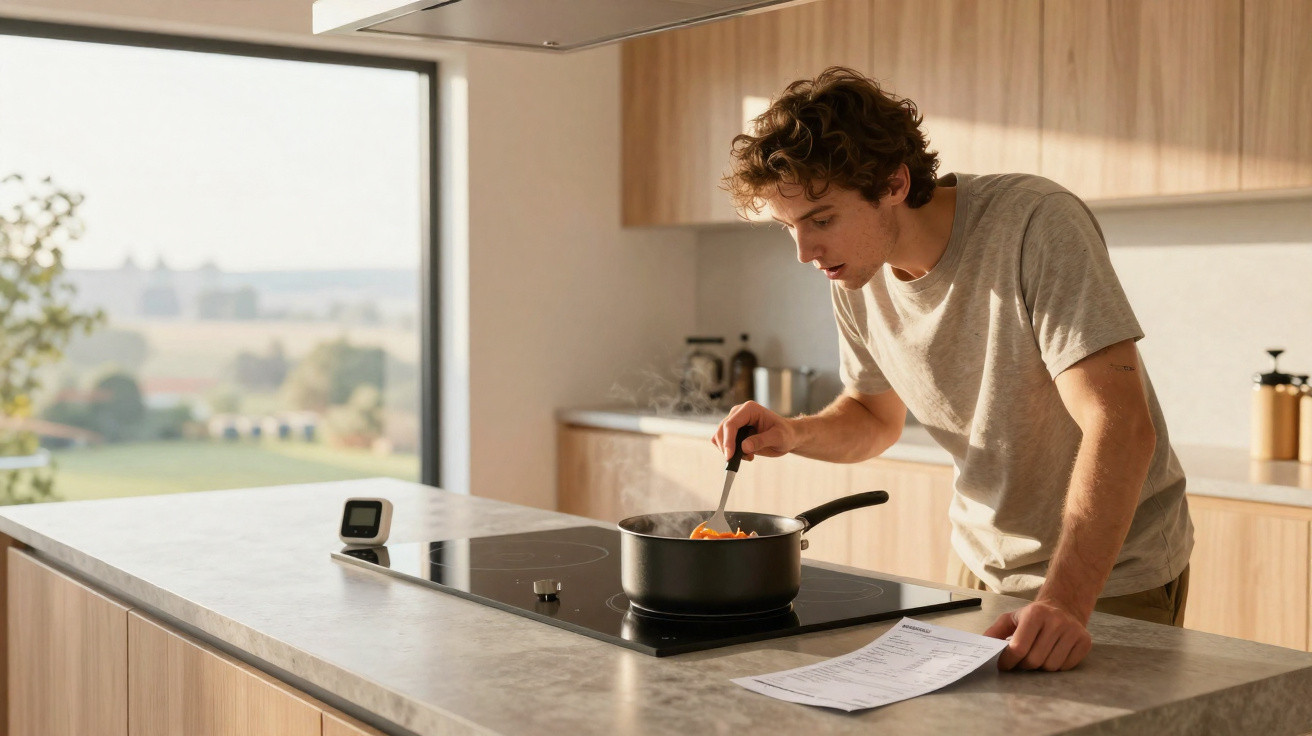
The worktop is smooth, with no visible hob rings, yet the pan boils as if by magic.
The standard kitchen layout is beginning to change quietly.
In newly built homes and high-end renovations, a new kind of hob concealed beneath the worktop aims to combine minimalist design, speed and lower energy use. It replaces the familiar visible induction hob and the older ceramic hob, but also brings a hefty price tag, more complicated building work and questions over who this technology genuinely suits.
What is the “invisible hob” replacing traditional induction?
At the heart of this trend is the so-called invisible cooking hob: a heating system integrated beneath the kitchen worktop itself, usually made from technical ceramic or porcelain stoneware. From a distance, it looks like one uninterrupted surface. The cooking area is only apparent once a pan is placed on it and the system is switched on.
In practical terms, the underlying technology remains the same as conventional induction: coils create an electromagnetic field that heats the base of the pan directly. The difference lies in where those components are fitted.
- Rather than sitting beneath a thin sheet of glass around 4 mm thick, the system operates below a worktop measuring up to 20 mm in thickness.
- The surface is generally made from high-density ceramic, designed to resist scratching, staining and thermal shock.
- In some cases, manufacturers provide lengthy worktop warranties of up to two decades.
Once dinner is over, the island becomes a seamless surface again, ready for serving food, holding tableware or acting as a workspace for an improvised home office in the kitchen.
Infrared and hybrid systems enter the picture
Alongside invisible induction, two further versions are emerging that could reshape the market even more:
- Infrared hobs beneath the stone, which heat the pan base through radiation;
- Hybrid models, which combine induction and infrared technology to direct energy more precisely.
These systems follow the same principle: concentrating heat exactly where it is needed instead of wasting energy by heating glass and unused areas around the pan.
The central promise of this new generation is simple: less wasted heat, a worktop that is cooler to the touch and noticeably shorter cooking times.
Sensors complete the package by cutting the power when no pan is present in the active area or when the system detects improper use.
50% faster? Where the speed gains appear
Users and manufacturers suggest preparation times can be cut by up to 50% compared with a conventional ceramic hob and, in some cases, with entry-level induction models. This improvement comes from the way energy reaches the pan.
Without the so-called “hot spots” around the cooking zone, almost all available power is focused on the bottom of the cookware. That has several practical results:
- Pasta water reaches boiling point in fewer minutes.
- Stir-fries and seared meat come together faster, without the long wait for a lukewarm frying pan to heat up.
- Slow-cooked dishes reach the ideal temperature sooner while delivering the same final result.
For people who cook every day, those few minutes saved at each meal add up over the course of a week – and not only on the clock.
Speed that can affect electricity bills
One less obvious point is that a hob may have a high rated power yet still cost less to run over a month. The key factor is how long it is used.
When the pan reaches the right temperature sooner, the appliance spends less time operating at high power, reducing total energy consumption over the month.
For a household preparing breakfast, lunch and dinner at home, a few minutes saved during each cooking task can add up to hours less use of electric heating overall. It is not a miraculous saving, but it is likely to become noticeable for households that use the hob heavily.
Safety: a cooler worktop and a less stressful kitchen
Safety is another major selling point. By directing energy more efficiently, the worktop surface stays more moderate to the touch, particularly around the edges of the active area.
This operation has three direct effects:
- A lower risk of accidental burns, especially for children and older people;
- Fewer overheating points that could damage utensils or the worktop itself;
- A less stuffy kitchen, as less heat escapes into the room.
When combined with sensors that switch the system off without a pan in place, this setup appeals to homes with young children, curious pets and people with reduced mobility. Overall, it can make the kitchen feel calmer, with less need to keep checking whether the heat has been left on.
How much it costs to replace a visible induction hob
While the convenience is appealing, the cost tends to bring expectations back down to earth. A good conventional induction hob can cost between R$ 1,500 and R$ 6,000, whereas high-end invisible systems often start at the equivalent of around R$ 4,000 for the cooking module alone, excluding both the worktop and installation. When converted to Brazilian market pricing, complete projects can comfortably exceed five figures.
| System type | Typical price range | Project profile |
|---|---|---|
| Traditional visible induction | Low to mid-range | Straightforward replacement, with no major building work |
| Ceramic hob | Low | Very tight budgets and moderate use |
| Invisible hob (induction/infrared) | Mid to high-end | New build or full renovation |
The total cost also includes:
- A high-resistance ceramic or porcelain stoneware worktop, often made to measure;
- Specialist labour from both a stonework installer and an electrician;
- Potential upgrades to the electrical installation to support the concentrated load.
For this reason, its current audience is still largely limited to new builds or extensive renovations, where the entire kitchen would be rebuilt anyway.
Who truly benefits from an invisible cooking hob?
Before following the trend, it is worth answering a few questions to establish whether replacing an existing induction or ceramic hob makes sense.
- Does the budget cover a new compatible worktop and the required labour?
- Does the household cook daily, or is the hob used only at weekends?
- Are there children, older people or pets who would benefit from a cooler surface?
- Are you comfortable with more integrated systems, sometimes operated through an external control panel or even an app?
- Is the property owned or rented? In rented homes, a traditional induction hob is usually the more sensible choice.
The new technology makes most sense for people who see the kitchen as the central room of the home, use the hob intensively and plan to remain in the same property for many years.
For anyone who cooks infrequently, rents their home or does not want to undertake building work, a good visible induction hob still offers more than enough speed, safety and temperature control for everyday life.
What hardly anyone mentions: practical limitations and risks
Like any new technology, the invisible hob has its sensitive points. One is its reliance on a specific worktop material. Not every natural stone copes well with the combination of repeated heat and thermal shock, limiting use to technical ceramics and porcelain stoneware.
Maintenance is another consideration. A fault in the cooking area cannot usually be resolved simply by replacing a sheet of glass. In some cases, part of the worktop structure must be dismantled, increasing both the cost and complexity of repairs.
There is also an adjustment period. With no clear visible markings, users need time to remember exactly where the “rings” sit beneath the surface. Some models feature subtle indicators, lighting or almost imperceptible outlines to guide pan placement, but there is still a learning curve.
How to estimate the effect on electricity bills and daily routine
To get an idea of whether the investment could pay off in your situation, one approach is to monitor your own routine for several weeks:
- Add up the daily time the hob is used at high power for main meals.
- Allow for a 20% to 40% reduction in that time with a more efficient system, leaving room for variation.
- Apply that saving to your electricity bill, taking your local tariff into account.
The amount saved is unlikely to cover the initial cost on its own within a few years, but it may reduce the monthly impact and, alongside the durability of the worktop and greater convenience, make the project easier to justify.
Another way to assess it is by trying induction first: people who currently cook with gas or a ceramic hob can test a portable induction hob before moving to a complex built-in system. This can help establish whether the faster, more controlled cooking style suits the household routine.
Terms and details worth checking before buying
Certain expressions appear regularly in catalogues and can be confusing:
- Induction: heats the pan's metal directly. It requires cookware with a magnetic base.
- Infrared: produces heat through radiation, similar to heating elements but more targeted.
- Hybrid: combines both approaches in an attempt to balance speed, control and thermal comfort.
- Rated power: the maximum figure in watts; it does not alone determine how much electricity will be used, as operating time matters just as much.
- Flexible zones: areas that detect the size of the pan and adjust energy distribution accordingly.
Taking time to review these details, compare technical specifications and match them to the dishes you prepare most often can help prevent disappointment. Someone who does a great deal of slow cooking, for instance, benefits more from precise temperature control than from the highest peak power.



Comments
No comments yet. Be the first to comment!
Leave a Comment