
Cleaning marble with vinegar or bicarbonate of soda may seem like a clever home remedy, but the stone reacts poorly to this kind of improvised approach. Because it has a carbonate and delicate base, its shine can quickly disappear when the wrong product becomes part of the cleaning routine.
What makes marble so sensitive to certain products?
Marble is formed through changes in limestone rocks and retains a carbonate composition, mainly calcite and sometimes dolomite, as shown by its mineral composition. This is why acidic products affect its light-coloured and polished surface.
The stone is also valued precisely because it can be polished and display decorative veining and textures. When cleaning erodes the top layer, the harm is not merely cosmetic: it affects the uniformity and finish of the covering.
These factors show why marble needs specific care:
- Limestone base: its carbonate composition makes the stone more susceptible to chemical attack.
- Valuable polish: the glossy finish is one of marble's most highly valued qualities.
- Veining and texture: its decorative appeal relies on a preserved, even surface.
- Premium use: the stone is widely used in construction and surface coverings.
- Cumulative damage: repeatedly cleaning it incorrectly speeds up loss of shine and permanent marks.
Why do vinegar and bicarbonate of soda damage marble flooring?
Vinegar is harmful because it introduces acidity to a rock with a carbonate composition, while bicarbonate of soda can become abrasive when made into a paste or scrubbed forcefully. The usual result is a loss of shine and the appearance of stains.
The most common mistake is assuming that grime and limescale are better removed with a strong homemade mixture, when marble requires gentle cleaning. The more often it comes into contact with unsuitable products, the greater the likelihood of irreversible and dull wear.
What is the correct way to clean marble without eroding the stone?
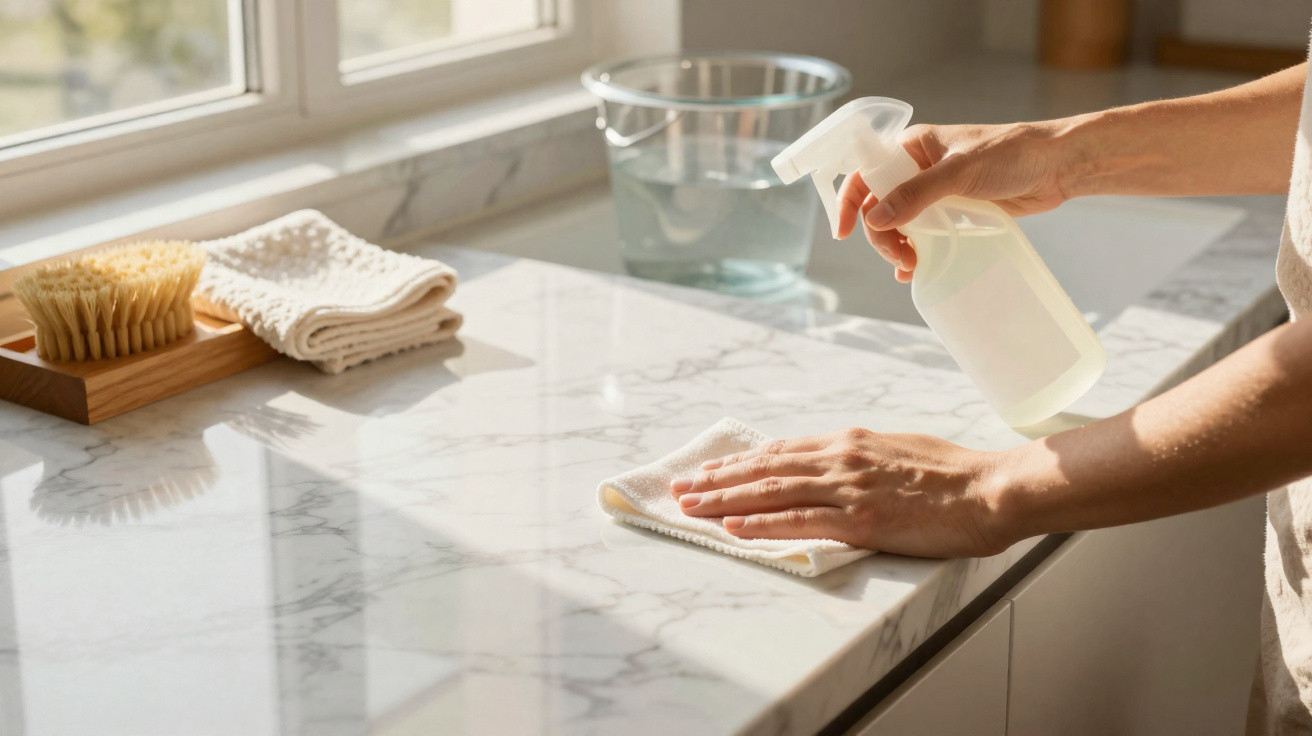
The safest approach is to mix colourless neutral washing-up liquid with room-temperature water, then apply it using a soft microfibre cloth. This combination respects the stone by cleaning it without directly attacking its sensitive and decorative surface.
Gentle cleaning preserves more
Less aggression, greater durability
Colourless neutral washing-up liquid, room-temperature water and microfibre make up a routine that is more compatible with marble's structure. The aim is to remove dirt without corroding or scratching it.
Rather than using strong homemade mixtures, the best result usually comes from carefully repeating a simple, consistent and low-impact method.
Microfibre is useful because it picks up residue without scratching, while room-temperature water avoids unnecessary shocks during routine cleaning. Rather than scrubbing until you force a result, it is best to repeat the cleaning with gentleness and consistency.
In practice, the right care is clearer when followed like this:
- mix a small amount of colourless neutral washing-up liquid into water;
- use a well-wrung microfibre cloth, never a soaking-wet one;
- clean with gentle movements, without abrasion or excessive pressure;
- dry the surface afterwards to prevent persistent marks.
How can marble flooring be protected for longer?
After cleaning it correctly, it is worth considering longer-lasting protection with water-repellent sealants designed for natural stone. They help limit liquid absorption and slow everyday wear, maintaining the smooth and shiny appearance for longer.
How often this care is needed depends on how the floor is used, foot traffic in the home and how often the surface is exposed to splashes. In more heavily used areas, preventative maintenance stops minor attacks from becoming visible wear and loss of protection.
This preventative reinforcement is generally worthwhile for several reasons:
- it makes it harder for liquids that may mark the stone to penetrate;
- it helps extend the effect of the covering's natural polish;
- it lowers the risk of persistent stains in high-use areas;
- it makes day-to-day maintenance gentler and more efficient.
How can you change your routine without continuing to damage the covering?
This care becomes even clearer in homes where the covering has already lost its shine due to acidic homemade mixtures, a situation similar to the explanation of why marble flooring should not be cleaned with vinegar. In these cases, a change in habits makes all the difference.
Ultimately, stopping the use of vinegar and bicarbonate of soda on marble is not excessive; it is basic prevention. With neutral washing-up liquid, water and the right cloth, the floor retains its polished appearance and useful life for longer.



Comments
No comments yet. Be the first to comment!
Leave a Comment