
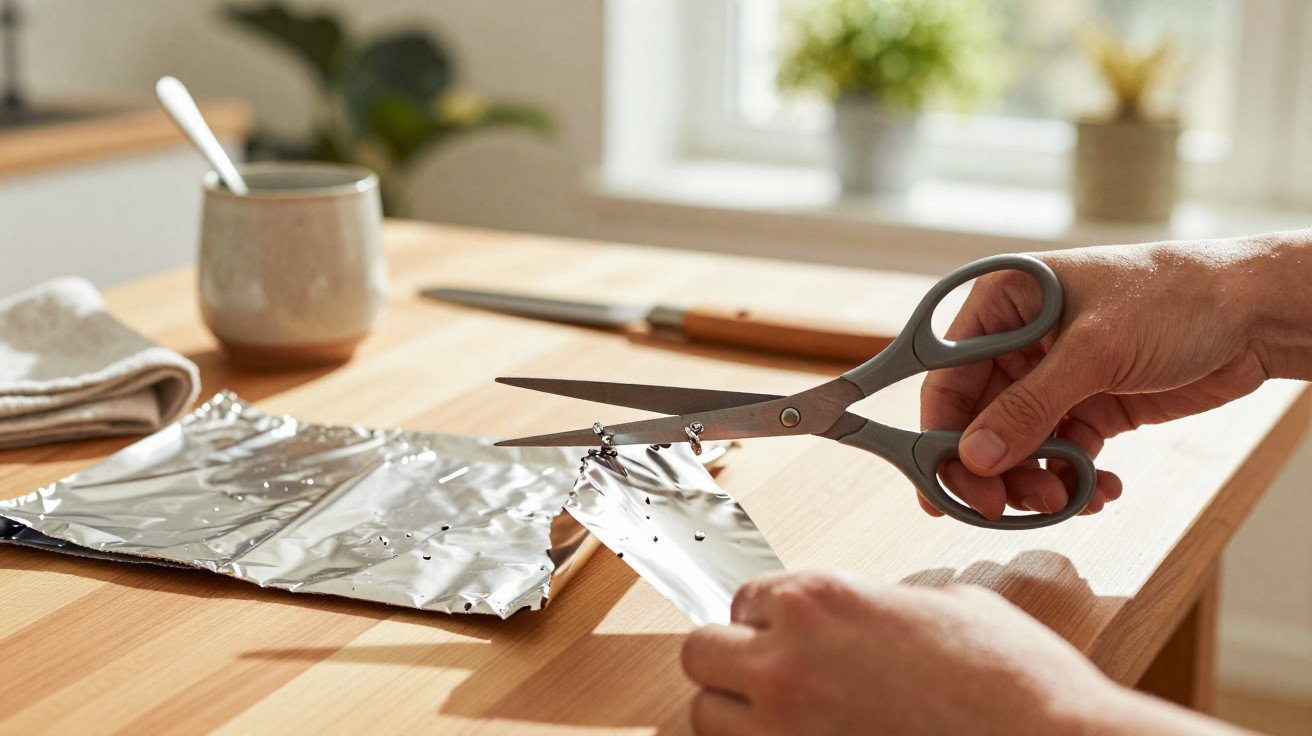
Putting aluminium foil on the tip of scissors has become a familiar habit in many homes and sewing workshops. The practice stands out for being straightforward and inexpensive, and is associated with attempts to improve cutting performance, protect the tool and extend its use for everyday light-duty jobs.
What does putting aluminium foil on the tip of scissors mean?
When people refer to putting aluminium foil on the tip of scissors, they usually mean either wrapping the end in the material or cutting through several layers of foil. In the first instance, the foil acts as a protective cover for the tip, helping to reduce the risk of accidents and minor dents in the blade.
The second approach, which is more widespread, involves folding the foil into several layers and making repeated cuts with the scissors. This produces slight surface polishing, which may improve performance in scissors that are only mildly blunt, although it is not a replacement for professional sharpening.
What is the purpose of putting aluminium foil on scissors every day?
The main aim of this practice is to try to improve a pair of scissors' cutting ability quickly, cheaply and at home. With general-purpose scissors, the trick can make cutting feel smoother when working with standard printer paper, thin packaging or school materials after the edge has begun to lose effectiveness slightly.
Wrapping the tip in foil can also protect the blade when scissors are stored in drawers, toolboxes or bags. In homes with children, this covering limits direct contact with the sharp end and prevents wear caused by friction against other metal objects kept alongside it.
How to use the aluminium foil trick on scissors step by step
Anyone wishing to try this method on household scissors can follow a simple process that requires no technical skill. The steps below are generally enough to check whether there is a noticeable improvement in cutting performance for basic uses:
- Cut a piece of aluminium foil approximately 30 to 40 centimetres long.
- Fold the piece several times to create a strip with multiple layers, 3 to 5 centimetres wide.
- With clean, dry scissors, make consecutive cuts along the strip, fully opening and closing the blades each time.
- Continue until the entire strip has been cut into smaller pieces, then wipe the blades with a dry or slightly damp cloth.
If the sole aim is to protect the tip, simply cut out a small square of foil, place it over the end of the closed scissors and shape it with your fingers. The cover can be replaced whenever it becomes badly crumpled or torn, supporting basic safety and preservation.
What are the precautions and limitations of using aluminium foil on scissors?
Although it can be useful as a household trick, aluminium foil is not suitable for high-precision scissors, including those used for hair cutting, professional sewing or surgery. In such cases, specialist sharpening is essential to preserve the correct blade angle and prevent irreversible damage to the cutting edge.
The method is also not advisable for heavily damaged scissors with visible serrations, broken tips or misaligned blades, as foil cannot resolve structural defects. To extend the tool's service life, this technique should be combined with simple care measures, such as avoiding unsuitable materials, storing scissors in a dry place and cleaning the blades after use.





Comments
No comments yet. Be the first to comment!
Leave a Comment