
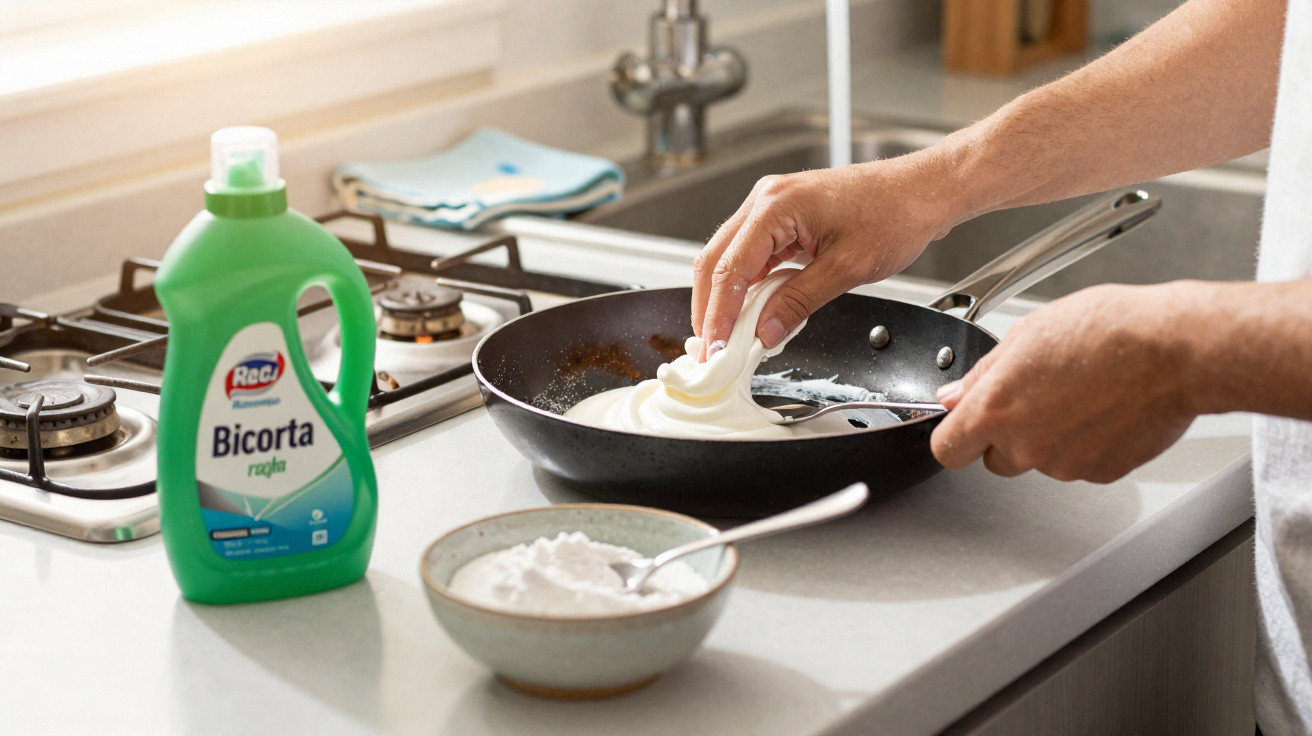
Mixing bicarbonate of soda with washing-up liquid creates a useful paste for lifting stuck-on grease, food residue and burnt-on grime from hard-wearing surfaces. The bicarbonate of soda provides gentle abrasion, while the washing-up liquid helps loosen grease. This combination is particularly effective on the bases of pans, oven racks and metal parts of the hob.
Why do bicarbonate of soda and washing-up liquid work better together?
Bicarbonate of soda contains fine particles that dislodge residue through friction without the need for an excessively harsh scourer. Washing-up liquid, meanwhile, contains surfactants that surround grease and make it easier to rinse away with water. When made into a paste, the two ingredients stay on the dirty area for longer than they would in a liquid solution.
- Bicarbonate of soda helps lift carbonised deposits.
- Washing-up liquid works mainly on oils and grease.
- The paste consistency keeps both ingredients in place on the soiled area.
- Less friction is usually needed to remove the crusted residue.
What ratio should be used to make the cleaning paste?
A practical starting point is two parts bicarbonate of soda to one part mild washing-up liquid. Mix them until they form a thick paste that spreads easily. If it is too dry, add a few drops of washing-up liquid or water; if it becomes too runny, mix in a little more bicarbonate of soda.
There is no need to make a large batch. For a small area of the hob, for instance, two tablespoons of bicarbonate of soda and one tablespoon of washing-up liquid will usually be enough. Prepare only what is needed for that cleaning task and dispose of any leftover paste afterwards.
How should bicarbonate of soda and washing-up liquid be used on a burnt pan or hob burner?
On durable surfaces, apply the bicarbonate of soda and washing-up liquid paste directly to the grease or burnt-on residue, then leave it for around 10 to 15 minutes. This gives the washing-up liquid time to work into the grime and allows the crusted layer to absorb moisture before scrubbing.
- First remove any loose residue with kitchen paper or a cloth.
- Spread a thin layer of paste across the encrusted area.
- Leave it for approximately 10 to 15 minutes.
- Scrub with a soft sponge or a brush suitable for the material.
- Rinse, or wipe with a damp cloth, until all of the product has been removed.
Why should the mixture not be used on every surface?
Although it may look like a very fine powder, bicarbonate of soda is still abrasive. Repeated scrubbing on non-stick coatings can scratch or wear away the layer that prevents food from sticking. For this reason, pans with Teflon or other delicate coatings should be cleaned according to the manufacturer's instructions, usually with washing-up liquid and a non-abrasive sponge.
The same caution applies to polished glass, glossy surfaces and certain metal finishes. Vigorous scrubbing with the paste may cause micro-scratches or dull the shine. On glass hobs, for example, it is safer to use cleaning products and scrapers designed specifically for that type of surface.
When is this cleaning mixture genuinely worthwhile?
Bicarbonate of soda with washing-up liquid is most effective where grease is combined with stuck-on residue on materials that can tolerate mildly abrasive cleaning. The outer bases of stainless-steel pans, oven racks and removable metal hob components are among the most suitable uses. If there is any uncertainty about the finish, always test it first in an inconspicuous spot.
The benefit comes from how the two ingredients share the task: washing-up liquid loosens the grease, while bicarbonate of soda helps remove the layer that remains mechanically attached. Allowing enough contact time and considering the material are more important than scrubbing hard, as the same abrasion that removes a crusted deposit can also harm a delicate coating.

Comments
No comments yet. Be the first to comment!
Leave a Comment