
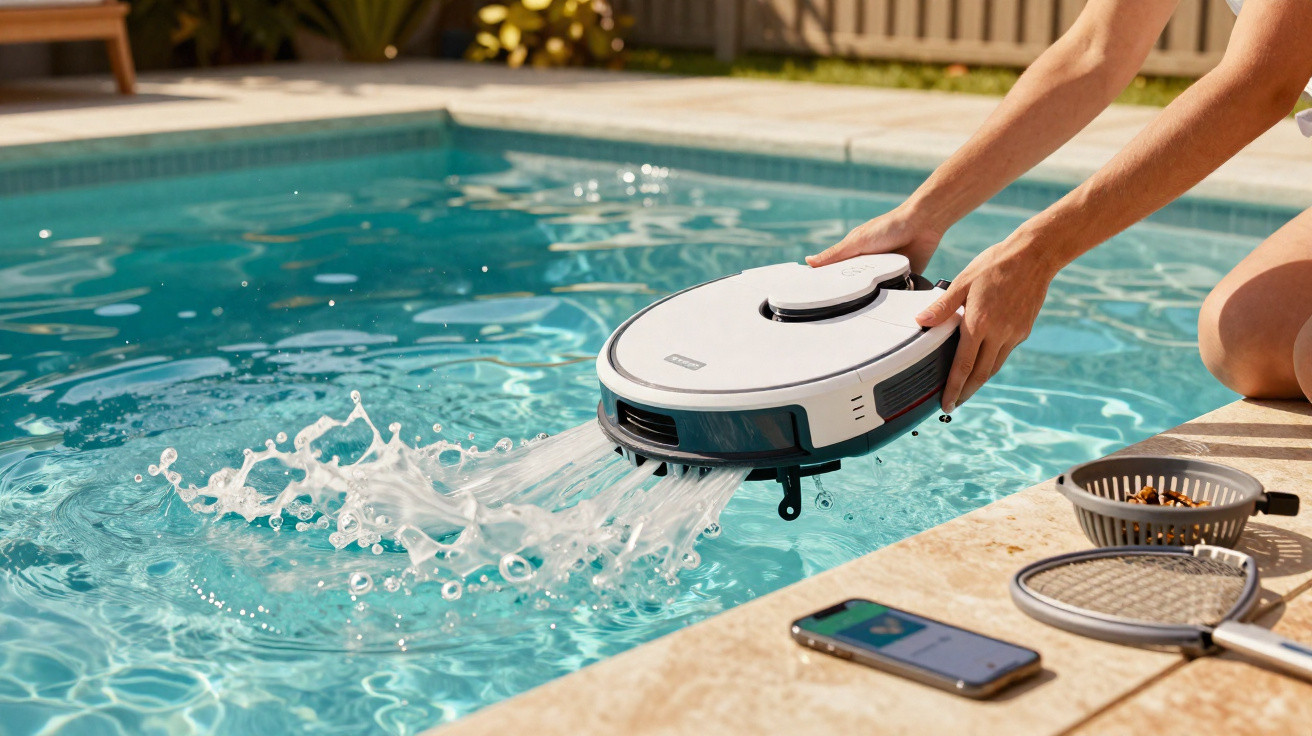
The Beatbot Sora 70 claims to deliver 4-in-1 cleaning. Pool floor, walls, waterline and even the water’s surface: it promises to leave the entire pool spotless. We tested this still-uncommon versatility for a month to find out whether it holds up in the water.
Quietly but steadily, pool robots are becoming more mainstream with every summer. That is good news, as France offers an enormous potential market. The country has nearly 3.7 million domestic pools, including 90,600 newly built ones in 2025 alone. This pool stock puts France first in Europe and third worldwide, behind the United States and Brazil.
Once dominated by specialists such as Maytronics and Zodiac, the market is now drawing a new generation of manufacturers. Aiper established itself early as one of the cordless pioneers, while Dreame, Mova and Ecovacs have more recently moved from floors and lawns to swimming pools.
Beatbot has taken a different route. The Shenzhen brand comes from neither the vacuum cleaner nor robotic lawnmower sector. Since entering Europe in 2024, it has focused exclusively on pool robots, specialising in assigning ever more jobs to a single machine.
The AquaSense Pro was the most spectacular illustration of that approach. Launched at €2,499, it used nine motors to clean the floor, walls, waterline and surface, while also dispensing a clarifying agent into the pool. That abundance of features came at a substantial price.
At €1,499, the Sora 70 retains the core of that formula for €1,000 less. It keeps the 4-in-1 principle - floor, walls, waterline and surface - along with two jets that funnel floating debris towards its suction inlet. We put this rare level of completeness at this price through a month of testing in a 40 m² pool, to see whether the Sora 70 loses its footing by trying to do everything.
A substantial machine that gets into the water without fuss
With the appearance of a miniature tank, the Beatbot Sora 70 takes a rather different design direction from several rivals. There are no pastel accents or two-tone bodywork to brighten it up. Black dominates almost everywhere, spanning the chassis’s matt plastics and a large glossy cover. The result is understated, yet suitably serious.
Its plastics are thick and the construction feels tight. That inspires confidence in a device set to spend its entire working life underwater. Despite its robust build, its 10.4 kg weight remains well below the Mova Rover X10’s 15.8 kg. Beneath the chassis, two tracks sit alongside four rollers fitted with rubber fins.
Set-up takes only a few minutes, which is worth remembering for anyone still hesitant about buying a pool robot. The Beatbot app detects the Sora 70 via Bluetooth before Wi-Fi takes over. Moments later, it is ready for its first circuit of the pool.
That Wi-Fi connection is not compulsory, however; the Ecovacs Ultramarine P1, for instance, does without it entirely. Underwater, it makes little difference anyway. Once submerged, the Sora 70 drops off the radar, just like every other pool robot.
Wi-Fi becomes useful when it resurfaces. Cycle completion, battery level, cleaning history and water temperature are then automatically sent to the app. The connectivity does not extend to mapping, though. Beatbot’s flagship AquaSense 2 Ultra displays its routes in the app. This is therefore the first premium refinement sacrificed to reduce the price.
How does the Beatbot Sora 70 navigate underwater?
Underwater, dolphins rely on sonar while sharks follow their sense of smell. Each has its own method, and pool robots work in much the same way. Aiper, for example, has opted for a camera paired with a rangefinder in its Scuba V3.
Beatbot instead uses 18 sensors, including two ultrasonic sensors to identify obstacles, slopes and changes in depth. The manufacturer says nothing about the other sixteen. They presumably monitor water temperature, the robot’s balance or the basket’s blockage level.
It is difficult to name a winning technology from the specifications alone. Whether camera, ultrasound or rangefinder, every manufacturer works with its own tools. As with robot vacuum cleaners, the real difference lies chiefly in the quality of the algorithms and how they use the data collected.
A few exploratory swims, followed by highly precise navigation
Known as SonicSense, the Sora 70’s ultrasonic sensors are designed to keep it away from steps and obstacles. Its first runs in our 40 m² pool were nevertheless somewhat erratic, as though the machine needed a warm-up lap. The S-shaped routes promised by the brand appeared only after several cleaning sessions, once it had apparently learned the pool.
After that, its method proved impressively disciplined. The Sora 70 climbs walls without hesitation, reaches the waterline and descends neatly. Our four corner steps caused no trouble either.
The robot detects them, positions itself on them and cleans them one after another without falling back to the floor, including the final, half-submerged step. That is impressive, as steps remain the industry’s nightmare. If your pool has a broad staircase or a submerged ledge, the Sora 70 will handle it without difficulty.
A few mishaps did occur during its dives, however. Roughly one cycle in four, we found a corner or small area that the robot had clearly missed. It was nothing serious, with the affected space rarely exceeding 1 m², and a second pass resolved the issue.
Six cleaning modes, but some controls are missing
As mentioned, the Sora 70’s main promise is its 4-in-1 cleaning. In other words, it handles the floor, walls, waterline and surface. The waterline is the band at water level where sun cream, pollen and greasy residue build up. Over time, particularly when a pool is used by adults and children alike, this creates an unattractive ring.
Six modes cover these areas. “Pro” combines all four in one cycle, while “Standard” cleans everything except the surface. Three dedicated programmes target just the floor, the surface, or the walls and waterline. An Eco mode completes the selection. The app also shows the status of consumables and sends a notification when a cycle ends. These alerts arrive only after the Sora 70 has resurfaced, however, as it cannot be contacted while working on the bottom.
Over the weeks, we found it a little sparse compared with competing models. There is no weekly scheduler for setting cleanings on specific days and at set times. Nor can you alter the suction power, whereas the Ecovacs Ultramarine P1 offers three levels, or adjust travelling speed as Mammotion allows with the Spino E1.
Lastly, although the six modes cover the essentials, they never let you create your own combination. If, for example, you want to clean the floor and surface without doing the walls, you will need to run two cycles.
Strong suction, but no ultra-fine filter
To get the work done, the Sora 70 employs eight motors divided between propulsion, brushing and suction. Two independent pairs of rollers, at both the front and rear, loosen dirt from the lining while the pump draws it in through a 17 cm-wide inlet. Claimed flow rate reaches 25.7 m³/h. It is not the fastest in the sector - the Mova Rover X10, for example, reaches 38 m³/h - but that is a more expensive pool robot. In its price bracket, the Sora 70 still ranks among the better performers.
Nothing escaped the basket on its first pass, from dead leaves and gravel to sand. It has a 6-litre basket, too, which is a welcome capacity. By comparison, the Aiper Scuba V3 makes do with 3.5 litres. It lifts out from the top with a press of the cover, and a blast from a hose empties it within seconds.
The mesh reveals its limits when dealing with fine particles, though. Its 150 microns roughly match the diameter of a fine grain of sand. Anything smaller - including pollen, microscopic algae and mineral dust responsible for cloudy water - passes through the basket and immediately returns to the pool.
For finer filtration, Beatbot sells an ultra-fine kit capable of reaching 3 microns for €60. First, that is very expensive for this type of accessory. Second, it is rather surprising that it is not included at the Sora 70’s price. To make the contradiction even clearer, the brand regularly offers it free with the robot during promotional periods. Frankly, it should simply be supplied as standard.
JetPulse, the Beatbot Sora 70’s defining feature
Cleaning the water’s surface would usually require spending more than €2,000 or adding a separately sold skimmer. Beatbot does neither, instead tackling the issue with its JetPulse system.
Two side jets propel water towards the front of the robot, creating a converging current that draws floating debris towards the suction inlet rather than pushing it ahead. In this mode, the robot no longer dives. It floats and travels across the surface, with its two jets producing a constant intake current in front of it.
The distinction matters. A robot that merely moves forwards pushes along whatever is drifting - a flower petal or a dead bee can be sent spinning to the other end of the pool in the turbulence created by its body. Here, the current brings them back towards the suction opening.
During our surface-mode sessions, the results were convincing. Everything floating on the water gradually disappeared as it passed. It did so without needing to cover the same place three times. The waterline receives the same treatment.
To put it to the test, we spent an entire afternoon applying an unreasonable amount of sun cream. The following morning, after letting the robot work for 2 hours, there was almost no trace left. The Beatbot Sora 70 had pressed itself just beneath the surface and removed virtually everything in its path.
Battery life is more about the pool than the battery
On paper, the 10,000 mAh battery looks impressive. It must be viewed in context, though, as it has to run eight motors, two pairs of rollers and a 25.7 m³/h pump. This explains why claimed battery life is limited to 5 hours on the floor and 7 hours on the surface.
Each mode has its own duration settings, calibrated according to the size of the task. Pro mode starts at four hours, Standard and Surface modes at two, while Wall mode drops to just one hour. A MAX setting lets the robot run until the battery is depleted. These numbers do not tell the whole story, however. A pool robot does not drain its battery in a predictable way: it depends on the selected mode, the pool’s size and, above all, its condition. Knowing your pool well is what matters most.
In our 40 m² pool, run times varied considerably. After a windy night, the Beatbot Sora 70 spent 2 hours skimming the surface before deciding it had done enough. On another day, with cleaner water, it finished in under an hour. In every case, its endurance never let us down.
Allow four and a half hours for a full recharge, thanks to 65 W fast charging. That is a welcome time, especially given its endurance. One minor disappointment remains: there is no charging station, even though less expensive robots can offer one.
Beatbot Sora 70 price and competition
Launched at €1,499, the Sora 70 is a mid-range robot. Above it, the AquaSense Pro cost €2,499 at launch and added a fifth skill: water clarification. The Mova Rover X10 is priced the same and also cleans the surface, with 38 m³/h suction.
Below it, direct competitors abandon that all-important surface cleaning. Released at €1,299, the Dreame Z1 Pro relies on its 30 m³/h flow rate and a map available in its app. The Aiper Scuba V3, launched at €1,099, includes a camera and artificial intelligence intended to refine its behaviour over the weeks.
Our verdict on the Beatbot Sora 70 pool robot
After a month of watching it dive, the conclusion is clear: Beatbot has made the right compromises. Its suction is effective on everyday debris, and walls do not intimidate it. On steps, it even performs better than many rivals, which still often struggle with this task.
Surface cleaning is particularly meaningful compared with models limited to the floor, walls and waterline. JetPulse genuinely allows it to skim the pool and collect floating debris, rather than simply floating around for show.
The savings compared with Beatbot’s premium range show up elsewhere. There is no mapping, the app offers limited customisation, small areas are occasionally missed and, most importantly, filtration stops at 150 microns. It is difficult to understand why the 3-micron filter, sold for €60, is not included in the box as standard, along with a charging station.
None of this matters greatly in pools that quickly become dirty. A pool surrounded by trees and regularly covered in leaves, pollen or insects will give it plenty to do at the surface. The same applies to a family pool, where children, sun cream and sand multiply dirt at every level. Its 6-litre basket and very good endurance also allow it to tackle larger jobs without repeated trips to the mains. In this sort of situation, it is hard not to recommend it wholeheartedly.
Beatbot Sora 70
€1,499
8.9
| Category | Score |
|---|---|
| ### Set-up and build quality | 9.0/10 |
| ### Navigation and obstacles | 9.5/10 |
| ### App and features | 7.5/10 |
| ### Cleaning performance | 9.5/10 |
| ### Battery life and charging | 9.0/10 |
What we like
- “4-in-1” cleaning, including the surface
- 6-litre basket and precise navigation
- Excellent cleaning performance
- Convincing battery life and fast charging
- Automatic parking at the surface
What we like less
- Optional 3-micron filter
- No charging station
- App has no weekly scheduler or suction adjustment
- No pool mapping

Comments
No comments yet. Be the first to comment!
Leave a Comment