
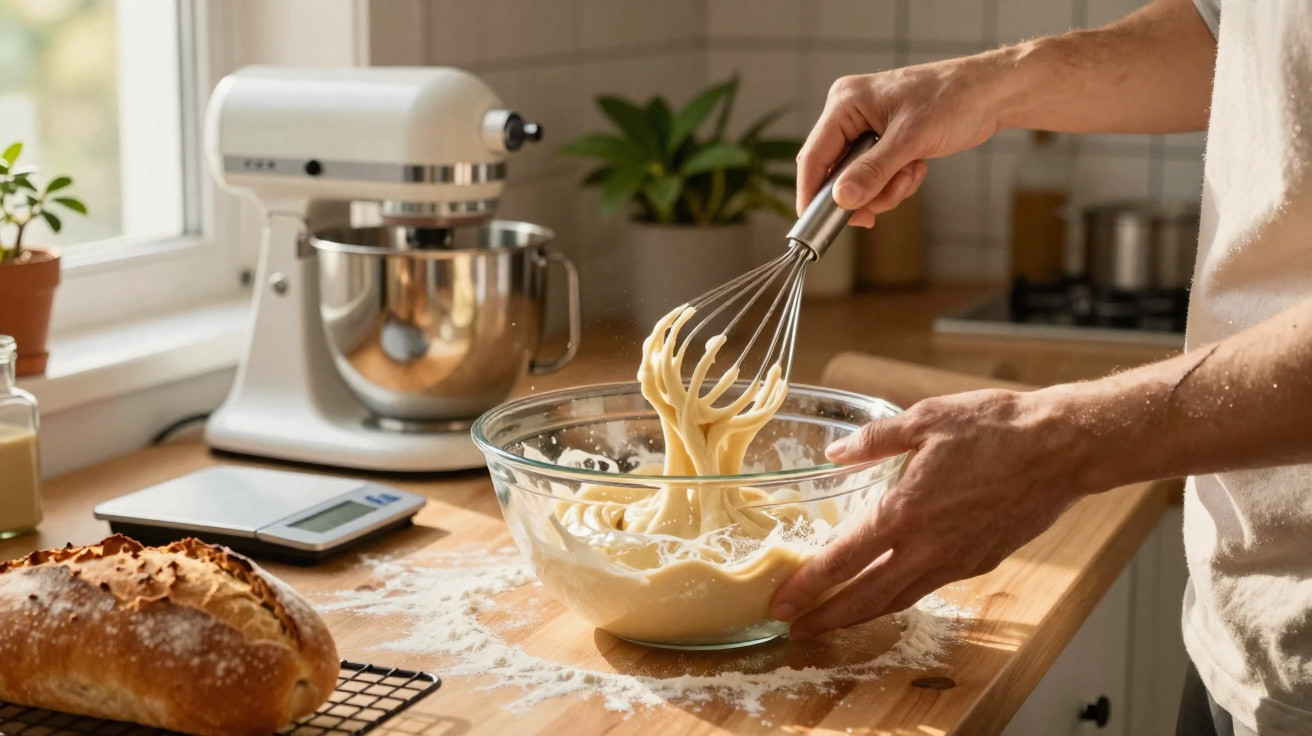
At a time when electricity is expensive and kitchens are short on space, one tiny accessory promises to speed up homemade doughs without a plug, button or digital display.
While many people dream of owning an expensive stand mixer, a simple manual tool costing around 12 euros is finding its way into kitchens and Amazon wish lists. Its proposition is straightforward: it mixes sticky dough quickly and with control, making a stand mixer unnecessary for many everyday recipes.
What is the 12-euro gadget challenging the stand mixer?
This accessory has no motor, takes up no worktop space and is lightweight. Known as a Danish dough whisk, or fouet danois, it is a traditional dough-mixing tool from Scandinavian kitchens that has enjoyed renewed popularity with the rise of home bread making.
At first glance, it looks nothing like the familiar balloon whisk. Its metal head consists of three concentric stainless-steel rings, made from thick wire of roughly 3 mm, which is rigid enough not to bend in dough. The construction is open: rather than trapping dough among many thin wires, it lets the mixture move freely through the rings.
Its handle is generally made from beech wood or silicone and is usually between 24.5 and 34 cm long. That reach makes it easier to get to the base of deep bowls and large mixing bowls, often used for bread, pizza and wetter cake recipes.
“This straightforward shape, designed for heavy and wet doughs, is what allows the tool to compete with machines costing many times more.”
The Danish dough whisk has rural origins. In colder parts of Scandinavia, it was used to work dense rye breads long before electric mixers arrived in home kitchens. It was not a “gourmet” accessory, but a practical implement built to last and work anywhere, whether electricity was available or not.
Why the Danish dough whisk competes with a stand mixer
For highly hydrated doughs - those containing more than 70% water and therefore very sticky - a stand mixer is not always the hero it appears to be. The rapid, continuous movement of its attachments incorporates a great deal of air and warms the mixture. This can speed up gluten development too much and oxidise the dough, often producing a denser, less irregular crumb.
The Danish dough whisk works differently. With a small contact area, it cuts through the dough rather than pounding it. When bringing together water and flour, it moves the mixture gently, limits mechanical warming and prevents too much air from being worked in. The result is often a well-hydrated dough with better autolysis and a more open crumb in bread recipes.
“In wet doughs, the Danish dough whisk hydrates flour efficiently without ‘working’ the gluten, which encourages lightness and a softer texture.”
For no-knead bread, sourdough loaves, highly hydrated pizza doughs and mixtures such as muffins or quick cakes, this utensil can comfortably fulfil the role of a stand mixer. The aim is simply to combine the ingredients until incorporated, without overworking them.
Some manufacturers state that the tool can handle around 900 g of flour in no-knead bread recipes without the metal head bending or the dough climbing uncontrollably up the handle.
Where the stand mixer remains unbeatable
That does not mean a Danish dough whisk replaces a stand mixer in every situation. For whipping cream, whisking egg whites to stiff peaks or kneading a rich dough containing butter and eggs for a long time, such as brioche, the stand mixer still has the advantage.
These recipes require tiny air bubbles to be incorporated, something a manual whisk cannot achieve with the same speed or consistency. This is where an electric motor proves useful, providing steady movement for extended periods without physical effort.
How to choose a good Danish dough whisk
Within the 10-to-12-euro price range, several versions of this tool are available, with differences that can affect both durability and comfort.
- Head material: prioritise 304 stainless steel, which is more resistant to corrosion and intensive use with wet doughs.
- Wire thickness: thicker wires, at around 3 mm, are less likely to bend when dough becomes heavy.
- Handle: wood feels pleasant and offers a secure grip; silicone provides better grip and is often dishwasher-safe.
- Size: versions between 25 and 34 cm work well in both smaller bowls and large mixing bowls.
It is also worth inspecting the finish where the handle meets the metal section. Large gaps can collect dried dough and make cleaning more difficult, which can affect hygiene over time.
Technique and movement matter when using a Danish dough whisk
Having the right tool is not enough on its own. The best movement with a Danish dough whisk is unhurried and almost patient. Rather than whisking rapidly, make slow circles while scraping the bottom and sides of the bowl, drawing the flour towards the water in the centre.
Once no dry flour remains visible and all the dough is hydrated, it is time to stop. From then on, resting and manual folds, if the recipe calls for them, take centre stage. This intuitive control suits anyone who does not want to rely entirely on timers and programmed speeds.
“The less you persist with mixing once the flour is hydrated, the more likely you are to achieve soft, elastic dough without overworking it.”
Who benefits most from this type of gadget?
A Danish dough whisk can make a particular difference for several kinds of home cook:
| Profile | Why the tool helps |
|---|---|
| People living in small spaces | It takes up no worktop space, fits into any drawer and can partly replace a bulky appliance. |
| Beginners in home bread making | It gives tactile control over the dough and reduces the fear of choosing the wrong mixer speed. |
| Those looking to save energy | It is entirely manual and uses no electricity during frequent baking sessions. |
| Sourdough enthusiasts | It respects the stages of autolysis and slow gluten development valued in this type of recipe. |
Care, limitations and minor risks
Like any kitchen accessory, the Danish dough whisk has its limits. It is less effective with very dry, low-water doughs, and the strain on your arm increases. In those cases, traditional hand-kneading or a stand mixer fitted with a dough hook still makes more sense.
Cleaning is another consideration. If dough dries on the rings, removing it may require a brush and some patience. Washing it immediately after use under running water will usually solve the problem. Soaking it for a few minutes can also help, particularly with wholemeal flours, which tend to stick more firmly.
For recipes containing eggs and sugar, the utensil works well for initial mixing, but it does not replace a standard whisk when the aim is to aerate cake batter for several minutes.
Concepts worth understanding before buying a Danish dough whisk
Two terms frequently arise when discussing this accessory: high hydration and autolysis.
High hydration means using a high proportion of water relative to flour. A dough at 70% hydration, for instance, contains 70 g of water for every 100 g of flour. This ratio creates very sticky doughs that cling to hands and make kneading tiring - precisely the situation in which a Danish dough whisk excels.
Autolysis is the resting stage for flour and water before salt or yeast is added. During this time, enzymes naturally present in the flour begin to work, helping gluten develop without intense mechanical effort. The utensil helps create that ideally combined initial mixture without overworking it.
Practical kitchen routines for the Danish dough whisk
In a household that bakes bread once or twice a week, a Danish dough whisk can handle the entire mixing stage, leaving only a few quick hand folds during fermentation. If there is a stand mixer, it can then be reserved for more demanding recipes, such as festive panettone and brioche.
For someone living alone with limited space who makes only a pizza and a few muffins at the weekend, this 12-euro accessory can become a key kitchen companion. It can replace a wooden spoon and an ordinary whisk and, in many cases, remove the immediate desire for a robust stand mixer that might spend more time decorating the worktop than actually switched on.
Comments
No comments yet. Be the first to comment!
Leave a Comment