
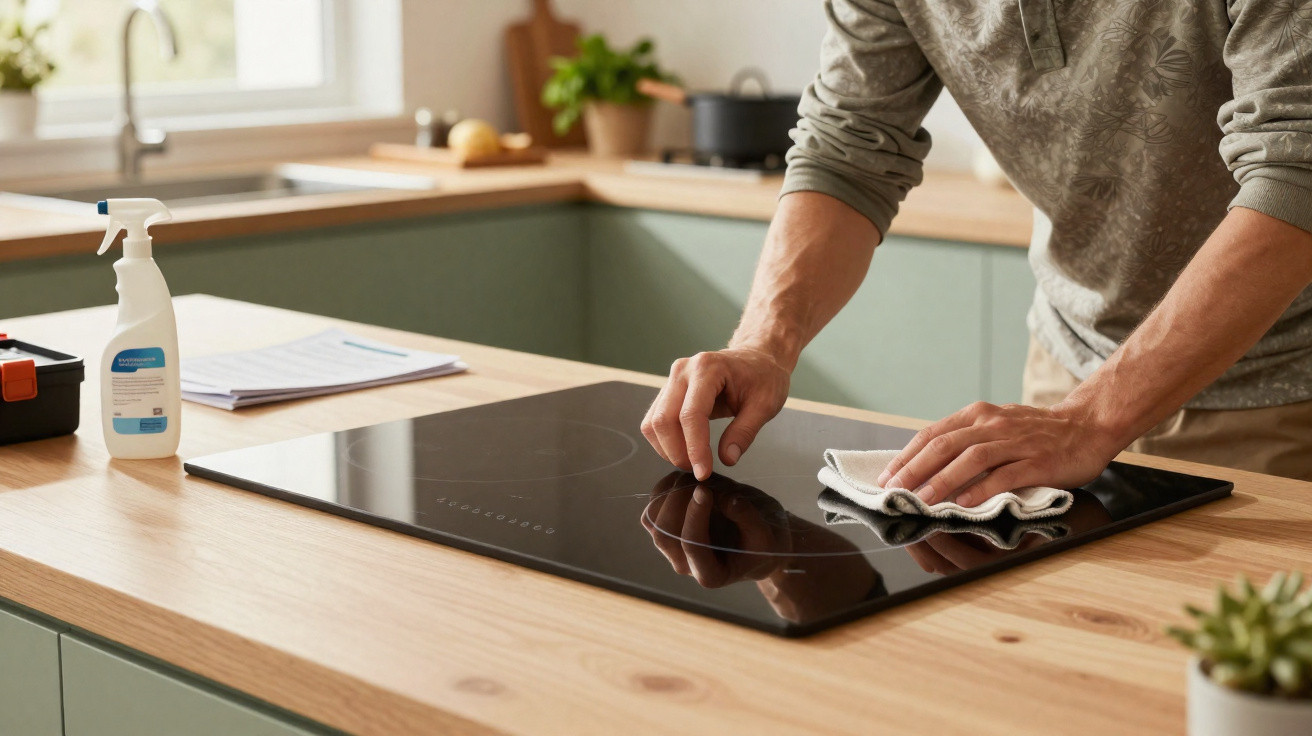
The first time you spot it, you are simply cleaning the hob after supper. The light catches something that was not there the day before. You stop, angle your head, and pass a fingernail over the glass ceramic surface. Under the kitchen light, a fine silver line shows up, like a tiny scar on otherwise smooth skin.
You run through the evening in your mind: the weighty cast-iron pan, a saucepan pushed sideways, a grain of salt that went unnoticed. Your cooktop, which had looked flawlessly glossy and almost futuristic, now seems a little older, more delicate and faintly uncared for.
You reach for your phone, search for “remove scratches glass ceramic cooktop”, and quickly disappear down a rabbit hole. Experts, forums and manufacturers all offer conflicting advice.
One message keeps resurfacing: perhaps you should leave it alone.
Why a tiny scratch on your cooktop feels so big
At first, a scratch on a glass ceramic cooktop seems insignificant. It is merely a hairline blemish on a gleaming black or white panel, visible only from a certain angle. But once you have noticed it, your eyes find it every time you enter the kitchen.
It can feel unexpectedly personal. The surface is not simply an appliance; it is where daily life plays out: hurried pasta dinners, experimental curries and children’s pancakes at 7 am. A cooktop carries all of that activity, so seeing it look exposed can be unsettling.
Your mind quietly asks: have I just damaged something expensive?
Speak to others and a familiar account emerges. A couple in a compact flat, delighted with their first “real” kitchen, decide to buy a glass ceramic hob. After two weeks, one of them slides a stainless-steel saucepan across a still-hot cooking zone. There is a faint scraping noise, then silence.
They say nothing at first. Later that evening, beneath cooler lighting, they notice a clean curved scratch. It is not deep, but it is long enough to irritate them. They spend an hour searching online, caught between bicarbonate of soda remedies and stern manufacturer warnings.
By the time the evening ends, the scratch seems far larger than the actual issue.
Part of the reaction comes from the way these cooktops are sold. Sleek. Immaculate. Almost futuristic. When every fingerprint is visible, even one scratch can feel like a betrayal of that polished promise.
Cost plays a part as well. A quality glass ceramic cooktop may cost as much as a respectable holiday. No one wants to acknowledge that a misplaced pan or an overlooked sugar crystal has caused a permanent mark.
So, when specialists disagree about whether scratches should ever be removed, it can strike a nerve. You are not only looking after an object; you are protecting everyday ease and something you take pride in at home.
What you can safely do (and where things get risky)
Most experts agree on the first action: inspect the mark carefully before attempting anything. Switch off the cooktop, allow it to become completely cold, and direct a bright light across the surface from the side. That angle is revealing. Fine marks that you can barely detect with a fingernail are generally considered “cosmetic”. Deeper channels that catch your nail are in more concerning territory.
For minor surface marks, some technicians accept a cautious method. Use a little ceramic hob cleaner, a soft cloth and slow circular motions. Do not be forceful or polish it as though it were a car. It is a matter of patience and repeated treatment over several sessions.
The uncertainty really begins with suggestions such as toothpaste, bicarbonate of soda or glass polish. Forums are full of enthusiastic reports: “It worked, my stove looks new!” Directly beneath them, somebody else may share photographs of a dull, cloudy area that was once glossy. The same product, different technique, and a very different outcome.
One homeowner I spoke with used metal polish on a light scratch. The mark did become less noticeable… but it created a clear halo where the coating had lost some of its sheen. The scratch was reduced, yet the “repaired” section became visible in particular lighting like a smear that would not clean off. That is the overlooked compromise: concealing one line can leave a more obvious visual defect.
Professionals who decline to remove scratches are not overreacting. Glass ceramic surfaces are designed with particular coatings that withstand heat, spread it evenly and remain comparatively straightforward to clean. Using abrasives does not only smooth a blemish; it may also wear away part of that protective layer.
Some manufacturers caution that, once the coating has been changed, staining may occur more readily, heating might be less even and fresh scratches could develop more quickly. The cooktop will still function, but it may perform slightly differently. That’s why one small cosmetic problem can turn into a long-term annoyance if you go too far in correcting it.
Between perfection and acceptance: finding your own line
A practical approach quietly recommended by many technicians is to pay less attention to the individual scratch and more to the overall finish. If the mark is shallow, a dedicated glass ceramic cleaner used once a week may gradually make it less noticeable. Continue with gentle cleaning, always using a non-abrasive sponge or microfibre cloth.
Another suggestion sounds almost overly simple: alter the lighting. Ceiling spotlights reveal every flaw, while softer or more diffused light above the hob can make fine scratches disappear from view. At times, the best “repair” is literally changing the way you see the surface.
This is often where people make matters worse. Frustrated, they turn to the most “effective” tip in a viral video and use powdered scouring products or the abrasive side of a sponge. That is how a minor cosmetic mark turns into a lasting, textured scar.
We have all had that thought: “I’ll just scrub a bit harder, what could go wrong?” In reality, nobody handles cleaning perfectly every day. It is usually rushed, distracted and fitted between other jobs. That is precisely when an absent-minded movement with the wrong tool can scratch a cooking zone that had remained unharmed for years.
Some repair specialists take a measured, almost philosophical view of the issue. They encounter scratched cooktops every week, and their advice is unexpectedly reassuring.
“Glass ceramic stoves are made to cook, not to live in a catalog photo,” one technician told me. “A few light scratches don’t mean it’s ruined. They mean it’s being used.”
To make sense of conflicting guidance, many homeowners rely on a straightforward checklist:
- Ask the manufacturer’s support team what it officially permits.
- Begin with the gentlest product and the softest cloth available.
- Try any unfamiliar technique on a corner or unused area first.
- Stop as soon as you see haze, dullness or a change in texture.
- Recognise that deep, greyish scratches are generally there to stay.
Living with a cooktop that’s not perfect anymore
After accepting that certain scratches will not vanish, another question arises: can you live with them, or will they annoy you every time you boil water? The answer is more emotional than technical. Some people no longer notice the marks after a week, while others dwell on them every evening.
There can also be something strangely liberating about the first obvious flaw. The cooktop stops being a shrine and becomes a practical tool again. You no longer tense up whenever someone puts a pan down a little too firmly. You relax. The kitchen returns to being somewhere life happens, rather than a room where you tread carefully to maintain a showroom finish.
| Key point | Detail | Value for the reader |
|---|---|---|
| Understand scratch depth | Superficial marks are largely cosmetic; deep grooves may affect safety and coatings | Helps determine whether to use gentle cleaning, seek professional guidance or replace the cooktop entirely |
| Use only mild methods | Non-abrasive cleaners, soft cloths and repeated gentle polishing over time | Minimises the chance of dull patches and helps retain the original gloss |
| Accept some imperfections | Scratches are common evidence of normal use on glass ceramic cooktops | Reduces anxiety, prevents excessive repair attempts and reframes the appliance as a working tool |
FAQ:
- Can scratches on a glass ceramic cooktop be fully removed? Very light, surface-level marks can sometimes be visually reduced with gentle cleaners, but deep scratches are rarely removable without leaving other traces.
- Are scratched zones dangerous to cook on? If the glass is cracked, chipped, or you see white or metallic lines beneath the surface, stop using that zone and contact a professional. Simple surface scratches are usually safe.
- Is baking soda safe for my cooktop? Only as a very fine paste with plenty of water and almost no pressure. Even then, it can dull the finish if used too often or too hard.
- Can a professional restore the surface like new? Most technicians can clean and improve the appearance, but they can’t “erase” scratches the way a car detailer can polish paint. Replacement is often the only way to return to a perfect look.
- How do I prevent new scratches? Use flat-bottom pans, lift instead of sliding pots, avoid sugar spills, and stick to soft cloths. Small daily gestures matter more than any miracle product.





Comments
No comments yet. Be the first to comment!
Leave a Comment