
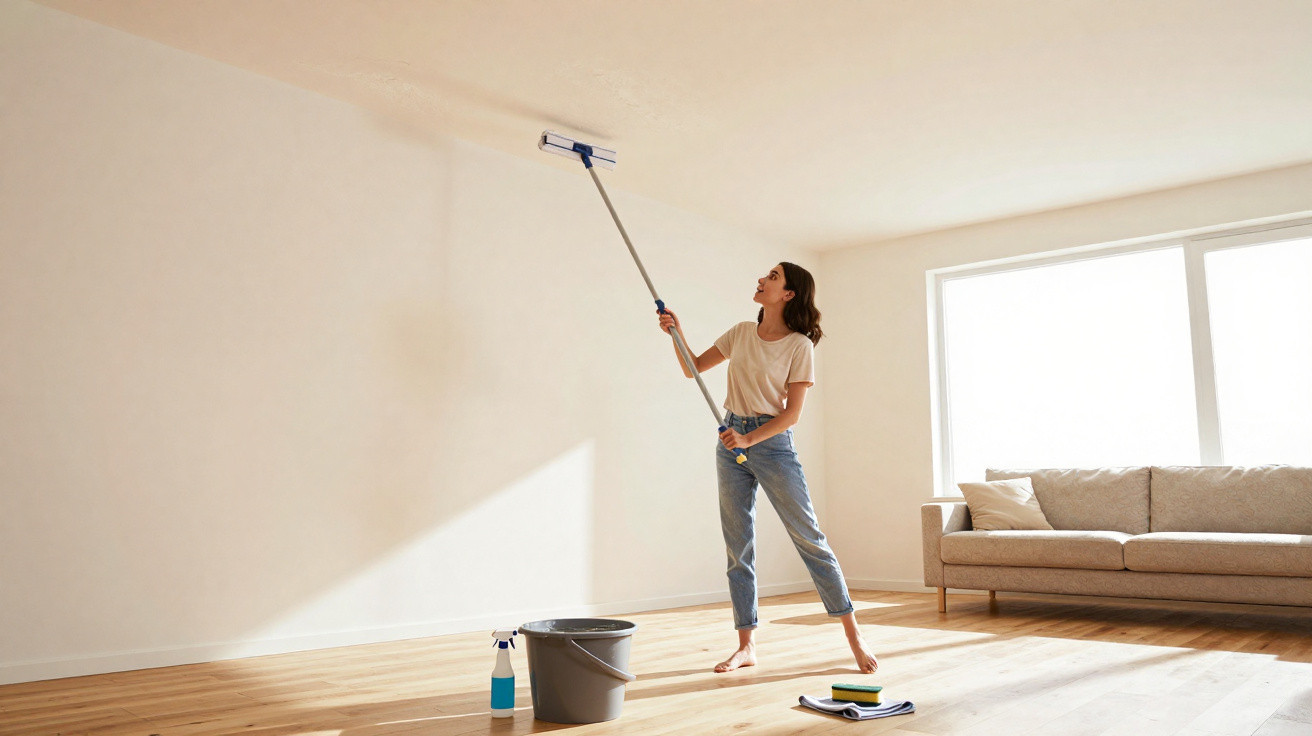
Older people and their relatives in particular will know the problem: stains, layers of dust and cobwebs are visible, yet there may be too little strength, time or simply safety for ladders, heavy buckets and harsh cleaning products. A method is currently doing the rounds in households that uses a simple home remedy mix and a telescopic handle to make ceilings and walls look fresh again in just half an hour – without acrobatics or aggressive chemicals.
Why walls and ceilings are often left uncleaned for years
Floors are mopped regularly, worktops are wiped down and bathrooms are scrubbed. Ceilings and high sections of walls, however, are easily overlooked. The reason is obvious: normally, you need a ladder, have to move furniture, balance cleaning water and, in the worst case, risk a fall.
This major clean is therefore often skipped in homes where older or unwell people live. Over the years, fine dust, nicotine, cooking vapours and mould spores can build up on textured wallpaper, painted surfaces and room ceilings. Rooms appear darker, colours lose their brightness and the air feels heavy.
“The invisible layer of dust on walls and ceilings puts strain on the respiratory system – and makes the entire room look older and less well cared for.”
People with allergies or asthma, as well as children and older people, can be particularly sensitive. Many relatives say they put off cleaning ceilings for a long time because they are concerned about accidents and overexertion.
The simple solution: a home remedy mix and telescopic handle
The current trend in many households brings together two familiar cleaning-cupboard staples with modern equipment: a flat floor mop with a telescopic handle and a homemade cleaning solution containing mild ingredients.
What you need for this method
- a flat mop with a wide head and telescopic handle
- a removable microfibre pad
- lukewarm water in a bucket
- a little black soap cleaner (made from plant oils)
- a splash of clear household vinegar
- a dry microfibre cloth for detailed work
Black soap cleaner removes grease and dirt without damaging most wall paints or wallpapers. Clear vinegar has a mild descaling effect, helps remove dull grey film and reduces odours. Together, they make a powerful yet comparatively gentle all-purpose cleaner.
How to mix the solution
For a standard-sized room, you will generally need:
- 5 litres of lukewarm water
- 1–2 tablespoons of black soap cleaner
- around 100 ml of clear household vinegar
Stir thoroughly until everything is evenly combined. Rather than producing a thick foam, the mixture will be a slightly cloudy liquid – ideal for damp wiping.
Step by step: clean walls and ceilings in 30 minutes
The key to this method is less about the cleaning solution than the technique: the microfibre pad should be only lightly dampened and wrung out very carefully. This prevents drips and streak marks.
- Prepare the room: Tilt or open the windows, remove light decorations from the walls and cover delicate furniture with a cloth.
- Dry dust first: Use a dry mop or duster to remove dust, cobwebs and loose particles before cleaning.
- Dampen the microfibre pad: Dip the pad into the cleaning solution, then wring it out firmly until it is only slightly damp.
- Work from bottom to top: Begin at the lower part of the wall and gradually work upwards. This stops dirty water running down and reduces the risk of tide marks.
- Use the light: Work against the light, positioning yourself so that light falling in from the side shines directly across the surface. Stains and streaks will be visible immediately.
- Move on to the ceiling: Once the walls are complete, extend the telescopic handle further and clean the ceiling in strips – evenly and without pressure.
- Ventilate: Air the room thoroughly once the job is done. Moisture and odours will disperse, while surfaces dry more quickly.
“When it has been wrung out properly, a single pass is often enough to visibly brighten an ordinary corner of a living room – without any rinsing afterwards.”
Health and safety: why relatives can breathe easier
For family carers especially, this method offers noticeable relief. There is no need to lift heavy buckets overhead or ask anyone to climb an unstable ladder. The work is done from floor level, with the grip height and range of movement remaining manageable.
This significantly lowers the risk of falls. Many household accidents occur when someone climbs onto a chair “just for a moment” to deal with a mark on the ceiling. A telescopic handle removes this dangerous extra step.
There is also a health benefit: cleaning removes a large proportion of the dust and mould burden. Those with allergies often notice easier breathing after only a few hours. Rooms look brighter, feel lighter and appear well cared for again – a psychological effect that families often underestimate.
Common mistakes that spoil the result
Although the trick sounds straightforward, there are a few pitfalls. Knowing about them can prevent frustration and unattractive streaks on the wall.
| Mistake | Result | Better approach |
|---|---|---|
| Mop pad too wet | Drip marks, wallpaper swelling | Wring the microfibre pad until it is almost dry |
| Starting at the top | Dirt runs downwards and marks develop | Begin at the bottom and work upwards |
| Not dusting beforehand | Muddy smears, dirt gets spread around | Dust dry first |
| No ventilation | Moisture remains and odours linger | Open windows and create a through-draught |
Where this method is best avoided
As versatile as the mix of mild cleaner and vinegar may be, it is not suitable for every surface. Take care with:
- pure lime or clay plasters, which do not tolerate water well
- delicate wallpapers with a paper surface, where even a little moisture can cause rippling
- freshly painted surfaces, where the paint has not yet fully cured
- alkyd resin or specialist paints, which could react chemically with vinegar
When in doubt, test the method on an inconspicuous area – behind a cupboard or curtain, for example. If the area discolours or the paint feels sticky, switch to another option, such as clean water with a dash of neutral all-purpose cleaner.
Practical everyday tips
Many users say they have adapted the method to suit their own circumstances. In smoking households, using a slightly stronger dose of vinegar can work wonders on yellowish film. In kitchens with heavy grease build-up, a second and slightly stronger pass can help above the cooker and hob.
Anyone with back problems should choose an especially lightweight mop and adjust the telescopic handle so that the arm only needs to work slightly above shoulder height. Family carers in particular benefit from splitting the cleaning into two short stages: the walls first, followed by the ceiling later in the day.
Why simple home remedies are so popular
With prices for specialist cleaning products rising, many households are returning to traditional products that grandparents already knew, combined with modern equipment. The blend of mild, plant-based cleaner and vinegar saves plastic bottles, is kinder to wastewater and reduces the number of different products kept in the cupboard.
The method also offers a mental benefit: knowing that a room can be thoroughly refreshed in around 30 minutes makes people less likely to keep putting off the major clean. For people caring for relatives or living with limited mobility themselves, it can restore a sense of control without causing them to overdo it.
There is another advantage: this technique is not limited to living rooms and bedrooms. It can also be used in hallways, stairwells and on cellar ceilings. Anyone who measures the ingredients carefully and understands their surfaces can tackle several problem areas in the home with one bucket of solution – from a slightly greyed stairway to a stained ceiling above an extractor hood.
Comments
No comments yet. Be the first to comment!
Leave a Comment